
Shenzhen Solo Travel Guide 2026: APEC, Skyline and Street Food
Most city guides are written for couples, families, or groups. This Shenzhen solo travel guide is for the foreign traveler landing alone at Bao’an with one phone, a bank card that may or may not work, and nobody to split a dim sum bill with. I wrote it during APEC Economic Leaders’ Week 2026, while Shenzhen hosted the 33rd APEC Economic Leaders’ Meeting. The problems are different: who you eat with, which metro exit leads to the right side of the road, whether a taxi driver understands your address, and what “safe at night” feels like on your own. This guide answers those from the pavement up.
Quick Facts
- Best solo window: October to December and March to April. APEC week in mid-to-late November 2026 fell in the prime window.
- APEC dates (as reported): Leaders’ Meeting 19 November 2026; CEO Summit 18 November; Leaders’ Week began 14 November. Confirm schedule details with official sources.
- Host: China, for the third time after Shanghai 2001 and Beijing 2014.
- Language: English is common in high-end hotels and among younger tech workers, thin elsewhere.
- Money: Effectively cashless. Set up Alipay or WeChat Pay with an international card before flying.
- Getting around: Clean, extensive metro. Stay next to a station.
- Night safety: Central Futian and Nanshan feel comfortable solo late; ordinary city caution applies.
- Visa: Shenzhen is in the 240-hour visa-free transit scheme; confirm nationality and route rules with the National Immigration Administration.
Why a Shenzhen Solo Travel Guide Reads Differently During APEC Week
A standard overview will tell you Shenzhen grew from a fishing village of about 30,000 in 1980 into a megacity of roughly 17 million, with more skyscrapers than New York and Hong Kong combined. Useless the moment you face a platform exit. A Shenzhen solo travel guide has to care about small things because, alone, small things are the trip.
I arrived at Bao’an on 16 November, two days before the CEO Summit. The International Service Center at Terminal 3 was the first place where being alone became an advantage. A bilingual helper pointed me to a free half-day city tour and told me about a free AI Travel Pass, with translation in more than 145 languages and about 15 yuan of transit credit usable in over 300 cities. Stock is limited, so treat it as a bonus.
During APEC week security was visible but relaxed, hotel staff were patient with broken Mandarin, and most visitors were here for meetings rather than sightseeing. For solo travel in Shenzhen that meant quiet mornings at attractions and busier evenings near the Civic Center. Hotel breakfast rooms filled with people on laptops.
APEC 2026 in Shenzhen: What Actually Happened
China hosted APEC with Shenzhen as host city, the third time after Shanghai 2001 and Beijing 2014, and the 33rd Economic Leaders’ Meeting. The Leaders’ Meeting was on 19 November 2026, the CEO Summit on 18 November, and Leaders’ Week began on 14 November. The summit issued the 2026 APEC CEO Summit Shenzhen Initiative. The host theme was “Building an Asia-Pacific Community to Prosper Together,” with three priorities: openness, innovation, and cooperation. There are 21 member economies, and APEC Secretariat Executive Director Eduardo Pedrosa of the Philippines serves to 31 December 2027.
Xi Jinping set out four pillars for the Asia-Pacific community: economic and trade cooperation, connectivity, innovation, and development. He announced 20 million US dollars for APEC practical cooperation, a planned Asia-Pacific Community Research Centre in Shenzhen, and new cooperation institutions in digital technology, cross-border data flows, clean energy, and small and medium enterprises. He invoked Shenzhen’s nickname Pengcheng, or Roc City, and a giant peng bird spreading its wings. The Shenzhen Initiative covered livelihoods, food trade, cross-border QR payment interoperability, cutting non-tariff barriers, a green trade rules framework, and artificial intelligence for economic and social good. 2026 also marked 20 years of the Free Trade Area of the Asia-Pacific vision.
Speakers at the CEO Summit included Vladimir Putin, To Lam, Anwar Ibrahim, Lee Jae-myung, Anutin Charnvirakul, Mark Carney, and Anthony Albanese. Pansy Ho discussed multi-stop travel and two-way visitor flows in the Greater Bay Area, while China UnionPay described interoperable cross-border QR payments with Indonesia, Vietnam, and Singapore.
Date-sensitive note (20 November 2026): dates, speeches, funding figures, and initiative contents reflect official and state media reporting as of 20 November 2026. Confirm with official sources including APEC, the Shenzhen government English site, Xinhua, and People’s Daily if you plan around specific events.
Going Out Alone at Night: Light Shows and Personal Safety
The question I hear most is about nights. In central Shenzhen my honest answer is yes, with the street sense you would use anywhere large. Metro stations are lit and staffed, ride-hailing works once payment is set up, and the main commercial streets stay busy. I walked back after 22:00 several times during APEC week. My one rule was keeping the phone above roughly 30 percent, since navigation and payment both live there.
The APEC light show showed how the city adapted. A special four-night run began on 12 November 2026 at Civic Center Square, at 19:00, 20:00, and 21:00, with 43 skyscrapers synchronized in a 270-degree panorama. The regular show runs on Fridays, Saturdays, and holidays from November to March. Booking ran through a WeChat mini-program for night-view reservations in the Futian central district, and schedules could shift, so I checked official updates that afternoon. Take Metro Lines 2 or 4 to Civic Center Station, Exit A or F. Gangxia North serves Lines 2, 10, 11, and 14.
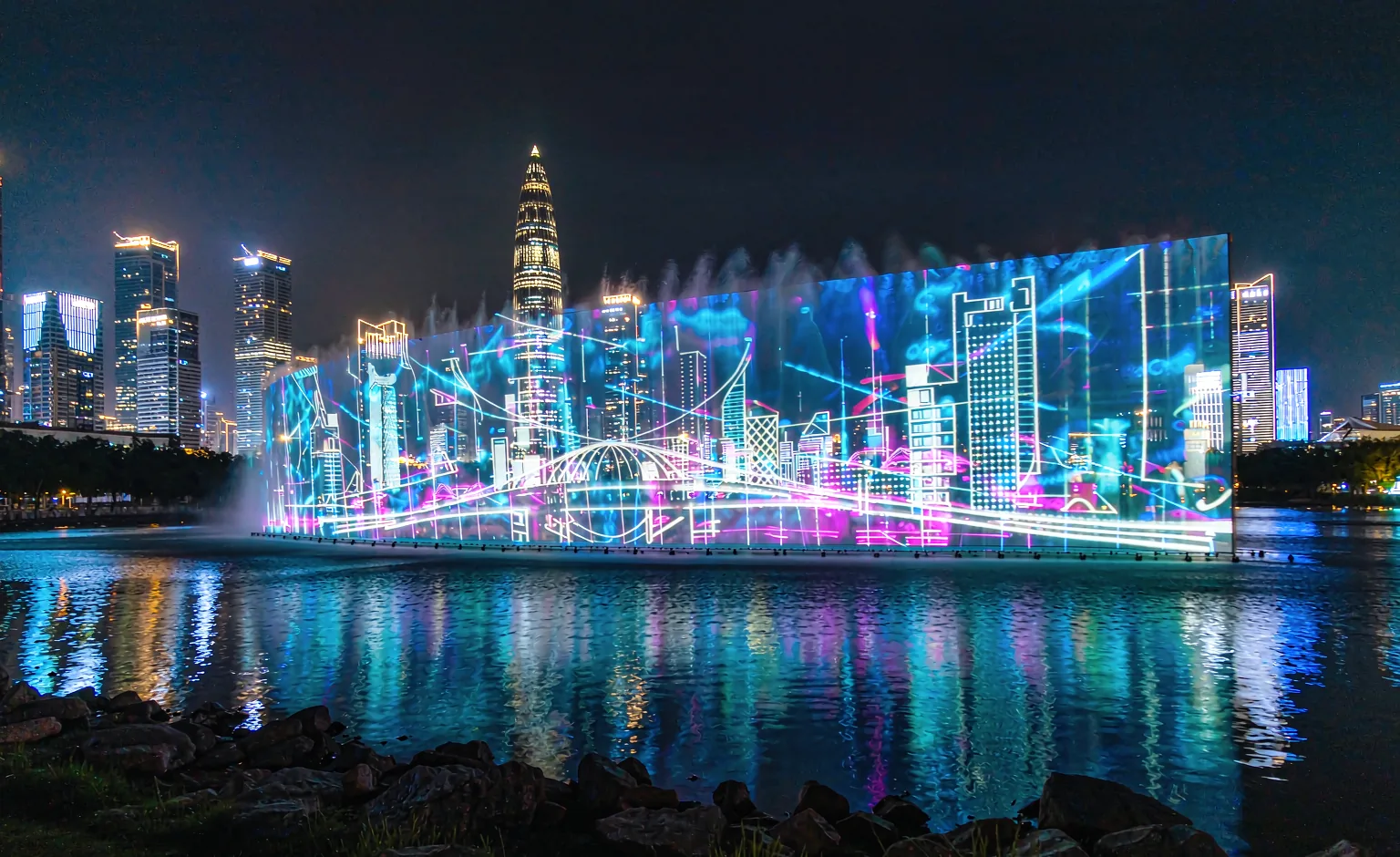
The other evening spectacle is at Shenzhen Talent Park, where jets, lasers, and projections play across the Houhai buildings, including the China Resources Headquarters Tower, or Spring Bamboo. Take Line 13 to Talent Park Station, Exit B1. I watched from the grass, several people clearly on their own, and nobody treated that as odd. Times change, so confirm on the day.
Where to Base Yourself and How to Find People
Your neighbourhood choice shapes every other hour. Luohu is the older commercial core, with cheaper rooms and the Hong Kong crossing nearby. Nanshan and parts of Futian suit travelers wanting mid-range modern hotels near tech offices and the waterfront. Futian CBD is the luxury end with skyline views. Whatever you pick, stay within a short walk of a metro station. I stayed near a Line 2 station and gained roughly an hour a day.
| Area | Best for a solo traveler | Metro access | Cost feel |
|---|---|---|---|
| Luohu | Low budgets, shopping, Hong Kong day trips | Dense, several lines | Low |
| Nanshan | Seafood, coastal walks, younger social scene | Good, Line 13 and others | Mid |
| Futian CBD | Skyline views, light show, business hotels | Excellent, Lines 2 and 4 | High |
| Bao’an airport zone | Late arrivals, early departures | Airport-linked | Low to mid |
Meeting people takes intention. Hostel common rooms and co-living cafes in Nanshan are the easiest route. The free airport tour is another: the fixed route runs Lianhua Hill Park, Huaqiangbei, and Qianhai Stone Park with a bilingual guide, giving you a ready-made group. During APEC week hotel breakfast rooms were full of people working alone, and a question about the show started conversations. Scams are the flip side: in Luohu avoid the tea-house invitation from a friendly “student” and the art-student pitch ending in an inflated bill. Both target people alone and trying to be polite. Tipping is not expected anywhere.
Solo Photo Walks: Lianhua Hill, OCT-LOFT and the Skyline
Lianhua Hill Park is the photograph a solo traveler wants to bring home. The walk to the Deng Xiaoping statue is short and paved, and the view over Futian is the best in the city. It is free. Go before sunset. I climbed at about 17:30 with my phone in one hand and water in the other; the path was busy enough to feel safe, quiet enough to linger at the railing.
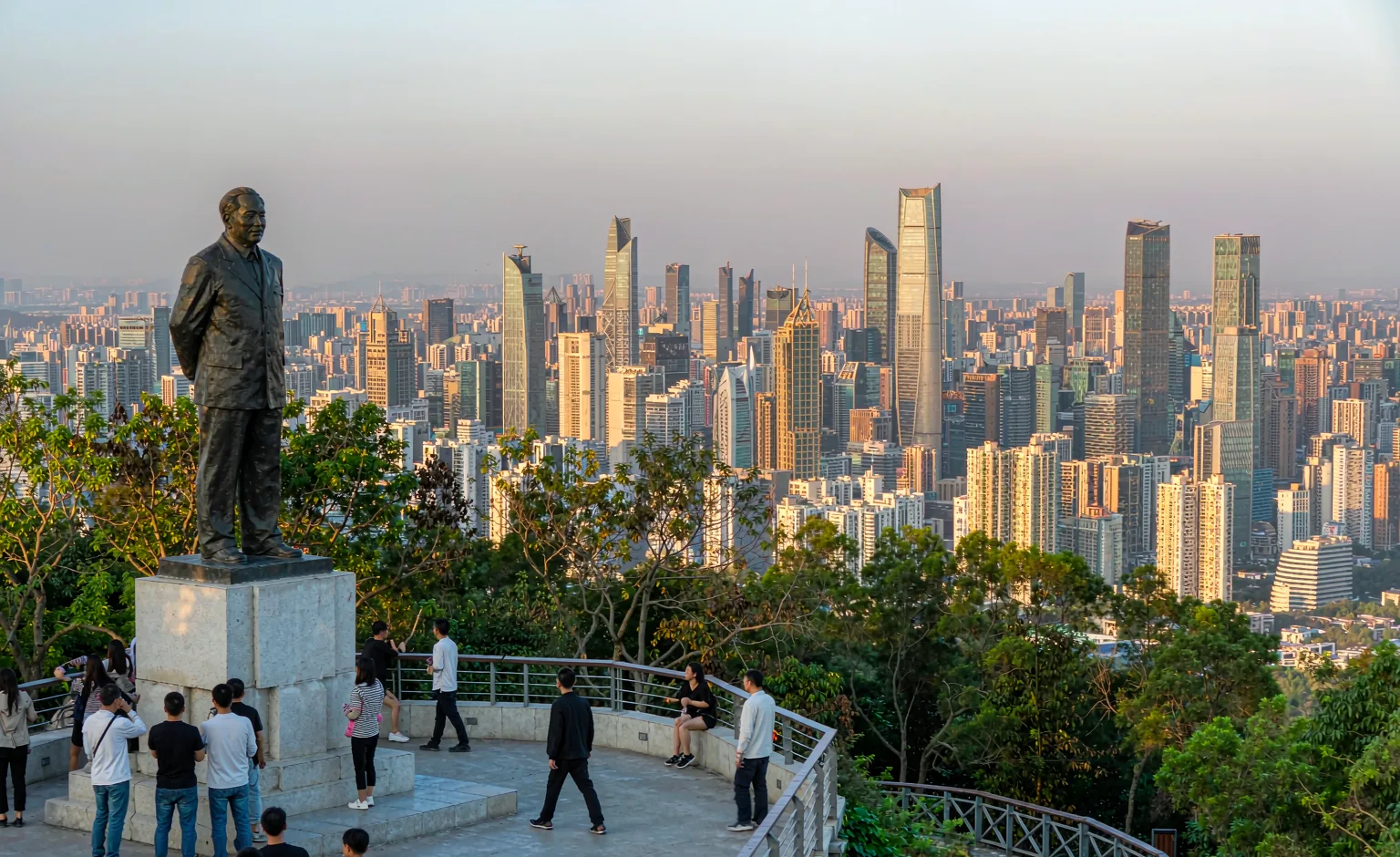
Navigation is the real hurdle. Metro exits are numbered rather than plainly named; the wrong one costs fifteen minutes and a sweaty re-crossing. I screenshot the exit letter before leaving. Offline maps saved me twice when data stalled inside a mall. For one skyline from above, the Ping An Finance Centre observation deck sits at roughly 562 metres in the world’s fourth tallest building, with tickets around 200 yuan, though confirm the price. Window of the World offers miniature landmarks for about 120 yuan and half a day.
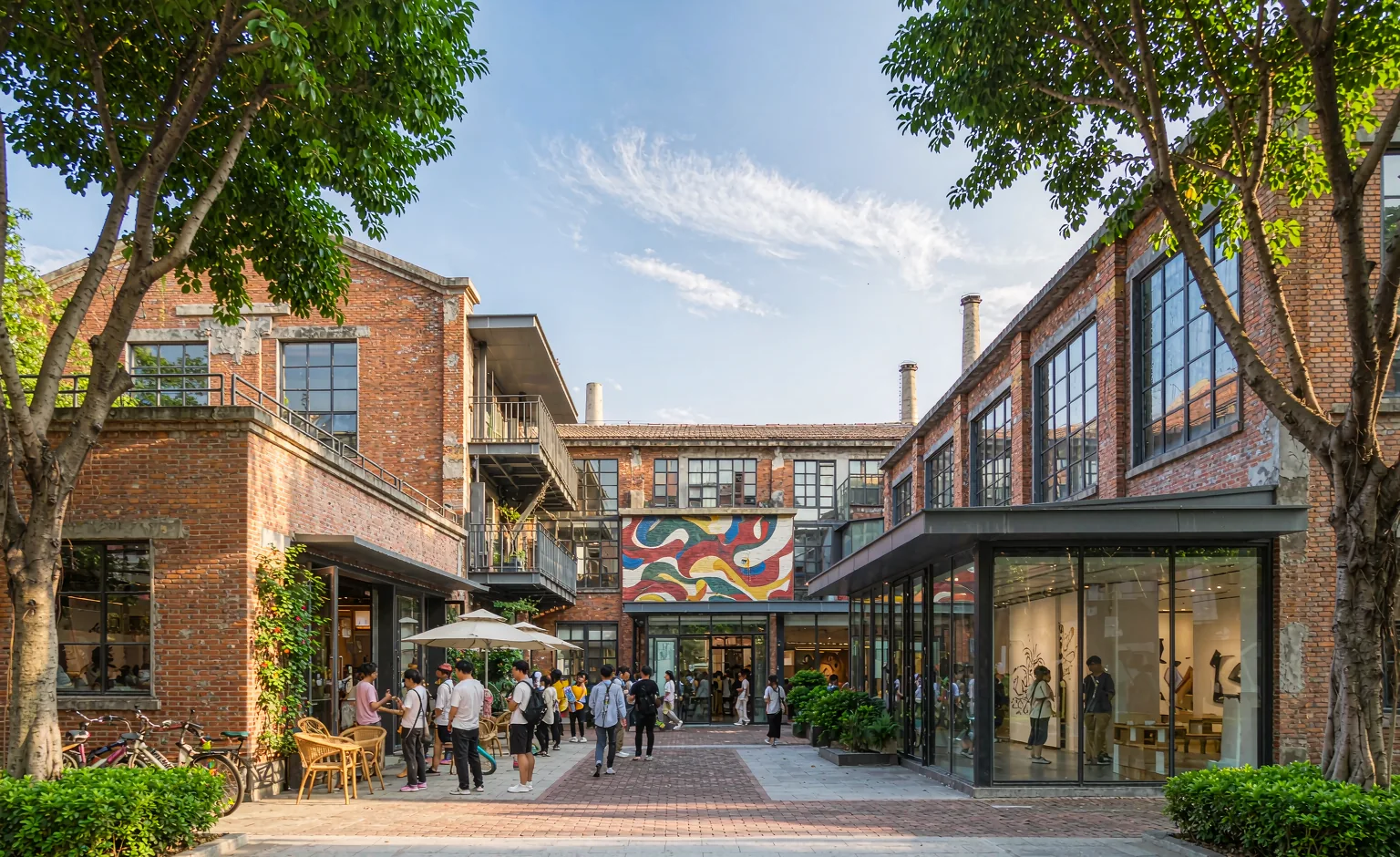
For a slower walk, OCT-LOFT Creative Culture Park is my pick: a former industrial estate turned arts district with galleries, independent cafes, jazz bars, and street art, free to enter. I drifted between small exhibitions, then sat in a courtyard watching other solo travelers do the same. Shekou Sea World is a waterfront plaza rather than an aquarium, built around the Minghua ship with a fountain show and international dining. For sand, Dameisha Beach is nearest but busy on weekends; Dapeng Fortress, a Ming-dynasty fort near Jiaochangwei beach, needs a full day.
Ordering Dim Sum for One
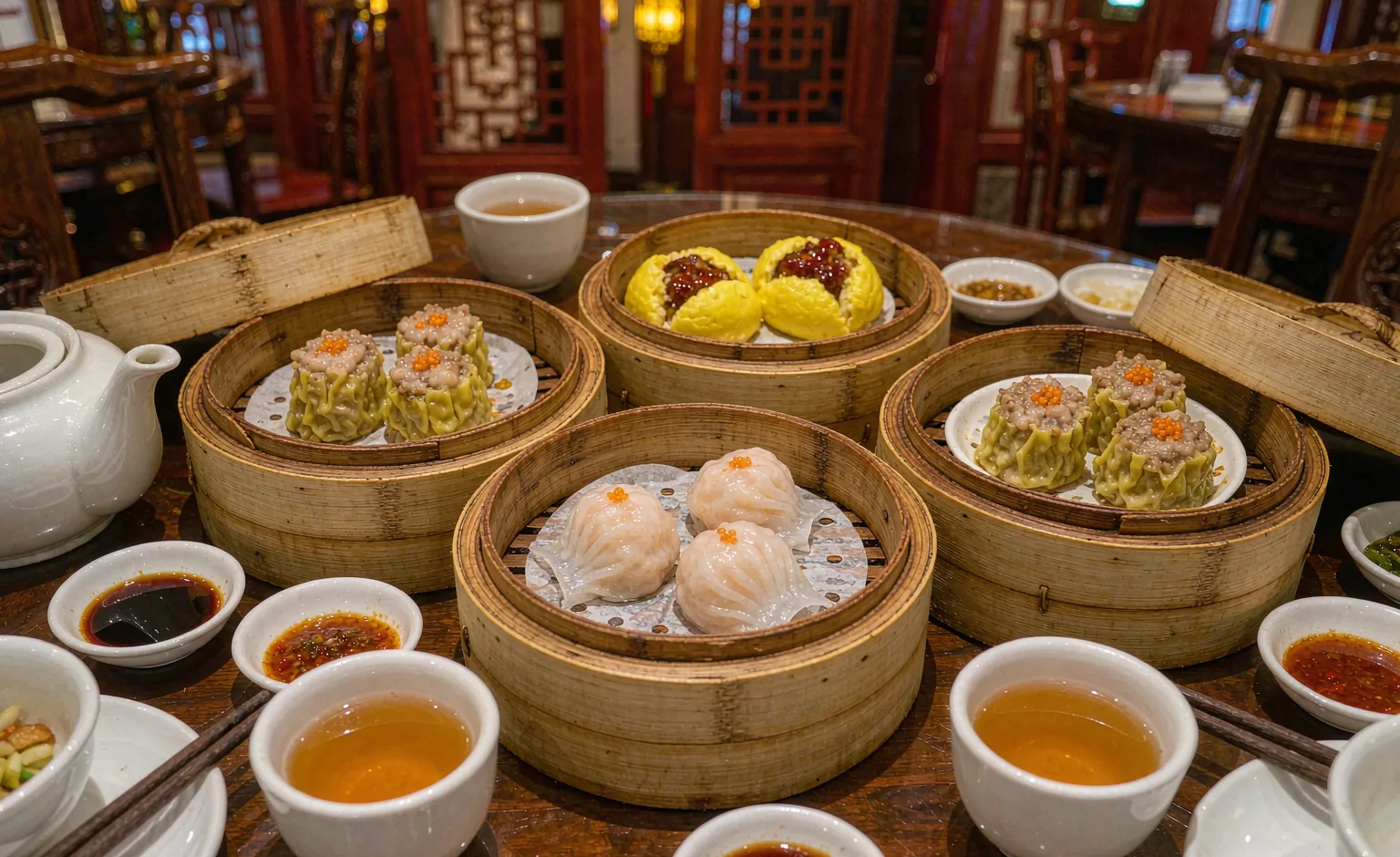
Eating alone is what solo travelers secretly worry about. Here it is barely an issue. Dim sum comes in small baskets meant for sharing, but plenty of people eat solo and ordering two or three dishes is normal. My first attempt was near the Civic Center, where staff handed me a paper sheet and pointed at pictures. I ordered har gow (虾饺), siu mai (烧卖), and char siu bao (叉烧包) by pointing at pictures and ate slowly. Nobody hurried me and the bill was small enough to feel like a victory.
The food base is Cantonese, but the city is full of migrants. Roast goose and char siu are worth seeking out; coconut chicken is linked to Nanshan, claypot rice to Luohu. Fresh South China Sea seafood draws people to Leyuan Road or Shekou, though a solo diner should check prices before ordering from a tank. For cheap local food, try an urban village such as Baishizhou, where stalls feed office workers. At the other end, Futian rooftop bars sell skyline views. My rule was one sit-down meal with a view per day and everything else where the office workers ate.
Huaqiangbei, the Airport Tour, and Solo Logistics
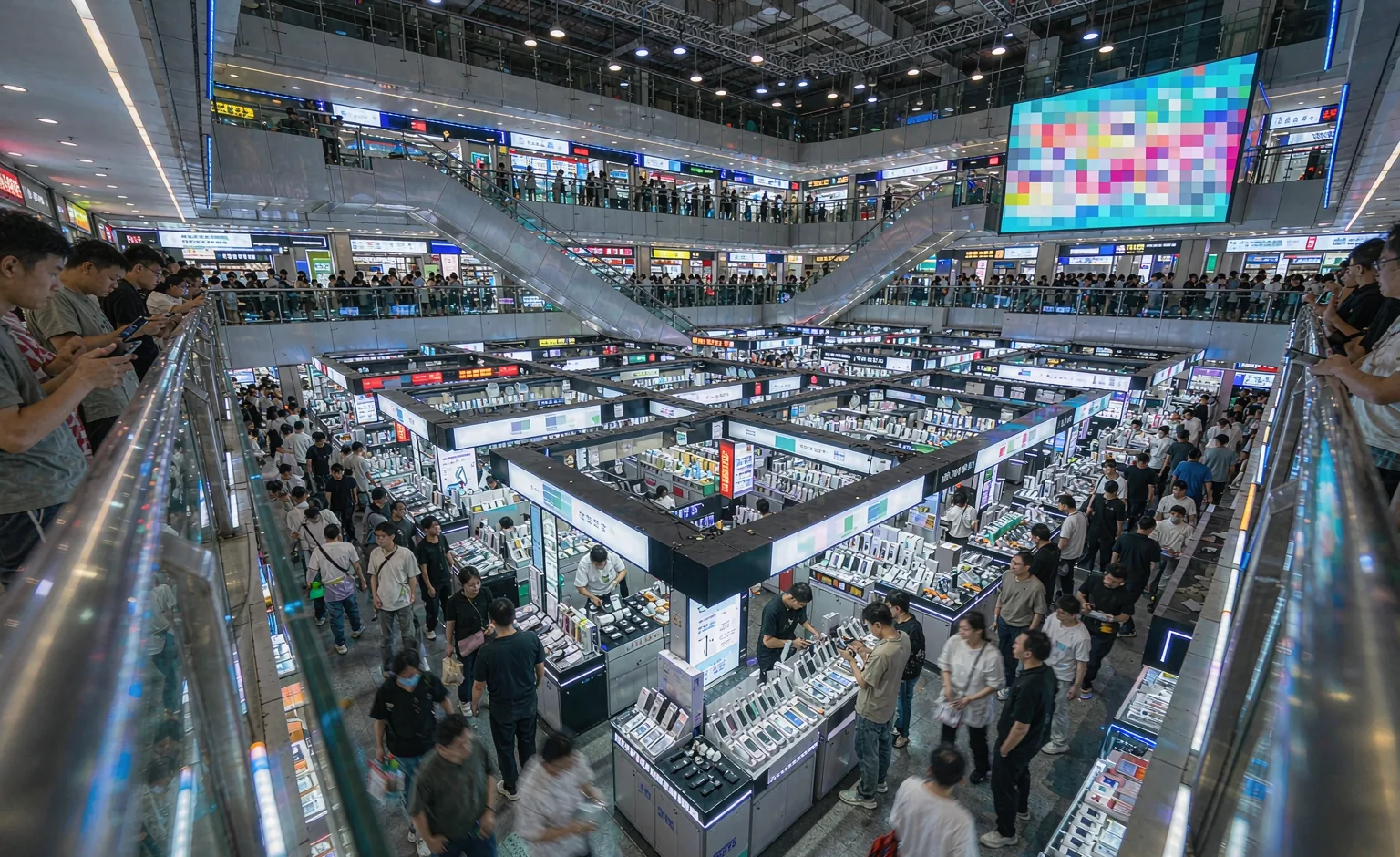
Huaqiangbei is the electronics market that turns visitors into bewildered shoppers: row after row of components, phones, and unidentifiable gadgets. I lost an hour and my sense of direction while hunting for a cable. It is also a stop on the free half-day tour from Terminal 3’s International Service Center, with bilingual guides and the fixed Lianhua Hill, Huaqiangbei, Qianhai Stone Park route.
Shenzhen is effectively cashless, so arrange setting up WeChat Pay as a foreigner in China before arrival and read how foreign travelers actually pay in China for Alipay and cash fallbacks. Book a VPN for China before you fly, or rely on an eSIM or roaming SIM, since familiar apps may not load otherwise. On entry, the 240-hour visa-free transit rules may cover your route, but confirm nationality and onward-ticket conditions with the National Immigration Administration. Hong Kong is close: high-speed rail from West Kowloon takes roughly 15 to 19 minutes, the MTR crossing 45 to 60, subject to visa rules.
If Shenzhen starts a longer China trip, it pairs with the northwest. For the overland leg, see our note on how many days a Xinjiang road trip needs. The contrast is the point: Shenzhen is dense, fast, and wet; the northwest is wide, dry, and slow. The same payment setup and translation tools carry across both.
Frequently Asked Questions
Is Shenzhen safe for a solo traveler at night?
In central areas, yes, with normal caution. Futian and Nanshan stay busy late, stations are staffed, and ride-hailing works once payment is set up. I walked back after 22:00 during APEC week without feeling exposed. Keep your phone charged, since it is map and wallet, and skip the tea-house and art-student pitches in Luohu.
Can a foreigner really use Alipay or WeChat Pay in Shenzhen?
Yes. Link an international card before arriving, then test both apps on a small purchase on day one. Shenzhen is effectively cashless, so bringing only foreign cards is the classic mistake. Carry a little cash as a fallback, but expect to use your phone for everything from the metro to a dim sum bill.
Do I need a visa to visit Shenzhen in 2026?
Shenzhen is part of China’s 240-hour visa-free transit scheme, but eligibility depends on your nationality, arrival country, and onward destination. Confirm the rules with the National Immigration Administration before booking. Do not assume APEC week changes the normal position for tourists.
How do I get around without speaking Mandarin?
Use the metro, where signs are bilingual and exits numbered, and screenshot your exit before leaving. A translation app covers most restaurant and taxi situations. English is common in high-end hotels and among young tech workers. The free AI Travel Pass at Bao’an Terminal 3, if available, translates over 145 languages.
Is it strange to eat dim sum alone in Shenzhen?
Not at all. Dim sum arrives in small baskets and many people eat alone, especially at lunch. Order two or three dishes and point at picture menus if needed. For a cheaper local feel, try stalls in an urban village such as Baishizhou.
Which area is best for a first-time solo visit?
Stay near a metro station. Futian CBD gives skyline views and access to the Civic Center show, but costs more. Nanshan offers seafood and a younger scene at mid-range prices. Luohu is the budget choice closest to Hong Kong, with more scams to watch for.
Is Shenzhen worth adding to a China trip that also includes Xinjiang?
Yes, because the two differ so sharply. Shenzhen is a compact, high-tech coastal city suited to three or four days of solo exploring; Xinjiang is a long-distance overland journey. The same payment setup and translation tools work in both, so chaining them is simple.