
Xinjiang Beverages Beyond Beer: Kumis, Airag & Herbal Teas
The first bowl of kumis I was given, on a hillside above Nalati in July 2019, I drank in three gulps to be polite and then had to sit down. It is sour, fizzy, slightly alcoholic, and tastes like yoghurt that has been arguing with itself. The woman who poured it watched my face with obvious enjoyment and immediately refilled the bowl.
Xinjiang’s drinking culture has almost nothing to do with the Xinjiang Black Beer you see in restaurants. It runs on fermented milk, boiled tea, pressed fruit and a Russian-influenced fizzy bread drink that turns up in the Ili Valley for reasons of history. Most of it is regional, seasonal, and cheap.
Kumis: Fermented Mare’s Milk
Kazakh qymyz, Kyrgyz kymyz, Mongolian airag. Mare’s milk fermented in a leather bag or a wooden churn for one to three days, stirred hundreds of times a day to keep the culture working. The lactose converts to lactic acid and a small amount of alcohol, generally 0.7% to 2.5% by volume.
Season is short. Mares are milked from roughly late May through September, with the best product in July and August when the grass is richest. Outside that window what you are offered is either frozen from summer or made from cow’s milk, which is a different and lesser thing.
Taste: sharp sour, slight effervescence, a thin body with a faint alcoholic tang at the finish. It is not sweet at all. First-timers usually describe it as challenging, and I was no different. By the third bowl on that Nalati trip I had started to like it, and by the following summer I was buying it deliberately.
Prices: ¥10 to ¥20 for a bowl at a roadside yurt, ¥25 to ¥40 for a 1.5 litre bottle from a Kazakh family, sometimes free if you are a guest, in which case refusing is difficult and mildly rude.
Where: the Ili grasslands, Nalati, Kalajun, Bayanbulak, the Tekes and Zhaosu valleys, the Altay steppes. Roadside stalls with a hand-painted sign in Kazakh, usually a plastic barrel and a ladle. On the road between Nalati and Bayanbulak in August there is one every few kilometres.
Stomach warning, honestly stated: this is unpasteurised, live-cultured, and strong. If your gut is unaccustomed, start with half a bowl. I have watched two travelling companions have a rough evening after enthusiastically drinking a litre at 2,200 m. Combining large amounts of unfamiliar fermented dairy with altitude is a bad plan, which our altitude sickness guide touches on from the other direction.
Shubat: Fermented Camel Milk
The southern and desert-edge cousin. Camel milk fermented over one to two days, thicker than kumis, less fizzy, with a distinctly savoury edge that some people find easier and some find worse.
Found around Karamay, the Junggar Basin fringe, parts of Hotan prefecture and increasingly sold in bottles in Urumqi supermarkets. Camel milk has become a health-product industry in Xinjiang over the last decade, so you will also see powdered versions at ¥200 plus a tin, which is a different market entirely.
Fresh from a herder: ¥15 to ¥25 a bowl. Bottled fresh camel milk in city supermarkets: ¥30 to ¥50 a litre.
Süt Chay: Salted Milk Tea
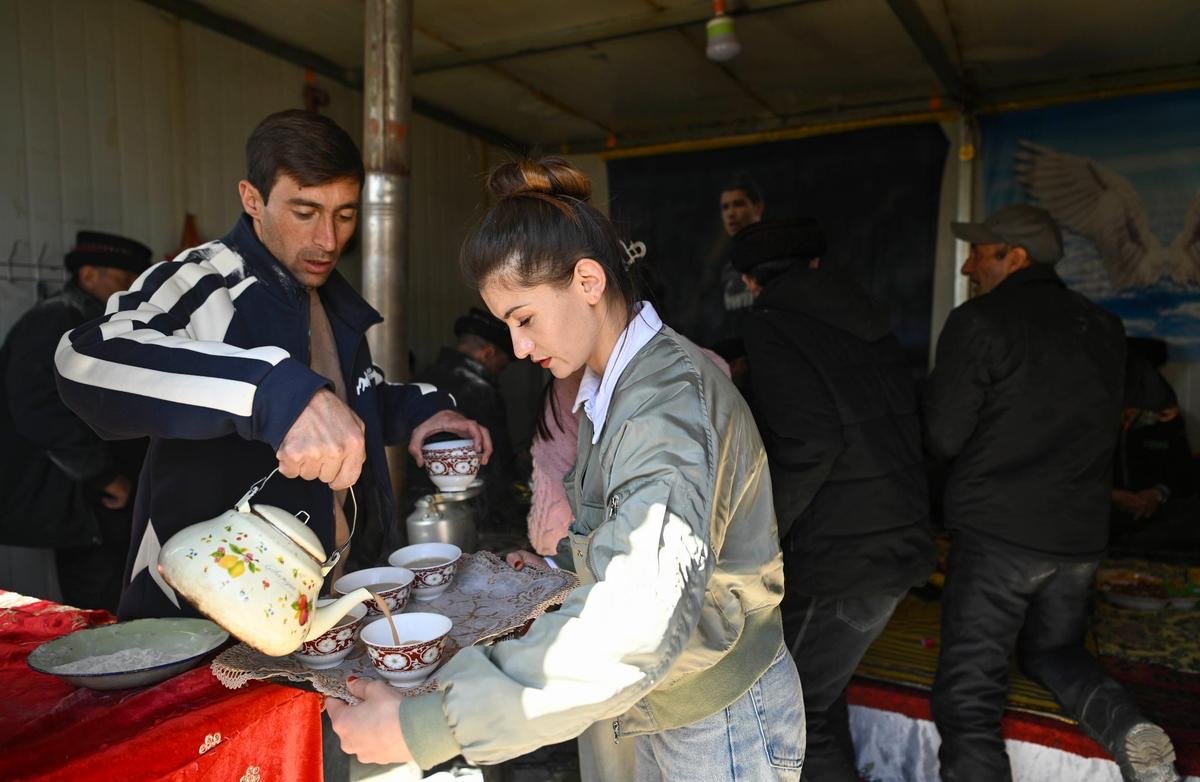
The everyday drink of the northern grasslands and, in a slightly different form, of Uyghur households too. Brick tea boiled hard, milk added, salt added, sometimes butter or cream, occasionally a crack of black pepper. Served in a bowl.
Kazakh and Kyrgyz versions lean heavier on cream. Tajik households in Tashkurgan use yak milk and the result is richer and slightly grassy. Uyghur süt chay in Kashgar tends to be lighter.
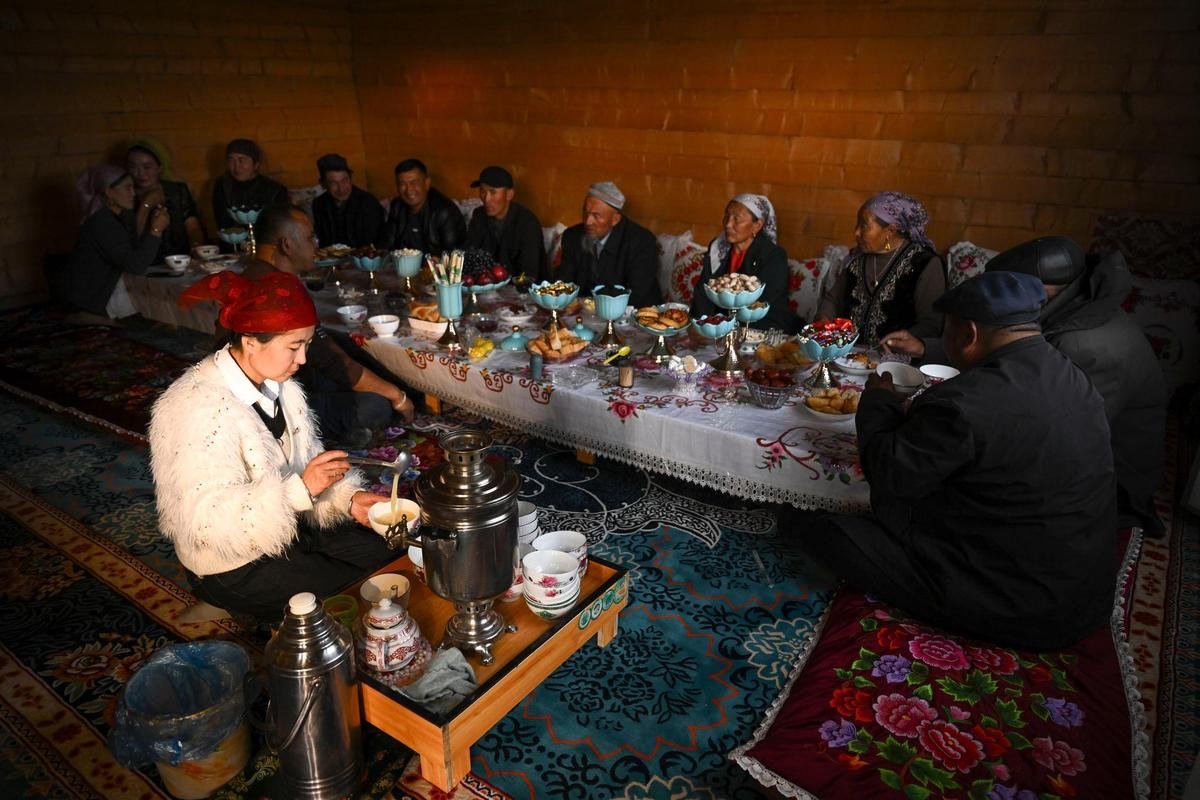
In a yurt this arrives continuously. The bowl gets refilled the instant you set it down, and the way to stop is to put your palm flat over the top. I did not know this on my first grassland stay and drank nine bowls across an afternoon.
Cost: ¥3 to ¥8 in a teahouse, free as a guest. Practical value: it is hot, salty and fatty, which at 2,500 m in wind is exactly what your body wants.
Dogh and Ayran: Drinking Yoghurt
Yoghurt thinned with water, salted or plain, sometimes iced. Uyghur bazaars sell it from metal tubs by the cup for ¥5 to ¥8. It is the standard partner to a plate of grilled meat, and there is a physiological logic to it that becomes obvious after six lamb skewers. Our kebab guide covers that side of the meal.
Sweet versions exist, usually with sugar syrup or honey, more common in tourist areas. The salted one is the traditional article.
Dora Chay: Medicinal Tea
Uyghur herbal tea, served by the pot in teahouses across southern Xinjiang. A base of black tea loaded with dried rose petals, jujube, cardamom, cinnamon, saffron, walnut, fig, liquorice root or rock sugar, in combinations that vary by shop and by what the owner thinks you need.
¥8 to ¥25 a pot, with free hot water refills for as long as you sit there. Some shops sell the dry blend by weight, ¥30 to ¥60 per 500 g, which makes a genuinely good souvenir that weighs nothing.
Effect: mildly warming, faintly sweet, and after three refills the pot is basically hot rose water. I drink this every evening in Kashgar in winter.
Eight-Treasure Tea
Hui Muslim tradition, strongest in Urumqi, Changji, Hami and Korla. Served in a lidded gaiwan bowl containing wolfberry, longan, jujube, chrysanthemum, raisin, sesame, walnut and rock sugar, topped with boiling water at the table.
Sweet, floral, more of a hot infusion than a tea. ¥10 to ¥18 a bowl. You drink through the gap made by tilting the lid, using the lid to hold back the solids. Removing the lid entirely and drinking from the open bowl marks you instantly as a visitor, which is fine, but now you know.
Kvass: The Russian Import
Fermented rye bread drink, very low alcohol, brown, fizzy, malty and faintly sweet. It arrived in the Ili Valley and Tacheng with Russian and Tatar settlers and never left. Yining sells it from barrels on street corners in summer.
Draught from a barrel: ¥5 to ¥10 a cup. Bottled from a shop: ¥6 to ¥12. The commercial bottled versions are sweeter and less interesting than the barrel stuff.
Season is roughly May to September. It is the single most refreshing thing available in Yining in August, when the temperature sits around 32°C and everything else on offer is dairy.
Fruit Juices Worth the Money
Pomegranate. Pressed to order at bazaars in Hotan, Kashgar and Turpan, five to seven fruit per cup, ¥10 to ¥15. Season September to November with cold-stored fruit stretching into winter. In Hotan I paid ¥8.
Sea buckthorn. Small orange berries from the Altay region, intensely sour, very high in vitamin C. Sold as juice or concentrate, ¥15 to ¥25 a bottle. Harvest September to October. It tastes like a citrus fruit that has been through something difficult.
Mulberry. White mulberry juice in Hotan in June, thick and honeyed, ¥10 a cup. Short window, worth chasing.
Apricot juice. Pressed or blended with ice at roadside stalls in Kashgar prefecture during the June to July harvest, ¥8 to ¥12.
Watermelon and melon juice. Everywhere in July and August, ¥5 to ¥10, usually just blended fruit with ice.
Muselles and the Alcohol Question
Muselles is a traditional Uyghur drink made by boiling down grape must with saffron and other additions, historically fermented and mildly alcoholic. It has a long documented history in the Turpan and Hotan areas. Today it is rare in public commerce and mostly encountered as a homemade product, if at all. I have been offered it twice in twenty-odd weeks of travel in the region.
More broadly: alcohol in Xinjiang is a two-track situation. Xinjiang Black Beer and local wines from the Turpan and Manas valleys are sold openly in supermarkets and in Han-run restaurants. Halal restaurants and Muslim neighbourhoods do not serve alcohol at all. Both facts are true simultaneously and a street can separate them.
Drinking in public in a conservative neighbourhood is poor form. Nobody will confront you about it. It will simply be noticed.
What to Drink Where: A Quick Reference
- Ili grasslands, Nalati, Bayanbulak, June to September: kumis, salted milk tea, yoghurt
- Yining town, summer: barrel kvass, black tea with jam
- Kashgar and Hotan, year-round: dora chay, dogh, pomegranate juice in autumn
- Turpan, July to September: grape juice, melon juice, iced liangpi to go with it
- Urumqi, Changji: eight-treasure tea, bottled camel milk
- Tashkurgan and the Pamir: yak milk tea, salted and buttery
- Altay, autumn: sea buckthorn juice
Hydration Reality at Altitude
Worth saying because it catches people out. Karakul Lake sits at about 3,600 m. Bayanbulak is around 2,500 m. The Duku Highway passes cross 3,400 m. At those elevations in dry air you lose considerably more water through breathing than you expect, and the fermented dairy everyone is handing you does not replace it efficiently.
I carry 2 litres of plain water minimum on any high-altitude day and treat kumis and milk tea as food rather than hydration. Alcohol, even the trace amounts in kumis, is worth moderating above 3,000 m on your first days.
Bottled water costs ¥2 to ¥3 in towns and ¥5 to ¥8 at scenic area kiosks. Tap water is not drinkable anywhere in the region.
Etiquette in Three Lines
Receive a bowl with the right hand, left hand touching the right forearm. Half-full means stay, brim-full is a hint. Palm over the bowl means you are finished, and it is the only reliable way to stop a Kazakh host from refilling it.
Refusing outright is awkward. Accepting a small amount and sipping slowly is always acceptable. If you genuinely cannot drink fermented dairy, taking the bowl, touching it to your lips and setting it down still counts as receiving hospitality.
Where I Would Send a First-Timer
Late July, a roadside yurt on the Nalati to Bayanbulak road, mid-afternoon. Ask for half a bowl of kumis, ¥10, and a bowl of milk tea, ¥5. Sit for an hour. If the kumis defeats you, the milk tea will not.
Then in Kashgar a week later, order a pot of dora chay for ¥12 and sit with it until the roses have given up everything they have. Those two experiences cover most of what this region drinks. For the full picture of the household these drinks come from, see our guide to Kazakh nomadic life and yurt stays.