
Uyghur Breakfast Culture: From Samsa to Milk Tea
At 08:15 Beijing time on a January morning in Kashgar, the temperature outside was minus 9°C and the shop I wanted was full. Twelve men, four small tables, steam on the windows thick enough to write in. The dish was kalla pacha, sheep head and trotter soup, and it cost ¥18. I have never been so glad to eat something that arrived with a tooth still attached to it.
Uyghur breakfast is not the meal most visitors experience. Most visitors experience a hotel buffet with cold fried eggs and a rice congee that nobody in Xinjiang eats voluntarily. The real thing happens in small rooms between 07:30 and 10:00 Beijing time, and it is worth reorganising your morning for.
First, Sort Out the Clock
Xinjiang officially runs on Beijing time, two hours ahead of the sun. Locals in Uyghur communities largely run on unofficial local time. When a shopkeeper says he opens at eight, he might mean 08:00 Beijing (dark in winter) or 08:00 local, which is 10:00 on your phone.
Practical rule: breakfast establishments in Kashgar, Hotan and Yarkant get going between 08:00 and 09:00 Beijing time and are finished by 11:30. In Urumqi, where the Han and Hui population is larger and the working day follows Beijing time properly, breakfast starts closer to 07:30 and ends earlier.
I have arrived at 07:00 in Hotan expecting a bustling scene and found three shuttered doors and a dog. Aim for 08:30 and you will be fine almost anywhere.
The Core: Milk Tea and Bread
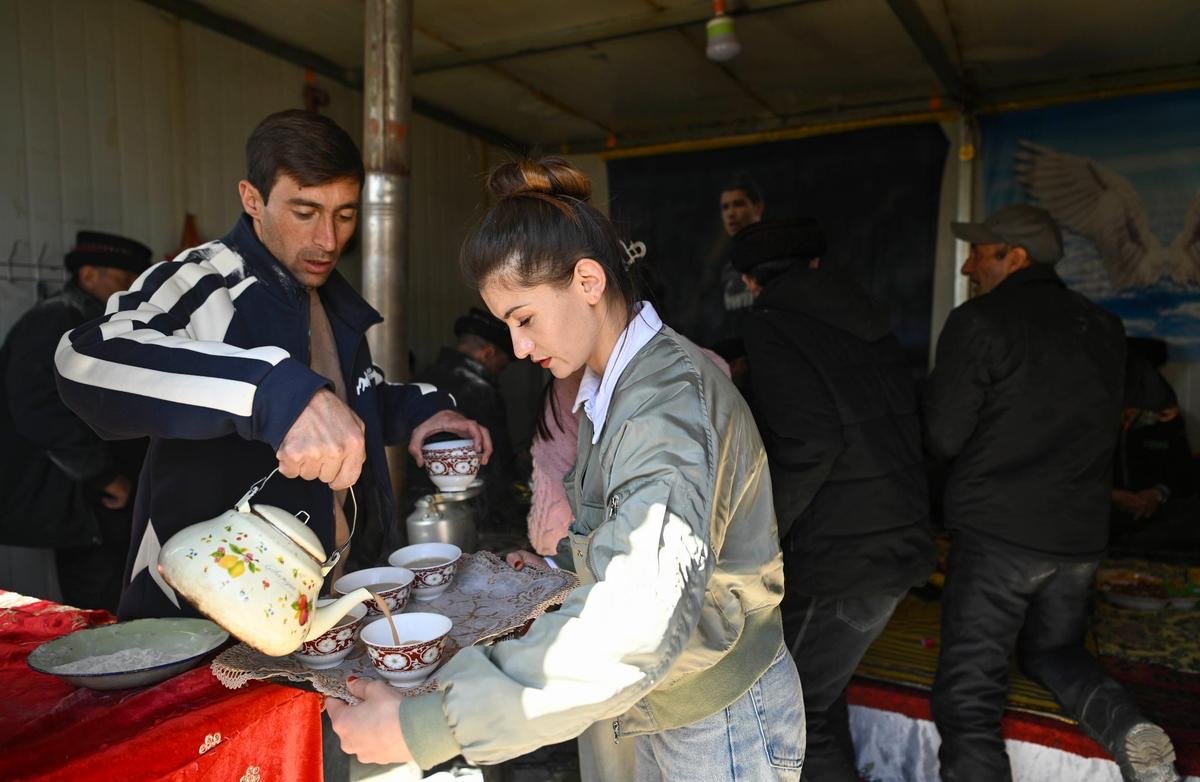
Strip everything else away and Uyghur breakfast is süt chay and naan. Brick tea boiled with milk, salted, sometimes with butter or a spoon of cream folded in. It arrives in a bowl, not a cup.
The technique that took me embarrassingly long to learn: you tear naan into the tea and let it soften, then eat it with a spoon or fingers. Dry naan with tea on the side is the tourist version. Bread in the bowl is the actual meal. It turns a ¥3 flatbread and a ¥4 bowl of tea into something that will hold you until two in the afternoon.
In Kazakh households in the Ili Valley the same principle applies but with more dairy on the table. Butter, clotted cream, hard curd. The bowl gets refilled the moment it empties, which is a hospitality convention rather than an offer, and the way to stop it is to place your palm flat over the bowl.
Costs: ¥3 to ¥8 for tea, ¥2 to ¥4 for bread. A full traditional breakfast at a neighbourhood shop is ¥10 to ¥20. If you want the full range of what gets poured in the morning, that sits in our guide to Xinjiang beverages.
Samsa: The Portable Option
Baked lamb pastries, pulled hot from the wall of a clay oven, ¥5 to ¥7 each. Two of them is breakfast. The morning batch is generally better than the afternoon batch because the oven has been fired fresh and the fillings were minced that day.
There is a stall near the eastern edge of Kashgar Old Town where the baker starts selling at 08:40 and stops when he runs out, usually around 10:30. I have queued there four times. The queue is six or seven people and moves fast. His samsa leak juice onto the paper, which is the marker of a good one.
Eat standing up, next to the oven, with a paper napkin you brought yourself. Napkins are not a given.
Kalla Pacha: The Serious Breakfast
Sheep head and trotter, simmered overnight, served as clear broth with pieces of meat, tongue, cheek and cartilage, plus a wedge of naan for dunking. Salt and pepper on the table. Sometimes chopped coriander.
This is winter food and old-school food. Younger Uyghurs in Urumqi will tell you their grandfather ate it every week and they eat it twice a year. The shops that still do it open early and close by 11:00.
Price: ¥15 to ¥30 depending on how much meat you get. The broth alone is around ¥12.
Honest assessment: the texture is challenging if you are not used to gelatinous meat. The flavour is clean, deeply savoury, not gamey. I would rank it above pho for cold-morning restorative power. My travelling companion in 2019 got through four spoonfuls and switched to bread.
Related: Öpke-Hesip
Lung stuffed with a milk-and-flour mixture, plus intestine stuffed with rice, liver and spices, both simmered and then sliced. Sold from big steel pots at bazaars, usually in the morning. ¥12 to ¥20 a portion.
The lung has a spongy, custardy texture that divides people permanently. The sausage is more approachable and tastes closer to a rice-based haggis. I like the sausage and can take or leave the lung.
Tonur Eggs and Other Small Things
Eggs baked slowly in the cooling bread oven, ¥3 each, tan-shelled, smoky yolk. Sold by the basket at bazaars. Buy three, eat one, keep two for the bus.
Alongside those you will find:
- Dogh, thinned salted yoghurt, ¥5, poured from a tub.
- Kaymak, clotted cream, spread on hot naan with honey. ¥10 to ¥15 for a small dish. Common in Yining and Kazakh areas, less so in the far south.
- Dried fruit and nuts on the table, particularly at guesthouses. Free. Eat them.
- Halwa, a dense semolina and oil sweet, sold in blocks by weight, roughly ¥20 per 500 g. Very sweet, eaten in small pieces with tea.
Noodle Soups: The Hui and Han Layer
In Urumqi, Changji, Hami and Korla the morning food scene shifts. Hui Muslim beef noodle shops open from 07:00 and serve hand-pulled noodles in clear beef broth with radish and chilli oil for ¥15 to ¥22. These are excellent and completely different from the Uyghur tradition.
You will also find fenтang, a starch-noodle soup, and various dumpling shops. In Yining, Russian and Tatar influence produces layered oil bread and pastries that would not look out of place in Almaty.
Xinjiang’s breakfast map is not one culture. It is roughly four overlapping ones, and which you get depends on which street you turn down.
Where to Actually Go
Kashgar
The lanes north and east of Id Kah Mosque. Not the main pedestrian street, which is repriced for visitors. Walk two blocks off it and prices drop by roughly 40%. Kalla pacha shops are marked by a big steel pot at the door and often a sheep’s head displayed unambiguously. Our Kashgar Old Town guide maps the wider area.
Hotan
The morning market near the main bazaar. Cheaper than Kashgar by about a quarter. Sunday is the big day but the food side operates daily. The öpke-hesip vendors here are the most confident I have seen.
Yarkant and Kargilik
Small-town breakfast, nearly no tourism, very cheap. ¥10 to ¥15 for a full meal. Also the places where a foreigner eating alone attracts the most friendly attention. I have twice had my bill quietly paid by another customer, which was awkward and lovely.
Urumqi
Split personality. Uyghur breakfast exists around the Grand Bazaar and in Shayibake district. Hui beef noodles are everywhere. Hotel breakfasts are Western-Chinese hybrids and generally not worth the calories.
Yining
Kazanchi neighbourhood. Cream, jam, layered bread, black tea. More Central Asian, sweeter, slower. Summer courtyard breakfasts run ¥25 to ¥45 and include far more than you can eat.
Etiquette Worth Knowing
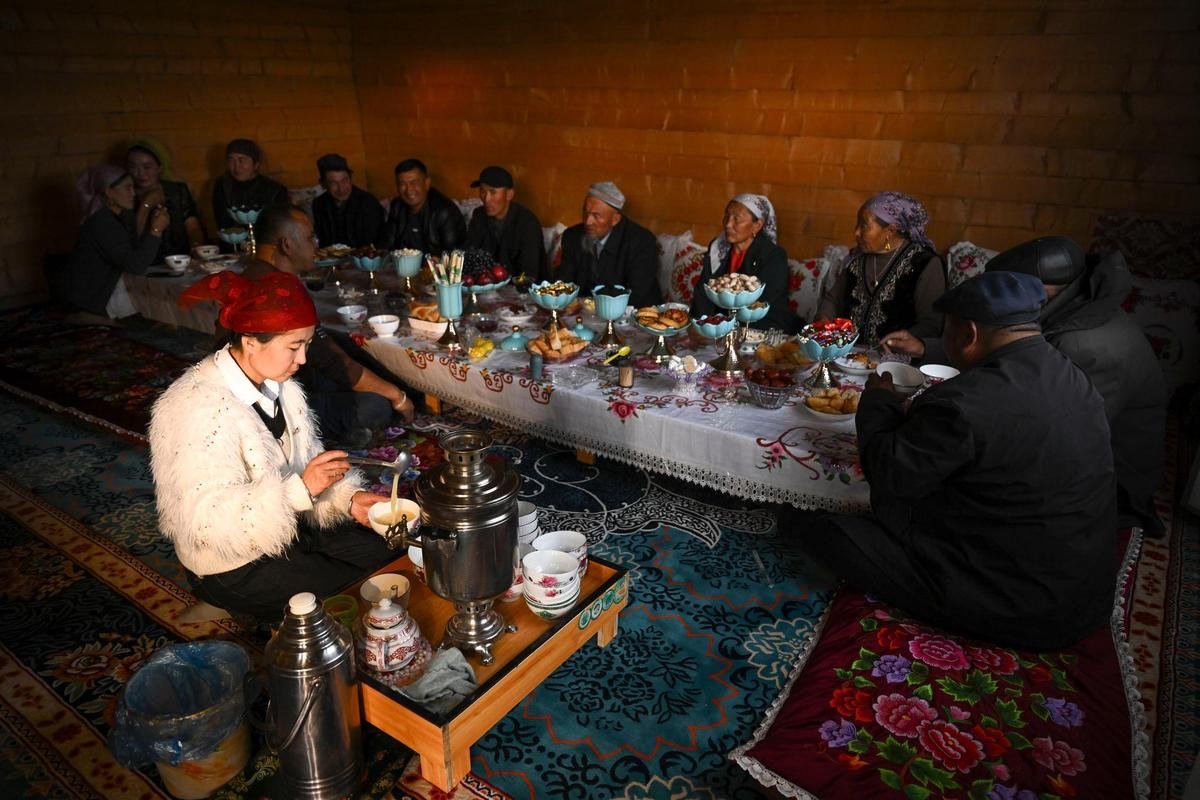
Bread is torn by hand. Never cut it with a knife at the table and never leave a piece face down.
Tea is received with the right hand, ideally with the left touching your right forearm. Half a bowl means stay. A brim-full bowl is a polite hint.
If you finish and someone starts a short prayer gesture with open palms drawn over the face, that is duagha, said after a meal. You are not expected to join. Sitting still for the eight seconds it takes is enough.
Pay at the counter on the way out. Tipping does not exist and confuses people.
Photographing food is fine. Photographing people mid-meal is not, unless you ask. A gesture at the camera and a raised eyebrow works.
If You Have a Sensitive Stomach
Eight trips, one bad episode, and that came from a bus station rather than a breakfast shop. Still, some ordering by risk level.
Lowest risk: tonur eggs, fresh naan, hot milk tea, samsa straight from the oven, beef noodle soup.
Medium: kalla pacha and öpke-hesip. Cooked for hours, but sitting in a warm pot for a while. Go where turnover is high.
Higher: unpasteurised dogh and raw cream, cut fruit sitting uncovered. Fine for most people, but do not start with these on day one at altitude.
Tap water is not drinkable. Bottled is ¥2 to ¥3. Hot tea is safe by definition.
Ramadan Changes the Timetable
During Ramadan, daytime breakfast shops in Uyghur neighbourhoods largely shut. What appears instead is the pre-dawn meal, seher, eaten before first light, and then the fast-breaking meal after sunset, which is enormous. Visitors are usually welcome at the evening meal and will be fed too much.
Eating and drinking in public during daylight in a conservative neighbourhood during Ramadan is not illegal, but it reads as rude. I eat in my room those weeks.
A Simple Three-Morning Plan
Morning one: milk tea and girde nan at any neighbourhood shop. ¥10. Learn the room.
Morning two: two samsa from an oven with a queue, plus a tonur egg and a dogh. ¥18. Eat standing.
Morning three: kalla pacha at a shop that opens at 08:00 and is empty by 11:00. ¥18. Bring an appetite and no assumptions.
After that you will have opinions of your own, which is the point. Mine, for what it is worth, is that the second bowl of milk tea is always better than the first, and that a samsa eaten more than fifteen minutes after it left the oven is a waste of ¥6. If you want the bread side of the story in more detail, see our tour of Xinjiang naan varieties, and for the evening equivalent of all this, the kebab guide covers what happens after dark.