

Eating Vegetarian and Vegan in Xinjiang: A Realistic Survival Guide for Plant-Based Travelers
The meat problem is real, but it is not the whole story
When I tell friends back home that I spent three weeks eating my way across Xinjiang as a vegetarian, the first reaction is always the same: “But isn’t it all lamb skewers?” It is a fair assumption. Walk into almost any night market from Urumqi to Kashgar and the air smells of cumin and smouldering charcoal, and the dominant protein on every grill is mutton. For the first two days of my first trip in 2019, I genuinely wondered if I had made a mistake. The grills were relentless, the menus led with meat, and my phrasebook had no word for “I don’t eat this.”
I had not made a mistake. Xinjiang is a crossroads, and its table is far more varied than the kebab stand suggests. The trick is not to hope for a vegetarian version of the meat dish in front of you. The trick is to learn the dishes that were plant-based long before you arrived, and to know how to ask for them without a translator app fumbling the words. Once I figured out the handful of staples, the region fed me better than I expected, and usually for less than the meat eaters at the next table were spending.

Start with the bread: naan is your backbone
If you eat nothing else, eat naan. The round, sesame-speckled flatbread baked against the walls of a tandoor oven is almost always vegan. I have stood in bakeries in Kashgar’s old town at 8 a.m. and watched loaves come out blistered and hollow, sold for 2 to 4 yuan each. The plain loaf and the onion version use only flour, water, salt, and occasionally a little oil or milk, never egg. Ask for “sutluq emes” if you want to be sure it has no milk, though in practice most plain versions are dairy-free and I never had a problem.
Naan travels. It stays good for two days wrapped in a cloth, which makes it the ideal fuel when you are driving the Dushanzi-Kuqa highway and the next town with a restaurant is 90 km away. I once crossed the Taklamakan’s edge on a loop from Korla to Aksu eating naan, tomatoes bought at a roadside stall, and the dried apricots I had packed from Turpan. It was not fancy, but I never went hungry. Our naan bread guide lists the regional shapes and which ones hide butter, so you can order with confidence instead of guessing at the counter.
The noodle dishes you can actually order meat-free
Laghman is the dish every traveler meets first: hand-pulled wheat noodles tossed with a sauce of tomatoes, peppers, and onion. In most Uyghur joints the default version comes with a little beef or mutton, but “gosh emes” (without meat) gets you the same rich, oily vegetable sauce over the noodles. I have eaten vegetarian laghman in a basement canteen in Yining for 18 yuan that beat anything I have had in London for five times the price. The vegetables were clearly from that morning’s market: green beans, cabbage, carrot, and a hit of garlic.
There is also a colder, vinegar-sharp version closer to a noodle salad, which in summer is a relief when the temperature outside hits 38°C. Ask for it without meat and you get a plate built for the heat. For a deeper look at the regional styles, our laghman noodles guide walks through the variations by town, and which ones take meat out cleanly. In Turpan I found a version with added mung beans that tasted like a proper cold meal, not a compromise.
Polo without the meat, and the rice question
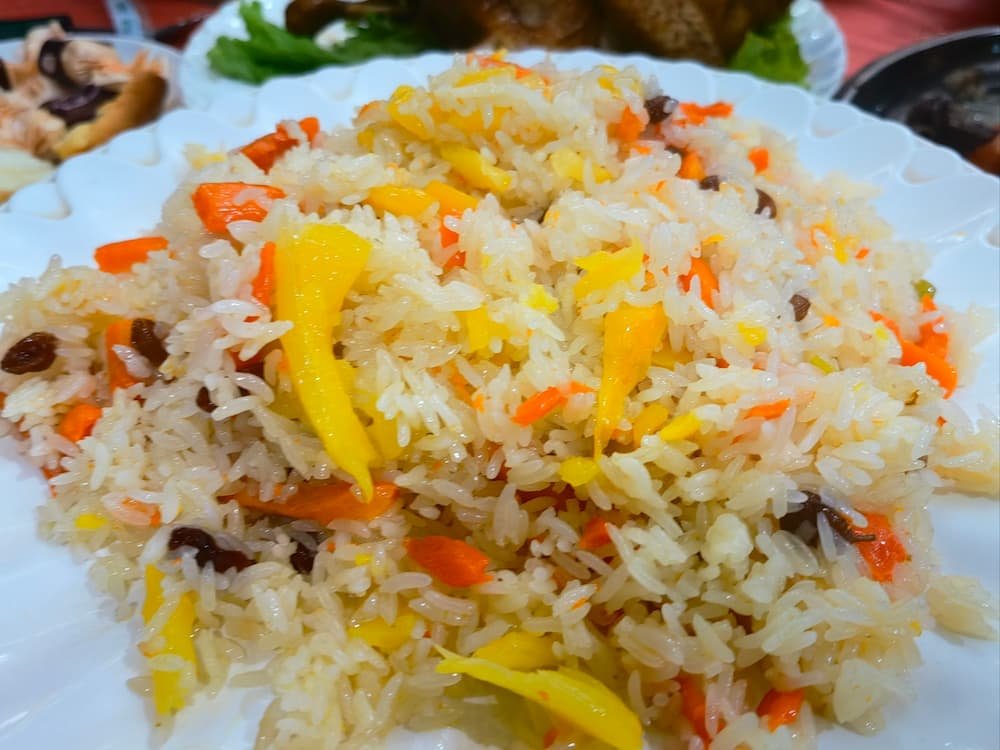
Uyghur polo (pilaf) is normally cooked with lamb and carrot, and the meat is folded through every grain. Ordering it vegetarian is harder here because the rice is often steamed together with the meat stock. Your best move is a carrot-and-raisin rice served at some canteens as a side, or to seek out the plain steamed rice that Han Chinese restaurants offer with vegetables. In the Ili Valley especially, where the Russian and Central Asian influence runs deep, I found rice pilafs made with dried fruit and nuts and no meat at all in a couple of family spots around Yining.
If rice is your safe harbor, it helps to read up before you sit down, because some menus fold meat into the broth where you cannot see it. The wider Uyghur restaurant guide sorts the common dishes by whether they hide animal stock, which saved me more than one awkward conversation where I had pointed at the wrong bowl.
Vegetables that taste like they mean it
The single biggest surprise of eating plant-based in Xinjiang is the produce itself. The continental climate, with its huge day-night temperature swing, grows tomatoes, peppers, and melons with a density of flavour that supermarket imports at home lack. In July around Turpan I bought a hami melon from a roadside truck for 6 yuan and it was the sweetest thing I ate all year. Timing your trip to August means grapes, and to September means apples and pears from the mountain valleys, as our fruit seasons guide lays out by month. I started buying fruit by the kilo at every stop and it became the spine of my diet.
Stir-fried green beans with garlic, dry-fried green peppers, and cold dressed cucumber are on nearly every Chinese-style menu and are reliably vegan. The risk is hidden oyster sauce or chicken powder in the wok, so if you are strict, learn the phrase “zhengsu” (pure vegetarian, no animal stock) and show it on your phone. In the bigger cities the word is understood; in a village canteen it may draw a confused smile, but they will usually just cook you plain vegetables in oil, which is exactly what you wanted.
Street food that happens to be vegan
Some of my best meat-free meals came from places with no menu at all. Roasted corn in summer, baked sweet potatoes from pushcarts in the cold months, and halves of watermelon sold by weight at the melon stalls are all naturally plant-based and cheap. In Urumqi’s night markets I grazed on torn bits of naan dipped in a spicy tomato paste some vendors sell on the side, and on plates of cold boiled peanuts. None of this is in any guidebook, but it kept me fed and happy while meat-eaters queued for skewers.
The one street trap is the fried snacks: many are made with egg or animal fat, and the visible ones are not always the safe ones. When in doubt, the bread and the fruit are your friends, and they are never the wrong choice.
Dairy: a gift and a trap
Here is where vegan travelers need to pay attention. Xinjiang loves dairy. Salty milk tea is filling and everywhere. There is thick yogurt, fresh cream, and a handmade ice cream sold from silver carts in the old towns. None of these are vegan, but the plain yogurt from a Uyghur dairy shop, eaten with your own fruit, is a solid vegetarian breakfast. The dairy and milk-tea guide maps where to find the good stuff and what is animal-based, which I wish I had read before my first salty-chai surprise in Aksu made me wonder if they had misheard “sweet.”
For vegans, the safest sweet is fruit, and the safest savoury is bread plus oil-cooked vegetables. It is a simpler diet than you might fear, and after a week I stopped missing cheese entirely. The fruit is good enough to make the sacrifice painless.
A sample vegetarian day on the road
To make it concrete, here is a day I actually had in Yining. Breakfast: naan and a small pot of plain yogurt with a sliced apple from the market, about 10 yuan. Late morning: walked the food streets and grazed dried figs. Lunch: vegetarian laghman at a corner canteen, 18 yuan. Afternoon: bought a hami melon and ate half, kept the rest for the car. Dinner: a plate of garlic green beans and steamed rice at a Han restaurant, 22 yuan, plus more naan for the next morning. Total around 60 yuan, no meat, no stress, and I went to bed full. That ratio held for most of the trip.
Where the cities make it easy
The three places where plant-based eating gets genuinely easy are Urumqi, Yining, and Kashgar. Urumqi has mushrooming vegetarian-specific cafes aimed at students and the health-conscious, with set lunches around 30 yuan. Yining’s food streets mix Han, Hui, and Uyghur cooking, and the Hui halal restaurants there will happily make you a plate of stir-fried vegetables and rice with no questions. Kashgar’s old town has the best food-street scene in the south, where you can graze on naan, fresh figs in season, and bowls of tomato noodle soup.
I would not plan a vegetarian trip around the remote Pamir or the deep Taklamakan towns, where the menu is mutton or mutton. But as a base for a road trip, the city triangle works, and you can stock a cooler for the empty stretches between them.
Common mistakes I made so you don’t
First, assuming “vegetable” on a menu means no stock. Ask about the broth. Second, skipping the fruit, which is the region’s secret weapon and the cheapest food you will eat. Third, not carrying cash in villages where the one good canteen takes nothing else. And fourth, trying to explain your diet out loud before showing it in writing. The four phrases written on your phone beat any accent.
My honest verdict
You will not eat as varied a vegetarian diet in rural Xinjiang as you would in Bangkok or Berlin. But you will eat honestly, cheaply, and with food that tastes of the place it came from. Pack dried fruit, learn four phrases, and treat naan as a friend. Three weeks in, I came home lighter and, frankly, a little proud of having eaten well where everyone said I could not. If you want the wider context for planning a whole trip around the table, the food culture overview is the place to start.