
Uyghur Muqam Music: Listening Guide & Live Venues
The first time I heard muqam properly I did not know what I was listening to. It was a wedding courtyard in Yarkand, June 2019, around 22:30, and a man in his sixties was playing something long-necked and bowed that sounded like a viola being strangled by a sitar. Everyone else was eating. Nobody was watching him. He played for maybe forty minutes and then a drum came in and the whole yard stood up at once, as if someone had pulled a lever.
That instrument was a satar. What he had been playing was the opening free-rhythm section of a muqam suite, and the lever-pulling moment was the shift into the dance section. Once you know the shape, you hear it everywhere in southern Xinjiang.

What Muqam Is, Structurally
Forget “traditional folk music”. Muqam is closer to a symphony cycle. UNESCO inscribed Xinjiang Uyghur Muqam on the Representative List of the Intangible Cultural Heritage of Humanity in 2008, having proclaimed it a Masterpiece in 2005, and the listing describes something enormous: the Twelve Muqam alone contains more than 300 pieces and takes over 20 hours to perform in full.
Twelve suites, each named after a mode: Rak, Chebiyat, Mushavrek, Chargah, Penjigah, Ozhal, Ejem, Ushshaq, Bayat, Nava, Sigah, Irak. Each suite splits into three movements.
Chong näghmä comes first — the “great music”. Slow, declamatory, sung over a long instrumental frame. This is the part that empties a room of tourists and fills it with old men.
Dastan is narrative. Love stories, hero stories, the ones everyone in the audience already knows the ending of.
Meshrep closes it. Fast, percussive, danceable. This is where the yard stands up.
The lyrics are a mixed inheritance — classical Uyghur poetry, proverbs, folk verse, and chunks of Chagatai, a literary language that stopped being spoken generations ago. Singers learn phrases whose meaning they carry rather than parse.
Four Regional Styles, and Why It Matters Where You Listen
UNESCO’s own text names four: Twelve Muqam, Dolan Muqam, Turpan Muqam and Hami Muqam. They are not variations on a theme. They sound like different musics.
Twelve Muqam is the courtly one, associated with Kashgar and above all Yarkand. Polished, long, formally rigorous.
Dolan Muqam comes from the Tarim rim — Mekit, Awat, the desert-edge settlements. It is rougher and much louder. Fewer instruments, more shouting, a kalun and a Dolan rawap and a bank of frame drums. The first Dolan performance I sat through, in a village hall near Mekit in 2022, physically hurt my ears and was the best two hours of that trip.
Turpan Muqam is shorter and brighter, more obviously tied to dance.
Hami Muqam sits at the eastern edge and shows it, with melodic turns that lean towards Gansu.

The Woman Who Edited It, and the Man Who Saved It
Two names carry the history.
Amannisa Khan was a queen of the Yarkand Khanate in the sixteenth century. Working with the court musician Qadir Khan, she gathered scattered muqam material, cut the archaic and impenetrable verse, and organised what survived into a coherent cycle. That editorial act is why Yarkand — Shache in Chinese — is called the home of the Twelve Muqam. Her mausoleum is in the town, and the town itself is criminally under-visited; our Yarkand guide covers what else is there.
Four centuries later the whole thing nearly evaporated. By 1951 exactly one man was known to be able to sing the complete cycle: Turdi Ahun, a musician in his seventies. A young musician named Wan Tongshu was sent from Beijing with a wire recorder, and the two of them worked in Urumqi for over two months — Turdi Ahun singing by day, Wan and his wife Lian Xiaomei transcribing at night, re-recording anything unclear the following morning. Wire recorders were unforgiving. If the wire snapped the reel tangled and work stopped until it was untangled and rejoined.
They filled 24 reels. By 1956 they had captured 245 pieces and 2,482 lines of lyrics. Turdi Ahun died that year. The edited scores were published in 1960 containing 320 pieces and 2,990 lines — the first time the cycle existed as sound, text and notation rather than as one elderly man’s memory.
You can see the physical evidence. Xinjiang Arts University in Urumqi keeps the Wan Tongshu Muqam documentation hall, holding 48 of those 1950s wire recordings, 635 pages of handwritten scores, and 1,231 pages of notes. Access is not casual — email ahead through the university — but for anyone seriously interested it is the single most important room on the subject.
Where to Actually Hear It Live
This is the part most articles skip. Here is what I have found across six trips.
1. Muqam Art Troupe, Xinjiang Art Theatre — Urumqi
The professional company, based in the capital. Full staging, costumes, a proper orchestra. Performances are irregular rather than nightly, and the schedule goes up on the theatre’s own channels a week or two ahead. Ask your hotel front desk to check; that has worked for me twice where searching in English failed. Tickets when I last went were ¥80 to ¥280.
It is the polished version. Purists sniff at it. Ignore them — it is also the only place you will hear the ensemble properly balanced, and if you are new to this, balance helps.
2. Yarkand — Amannisa Khan Memorial Complex
Small daytime performances run in and around the memorial garden, often mid-morning and mid-afternoon in the tourist season. Group sizes are small. I have twice been the only foreigner present and both times ended up being handed a dap and told to keep time, badly.
3. Mekit and Awat — Dolan Muqam
Harder, better. Mekit County promotes itself as the Dolan heartland and there is a performance venue in the county town, but the real thing happens at weddings and village gatherings. Hire a local driver for a day (¥400 to ¥600 in 2022) and say the word “Dolan” — the network does the rest. Go with realistic expectations about scheduling.
4. Kashgar Old Town
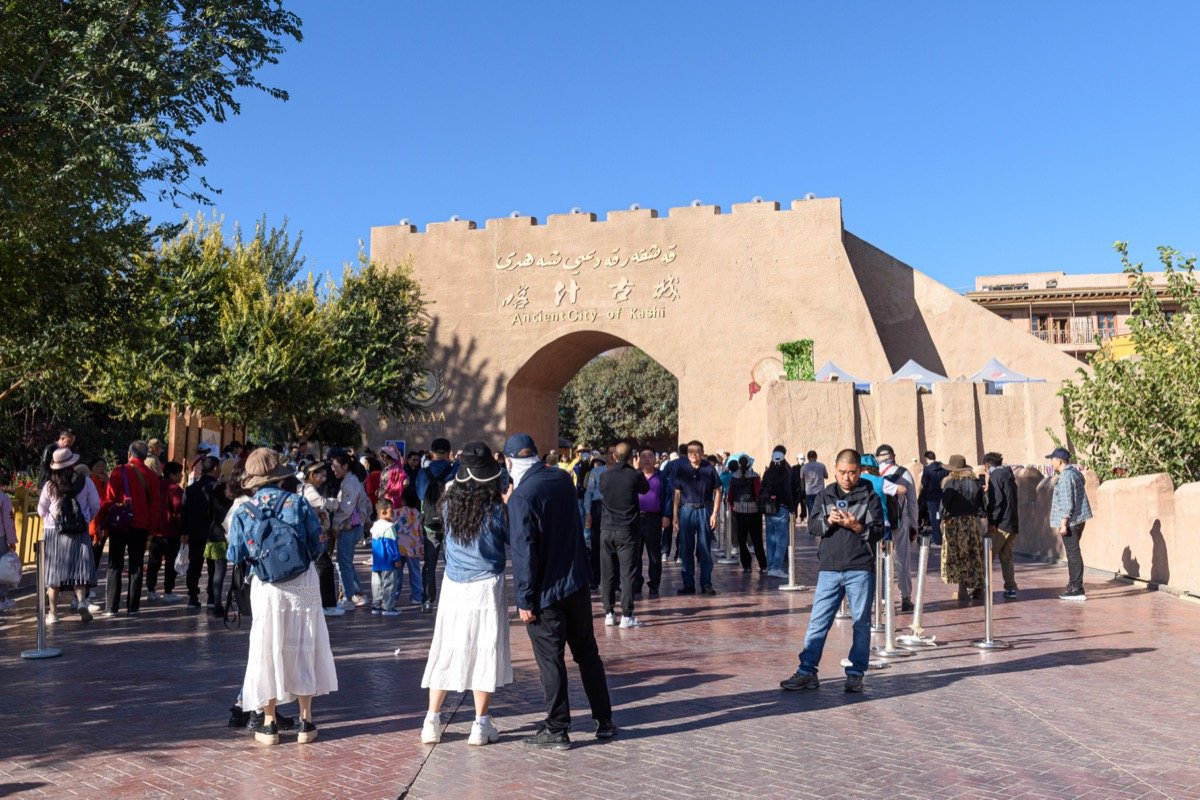
Daily, free, and unpredictable. Musicians set up near the Id Kah square and along the main restored lanes. Much of it is short-form and tourist-facing, but the players are real players. Late afternoon is better than midday. Sit down, order tea, listen for twenty minutes, tip ¥10 or ¥20. Our Kashgar Old Town guide maps the lanes where this tends to happen.
5. Turpan — Grape Valley and village venues
Turpan Muqam turns up in the vineyard-restaurant circuit, which sounds cynical and mostly is, but the musicians in the smaller family courtyards outside the main scenic gate are genuine and the setting — grape trellis, 38°C, a bowl of melon — is hard to argue with.
6. Weddings
The honest answer to “where is the best muqam”. You cannot book one. If you are invited, go, bring ¥100 to ¥200 in a red envelope, eat what you are given, and stay past 22:00 because that is when the music stops being background.
The Instruments, So You Know What You Are Looking At
Satar — long-necked bowed lute with one played string and up to a dozen sympathetic strings underneath. The lead voice of Twelve Muqam. That eerie halo you hear is the sympathetics ringing.
Tembur — long-necked plucked lute, five strings, bright and metallic.
Dutar — two silk or nylon strings, soft, domestic. Played at home more than on stage.
Rawap — plucked, with a small skin-covered body and horns on the neck. The Dolan rawap is a different, heavier animal.
Ghijek — spike fiddle, bowed, played resting on the knee.
Kalun — a zither struck or plucked, central to Dolan style.
Dap — frame drum with rings inside the rim, and the reason Dolan performances are so physically loud.
Sapayi — a pair of wooden sticks with iron rings, shaken. Usually the last thing anyone notices and the first thing you miss in a recording.

Buying an Instrument
Instrument workshops cluster on Kokmaidan Road in Kashgar and around the old town’s craft lanes. A decorative wall-hanging rawap is ¥150 to ¥400. A playable one starts around ¥800 and a good handmade tembur runs ¥2,000 upwards. Ask the maker to play it before you buy — if he will not, the instrument is furniture.
Getting one home is the real problem. Airlines within China have accepted a rawap as cabin baggage for me twice and refused once. A hard case adds ¥300 to ¥600 and is not optional. If you would rather buy something that fits in a suitcase, our handicrafts guide runs through atlas silk, knives and textiles with current prices.
How to Listen Without Being Bored
Honest advice. The chong näghmä section is slow and you will not have the reference points to enjoy it on first exposure. Do not fight that. Three things helped me.
Count the drum. Muqam rhythmic cycles are asymmetric — seven beats, nine beats — and once you lock onto the cycle, the melodic line stops sounding formless.
Watch the audience, not the stage. Old listeners visibly anticipate transitions. When four heads lift at once, something is about to change.
Listen to one suite repeatedly before you travel. Rak is the conventional starting point. Twenty minutes a day for a week and the vocabulary starts to settle.
Where the Music Comes From
Muqam did not appear from nowhere. The court musics of the ancient oasis kingdoms — Kucha, Kashgar, Gaochang, Hami — fed into it over centuries, and those kingdoms were nodes on a trade network that carried instruments and modal systems east and west. Musicians appear on the walls at the Kizil Thousand Buddha Caves outside Kuqa, painted between the third and eighth centuries, holding lutes and harps that look uncomfortably like instruments still in use. The broader context sits in our Silk Road history guide.
A Three-Day Listening Route
Day one, Urumqi. Check the Muqam Art Troupe schedule the moment you land. Xinjiang Regional Museum in the afternoon for instrument context.
Day two, fly to Kashgar. Old town lanes late afternoon, instrument workshops on Kokmaidan, dinner somewhere with musicians.
Day three, drive to Yarkand — about three hours, ¥400 for a car. Amannisa Khan complex in the morning, then push another two hours to Mekit if you have the appetite for Dolan.
Total, with a driver and mid-range rooms, ran me about ¥3,200 for three days in 2022.
I never found out the name of the satar player in that Yarkand courtyard. He finished, drank tea, put the instrument in a cloth bag and left before the dancing was over. Whatever he was playing was a fragment of something that takes twenty hours to say completely, and he gave it forty minutes on a Tuesday night for people who were mostly eating. That ratio tells you something about how this music actually lives.