
Night Trains and Sleeping-Car Rail Travel Across Xinjiang
The Night I Let the Train Do the Driving
I boarded the southbound sleeper in Urumqi at 9:42 p.m., hauled my duffel up the metal step, and found my berth before the conductor had finished punching tickets. By the time the train cleared the city lights I was horizontal, and by the time I opened my eyes the desert sun was already flat and orange over the platforms of Kashgar. That single ride, roughly 1,458 kilometers and about 24 hours of rolling, cost me less than a third of what I would have spent on fuel, tolls, and a night in a hotel had I driven it myself. I have done this crossing three times now, and the math has never changed in the train’s favor.
Why Sleep Through the Crossing
The geography of Xinjiang is the first thing you have to respect. It is a region where the headline distances between cities run to four figures in kilometers, and the roads, while excellent, ask a full day of attentive driving from you each leg. The sleeper train turns that lost day into a recovered one. You board after dinner and you arrive with a morning free.
My rental car stayed parked in Urumqi for the week I was gone. The daily rental rate kept ticking, sure, but I avoided roughly 1,500 kilometers of wear, two fuel stops, and the particular exhaustion that comes from staring at a divided highway at 2 a.m. For a self-driver, the sleeper is not a replacement for the road trip. It is the part of the trip you choose not to drive.
The cost gap tells the same story. A solo drive to Kashgar burns close to 900 yuan in fuel and tolls, plus a hotel night near 250 yuan, before you count the value of a day lost to the wheel. The soft sleeper ran me 490 yuan and delivered me at 9 p.m. ready to eat. The train wins on money and on mood, and the mood is the part most first-timers underestimate.
The Classic Overnight Routes
Three lines carry most of the overnight traffic, and each one suits a different kind of plan. The Urumqi–Kashgar run is the legend: trains leave in the late evening and arrive the following evening, covering about 1,458 kilometers in something close to 24 hours. I have taken the daytime alternative and arrived cross-eyed; the night version lets the Tarim Basin blur past while you sleep.
The Urumqi–Hotan route runs deeper into the south, roughly 1,950 kilometers and closer to 30 hours end to end. I split it once with a long stop in Aksu and never regretted the detour, stepping off into a town the guidebooks skip and buying fresh bread from a cart by the gate. The Urumqi–Yining line is the gentle one, about 600 kilometers west into the Ili valley, and it can be done overnight in around 10 to 12 hours. Yining in summer is the green counterweight to the rest of the region, and arriving rested there felt like a small prize.
Smaller hubs feed these main lines too. Turpan sits on the eastern approach, Korla anchors the middle, and Aksu breaks up the long southern haul. Plan which leg to ride and which to drive by checking the main rail hubs before you book, and the map starts to make sense.
Hard Sleeper vs Soft Sleeper
The two classes are the heart of the pricing, and the gap between them is wider than the bed. Hard sleeper opens into a six-berth bay with three tiers and no door. I paid about 310 yuan for the Urumqi–Kashgar hard sleeper on my first trip, and the car was full of families, students, and a guitarist who played quietly at the end of the carriage until the conductor dimmed the lights.
Soft sleeper closes you into a four-berth cabin with a real door, reading lights, and a small table. The same Urumqi–Kashgar leg ran me around 490 yuan in soft sleeper, and on a later trip the extra 180 yuan bought me actual sleep rather than the polite half-doze of the open bay. For the 30-hour Hotan run I would never book hard sleeper again; the cabin door alone is worth the fare on a long night.
A third tier exists below hard sleeper, the hard seat, but I will not pretend it is comfortable for these distances. The real choice is hard versus soft, and the price tiers scale with distance. Yining in soft sleeper cost me near 230 yuan, while Hotan in soft sleeper climbed past 600 yuan. Budget roughly 100 to 110 yuan per 500 kilometers in hard sleeper, and about 60 percent more for soft.
Booking on 12306 With a Passport
Foreign travelers buy through the 12306 platform, and the passport is your ticket credential, not your nationality. You register the passport number exactly as it appears on the document, match the expiration date, and the system issues a ticket tied to that number. I learned the hard way to carry the physical passport on board, because the conductor scans it against the berth.
The app and the website both work, though the website handled my foreign card better than the app did on two of three tries. Booking opens 15 days ahead, and the popular Urumqi–Kashgar soft sleepers sell within hours of release in peak season. I set a reminder for the release window and still missed a berth once, falling back to hard sleeper for that leg. Have a backup date ready before you commit, and weigh the overnight against the region’s high-speed rail lines if your target city happens to sit on one.
What the Berths and Cabins Are Like
Picture the hard sleeper as a wide shelf with a thin mattress, a pillow that resists fluffing, and a tiny communal reading light that your neighbor controls. The middle and lower berths are the prized spots; the top berth is cheapest and closest to the luggage rack and the rattling ceiling. I gravitate to the lower berth now, because swinging your legs out at a station stop without climbing over two strangers is its own luxury.
Soft sleeper changes the feel entirely. Four berths, two upper and two lower, fold into a cabin you can shut off from the corridor. The mattress is thicker, the curtain draws, and the air tastes less of thirty people’s dinners. On the Yining run I read for an hour, lowered the light, and slept through the approach to the mountains.
Both classes share one truth: the train moves, the car rocks, and the rhythm becomes a friend by the second hour. Earplugs and a sleep mask move from optional to essential the moment the corridor light stays on past midnight, and a small pillow from home beats the thin station-issue one by a wide margin.
Food On Board and At the Stops
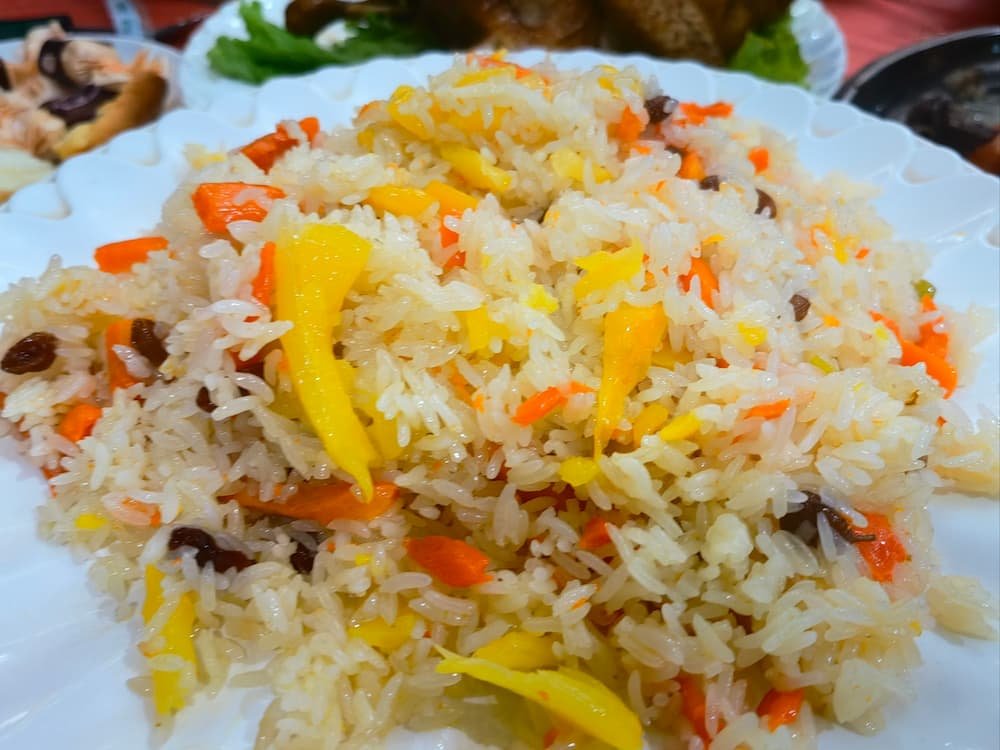
The dining car is honest but narrow. I found noodles around 25 yuan, boxed rice near 35 yuan, and a thermos of tea that the attendant refilled for free. The food will not win awards, yet a hot bowl at 11 p.m. after the lights dim is better than it has any right to be. I pack a backup of bread and fruit regardless, because the dining car closes and the trolley grows thin after midnight.
Station stops are the real feasts. The Urumqi–Kashgar train halts at Turpan, Korla, and Aksu among others, and at each the platform fills with vendors. I bought skewers at one stop for 3 yuan a piece, steamed buns for 2 yuan, and a bag of grapes that out-sweetened anything in the dining car. Vendors call through the windows, and the train waits long enough to buy, eat, and climb back aboard. Time your hunger to the longer stops, and keep small notes ready because change runs short.
Water is the thing to watch. Bottles cost little at the stops but the car’s hot-water dispenser is free and always busy. I fill a bottle at every long halt and never went thirsty across three crossings, and the same dispenser makes a decent cup of instant coffee when the dining car has shut for the night.
Etiquette, Luggage, and the Small Print
The cars run on a quiet consensus. Shoes come off near the berth, phone calls move to the vestibule, and the corridor light is someone’s enemy by midnight. I keep my duffel on the rack above the berth, not in the aisle, because the conductor will ask you to move it anyway. A small lock on the zipper has saved me twice when I dozed through a busy stop and the car shifted under me.
Luggage limits are generous but not infinite. The rack suits a mid-size suitcase and a daypack; anything larger rides at the car’s end. I travel with one roller and one bag and have never been challenged, but I have watched a cyclist wrestle a boxed bike into the vestibule with mixed success and a patient conductor.
One practical note for foreign riders: keep the passport on your person, not buried in the luggage. The berth check happens once, sometimes twice, and fumbling through a packed bag at 10 p.m. is a poor way to meet your conductor. The train runs on schedule with a punctuality that rewards being ready at the door five minutes before your stop, so I pack the night bag the evening before and keep it by the lower berth.
Pairing the Train With a Rental Car
This is where the self-driver wins. I left my rental in a Urumqi lot, rode the sleeper to Kashgar, and collected a different car at the far end to explore the southern roads. The train swallowed the boring 1,458 kilometers; the car handled the interesting 200 around the city and the mountain passes. You pay for the rental while you travel, yet you skip the dead highway hours and arrive sharp.
The trick is pickup logistics. Kashgar, Yining, and Hotan all have rental desks near the stations, and I booked the return car before I boarded so it waited on the platform side. Returning, I drove back toward Urumqi over two easy days, something I would never have done fresh off a 24-hour wheel grind. The sleeper and the rental are not rivals; they are a relay, and the passenger is the only thing that moves between them.
When a line does not reach your target, the region’s intercity buses as a backup cover the gaps the rails leave, and on the rare stretch with no service I have leaned on hitchhiking the gaps with local trucks. The train gets you to the hub; the rest is yours to assemble with the car you parked or the one you rent.

How This Stacks Up Against High-Speed Rail
The region’s high-speed rail lines are fast and smooth, yet they do not reach Kashgar or Hotan. The fast trains serve the northern and eastern corridors, Urumqi to Turpan to Korla and beyond, and they cut those legs to a fraction of the sleeper’s time. I rode the high-speed link to Turpan in under an hour and felt spoiled, then transferred to a conventional sleeper for the long southern pull.
The sleeper’s edge is coverage and cost. Where the fast lines stop, the night train continues, and at a price the high-speed seat cannot touch for an overnight distance. Think of high-speed as the sprint and the sleeper as the crossing. I use both, and I let the destination decide, because the southern cities simply have no fast alternative worth the name.
Planning the two together means knowing the hubs and which legs each mode serves. I sketch the map by hub first, then drop the sleeper onto the longest gap, and finally bolt the rental car onto whichever end needs a road. That order has saved me from every awkward transfer I have attempted, and it keeps the long, dull kilometers on the rails.
Bring the Right Night
My advice after three crossings is plain. Book soft sleeper for anything past 18 hours, hard sleeper for the short Yining hop, and never underestimate the value of arriving awake. The train is the cheapest hotel you will sleep in and the most scenic one you will barely see. Let it carry the distance while you carry the memories, and let the rental car wait for the part worth driving.