
Religious Sites of Xinjiang: Mosques, Temples & Sacred Mountains
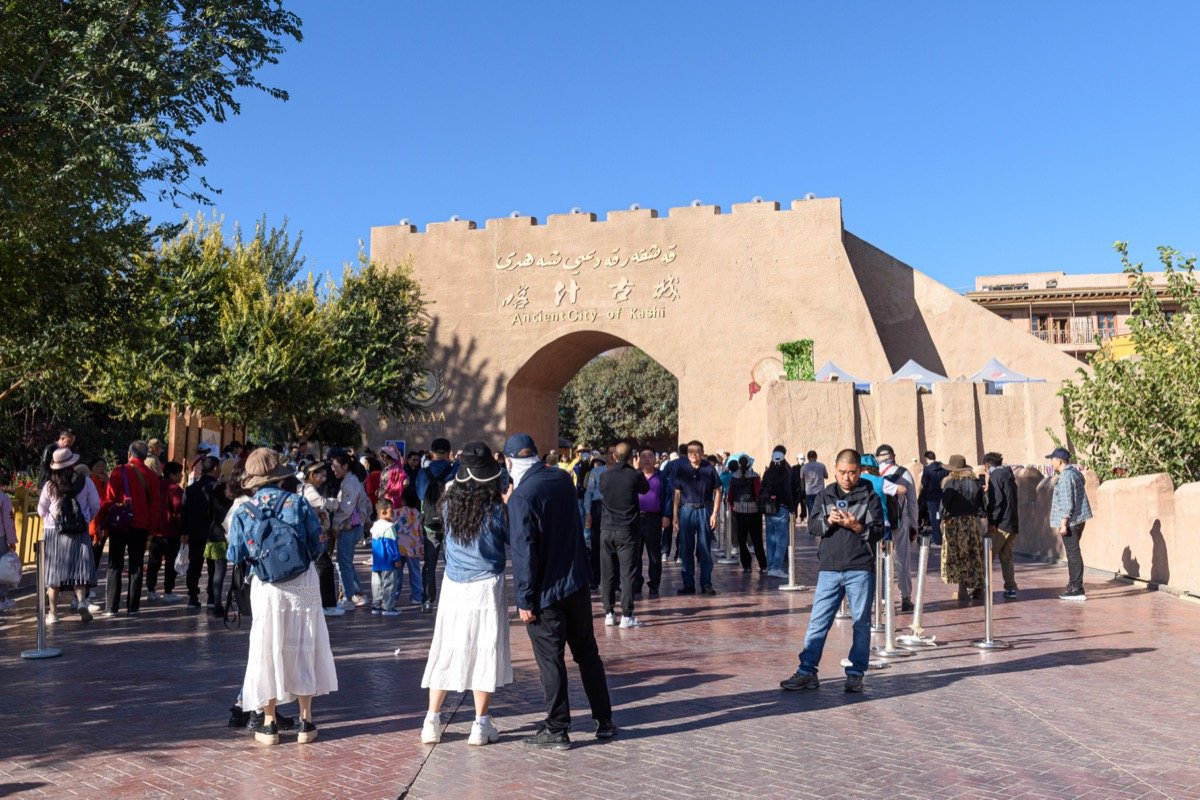
An old man at the Id Kah Mosque gate in Kashgar once watched me faff about with a camera strap for a full minute before he said, in Mandarin, “the light is better after four.” He was right. He was also, I suspect, telling me to come back when there were fewer people milling about the courtyard, which was a more useful piece of advice than anything I had read beforehand.
Xinjiang’s sacred landscape is unusually layered. Buddhist cave temples cut in the third century sit two hours from mosques still in daily use. Taoist halls perch above an alpine lake. Whole mountains function as objects of reverence without a building on them anywhere. You can cross between these worlds in a single day’s drive, and most visitors do it without noticing.
Before Anything Else: How to Behave
This section matters more than the list that follows.
Dress covered at mosques and mausoleums. Shoulders and knees, both sexes. I travel with a light long-sleeved shirt that lives in my daypack from March to October purely for this.
Women should carry a scarf. Not always required in courtyards, always appreciated, occasionally necessary.
Shoes come off where there is a shoe rack or a raised carpeted platform. Watch what everyone else does and copy it.
Prayer times are not viewing times. Friday midday in particular — arrive after, not during. If people are praying, you stop walking and you certainly stop photographing.
Ask before photographing any person. A raised eyebrow and a lifted camera does the job. Learning to say hello and thank you gets you further than any of this; our essential Uyghur phrases guide has the eight words that matter.
Do not photograph inside prayer halls unless you have been explicitly told it is fine.
Id Kah Mosque, Kashgar
Founded in 1442 and enlarged repeatedly since, Id Kah is the largest mosque in China, with a courtyard complex covering roughly 16,800 square metres. The yellow facade with its flanking minarets is the single most photographed structure in the region and, unusually for such things, it is better in person than in photographs — because the photographs cannot show you the poplar grove inside.
The courtyard is planted. Sunlight comes through the leaves onto brick and the temperature drops five degrees when you step in from the square. The prayer hall runs along the western side, its ceiling carried on painted wooden columns, and the wood is old enough that the paint has gone chalky.
I paid ¥45 in 2023. Give it 45 minutes minimum. Late afternoon, as instructed by the man at the gate, is the light. Detailed practicalities including the shoe situation and the side entrances are in our Id Kah Mosque visitor guide.
Emin Minaret, Turpan
Built in 1777 and standing 44 metres, this is the tallest ancient minaret in China and the most satisfying piece of brickwork I have seen anywhere. It tapers like a chimney and the entire surface is patterned in laid brick — fifteen distinct geometric bands, no tile, no paint, just brick set at different angles catching different amounts of sun.
Which means the whole thing changes completely between morning and evening. At 09:00 the patterns are flat. By 19:00 in summer they are three-dimensional. I have been three times and only understood the building on the third visit, in low light, standing about 40 metres to the southwest.
Ticket around ¥45. It is 2 kilometres east of Turpan city centre, ¥15 by taxi. Climbing the minaret is not permitted.
Abakh Hoja Mausoleum, Kashgar
Five kilometres northeast of central Kashgar, this seventeenth-century family tomb is the most visually lavish religious building in Xinjiang — a green and white tiled dome over a chamber holding dozens of tombs of a single family across five generations.
The complex includes a teaching hall, a small mosque and a cemetery, and the tilework varies wildly in quality because it has been repaired over three centuries by whoever was available. Look for the patches. They are more interesting than the intact sections.
Entry was ¥30 when I last went. Mornings are quieter. It takes an hour.
Mor Pagoda, Outside Kashgar
Thirty-odd kilometres northeast of Kashgar, on a gravel terrace with nothing else around, stand two eroded mud-brick masses. One is a stupa, the other the remains of a temple platform. This was a Buddhist site, active roughly from the third to the tenth centuries, and it is the westernmost significant Buddhist ruin in China.
Systematic excavation began in 2019 and the site has since become one of the more important digs in the region. There is very little infrastructure. When I went in 2023 there was a fence, a sign and one attendant, and I was alone for ninety minutes.
Go for the strangeness of it. Kashgar is a city where Buddhism has been gone for a thousand years, and this is the physical residue, sitting in the desert forty minutes’ drive away. A car and driver for the round trip cost me ¥250.
Kizil Thousand Buddha Caves, Kuqa
The most important Buddhist art site in Xinjiang, and among the earliest in China. Two hundred and thirty-six numbered caves are cut into a cliff above the Muzat River, with murals spanning roughly the third to the eighth centuries. Kizil was inscribed on the UNESCO World Heritage List in 2014 as part of the Silk Roads: Chang’an–Tianshan Corridor network.
The painting style is neither Chinese nor Indian. It is Kuchean — a local synthesis with Gandharan and Persian input, characterised by diamond-shaped compositional grids on the vaults, each diamond holding a scene from a previous life of the Buddha. The blue is lapis lazuli, traded in from what is now Afghanistan.
What you need to know before going: a standard ticket admits you to a small rotating selection of caves, typically six to eight. The extraordinary ones require a supplementary fee that can run into four figures per cave, and a guide. Photography inside is prohibited, enforced, and you will be asked to leave bags.
Much of the best material is not there. Large sections of mural were removed by European expeditions in the early twentieth century and sit in museums in Berlin and elsewhere. The guides mention this. The empty patches on the walls are legible even if you know nothing.
Kizil is 67 kilometres northwest of Kuqa. Budget a half day. Full detail in our Kizil caves guide.
Subash Ruins, Kuqa
Twenty kilometres north of Kuqa, split across both banks of a river, Subash was a large Buddhist monastic complex from roughly the third century until it was abandoned around the thirteenth. The monk Xuanzang stayed here in 630 CE on his way west. It shares Kizil’s 2014 World Heritage inscription.
There is no roof left anywhere. What survives is mud-brick walls and stupa cores standing three to ten metres in a gravel valley, and the scale takes a while to register — the eastern site alone runs several hundred metres. I walked it at 18:30 in June, when the light comes in sideways and the walls throw shadows across the gravel, and it was the most affecting hour of that entire trip.
Ticket around ¥25. Almost nobody goes. Bring water; there is no shade.
Bezeklik, Turpan
Seventy-seven caves cut into a cliff above a gorge in the Flaming Mountains, painted between the fifth and fourteenth centuries. Bezeklik suffered badly — from later iconoclasm, from the removals of the early twentieth century, and from the bombing of Berlin in 1945, which destroyed murals that had been cemented into museum walls and could not be moved to safety.
What remains is fragmentary. Go anyway, and go for the setting: red sandstone cliffs, a green ribbon of poplars in the gorge below, and summer temperatures over 40°C that make the geology feel like an argument.
Heavenly Lake and Bogda Peak
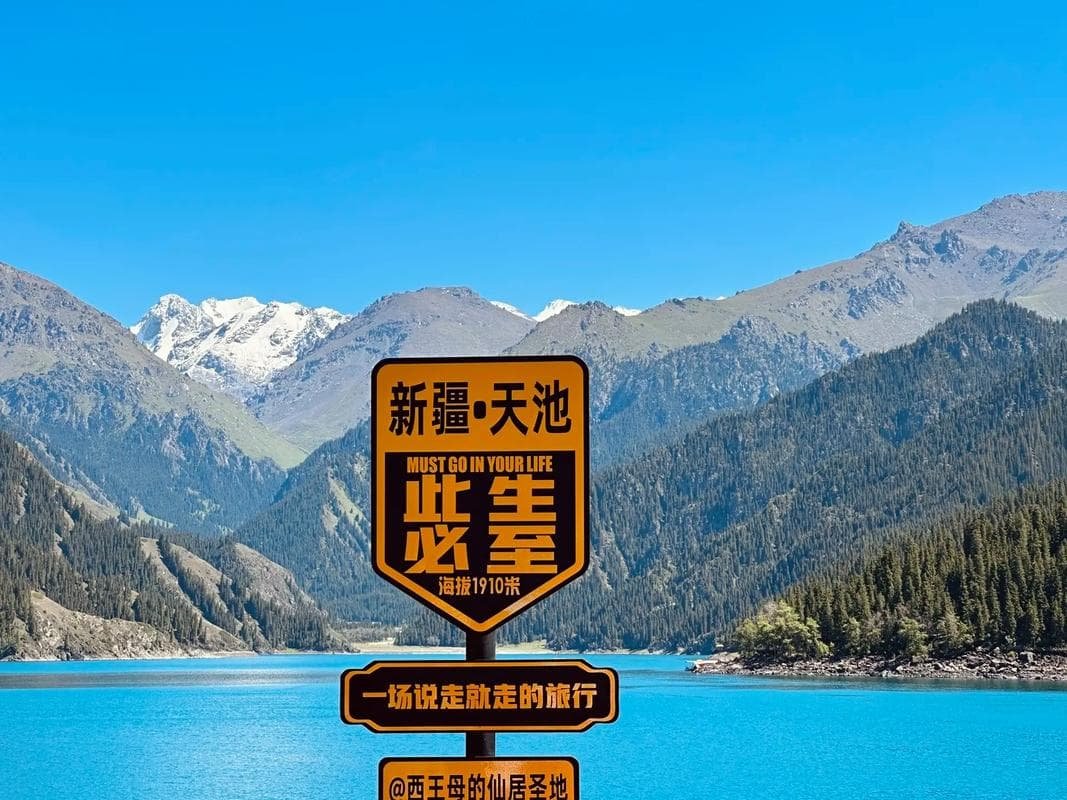
Ninety minutes east of Urumqi, Tianchi sits at 1,910 metres beneath Bogda Peak, which rises to 5,445 metres. The lake is part of the Xinjiang Tianshan World Heritage property inscribed in 2013.
Bogda means “sacred” or “holy” in Mongolian, and the mountain has been an object of veneration for centuries. On the lake’s northern shore stands Fushou Temple, a Taoist complex rebuilt in recent decades on a much older foundation — incense burners, a hall with a lake view, and a steady stream of visitors who are clearly there to pray rather than to sightsee.
This is the layering I mentioned. A Taoist temple, a Mongolian sacred peak, a Kazakh herding culture in the valleys below, all inside one scenic area gate.
Entry plus the compulsory shuttle ran ¥215 in 2023. Go on a weekday. Weekend crowds from Urumqi are severe.
Muztagh Ata: A Mountain as a Shrine
Seven thousand five hundred and nine metres, on the Pamir plateau, four hours south of Kashgar on the Karakoram Highway. Kyrgyz and Tajik communities in the surrounding valleys treat Muztagh Ata as sacred, and the name translates as something close to “father of ice mountains”.
There is no temple. There is no gate, no ticket for the mountain itself, no building. That absence is the point and it took me two visits to appreciate it. The mountain is approached rather than visited.
The standard viewpoint is from Karakul Lake at 3,600 metres, where on a still morning the reflection gives you the whole thing twice. I have been four times and had the reflection once, at 07:40 in September, for about eleven minutes before the wind picked up.
Altitude is real here. Karakul is high enough that a bad night is common, and Tashkurgan beyond it sits at 3,100 metres. Foreign passport holders need a border permit for this corridor. Our Muztagh Ata guide covers the permits, the road and the acclimatisation.
The Northern Mosques Nobody Mentions
Xinjiang’s Hui communities built in a completely different idiom — Chinese timber-frame architecture with upturned eaves, courtyards, and minarets that look like pagodas.
The Shaanxi Grand Mosque in Urumqi is the clearest example: from the street it reads as a Chinese temple until you notice the absence of figural decoration. Yining has several, and the Baytulla Mosque in the old quarter mixes Central Asian and Chinese elements in a way that maps the trade history of the Ili Valley better than any museum caption.
These are working neighbourhood mosques, not attractions. No tickets, no signage in English, and you should be a great deal more careful about wandering in. Stand outside, look at the roofline, and if someone invites you in, go.
Practical Route Planning
Buddhist circuit, three days. Fly to Kuqa. Day one, Kizil caves. Day two, Subash ruins in the morning and the Kizil-Gaha beacon tower in the afternoon. Day three, drive or train to Turpan for Bezeklik and the Turpan museum. Add Mor Pagoda if you continue to Kashgar.
Islamic architecture circuit, three days. Kashgar base. Day one, Id Kah plus the old town. Day two, Abakh Hoja and the Sunday bazaar if the timing works. Day three, drive to Yarkand for the Amannisa Khan complex and the old mosque there.
Sacred mountains, five days. Urumqi for Tianchi and Bogda. Fly to Kashgar. Karakoram Highway to Karakul and Tashkurgan with two nights for altitude.
Costs and Timing
Tickets across the sites listed here total roughly ¥500 to ¥600 for one person, with Tianchi and Kizil taking the largest bites. The supplementary special-cave fees at Kizil can dwarf everything else combined and are worth it exactly once, if you care about the painting.
May, June, September and early October are the sensible windows. July and August put Turpan above 40°C, which turns Bezeklik into an endurance exercise. Winter closes several of the mountain sites and reduces daylight at the desert ones to a narrow band.
I went back to Id Kah at 16:30 the following day. The old man was not there and the light was, as advertised, better — coming across the courtyard low and gold through the poplars, with maybe fifteen people in a space built for thousands. That is the version of the building I remember, and I would not have found it by reading the sign.