

Tajik People of Tashkurgan: Customs, Music & Eagle Hunting
The first time a Tajik man greeted me properly in Tashkurgan I got it wrong. He took my right hand in both of his and bent to kiss the back of it, and I pulled away, because in the half second available I did not know what was happening. He laughed. Then he did it again slowly so I could copy it.
That greeting is one of the most distinctive things in the region. Older man to younger, the younger kisses the elder’s palm. Between equals, both bend and kiss the back of the other’s hand simultaneously. Women embrace and kiss cheeks, and a younger woman may kiss an older woman’s palm. It takes about four seconds and it happens every time two people meet, even if they met yesterday.
Tashkurgan sits at roughly 3,100 m in the far southwest corner of Xinjiang, 295 km from Kashgar along the Karakoram Highway. The county is about 25,000 square kilometres of high Pamir, bordering Tajikistan, Afghanistan and Pakistan. Around 40,000 people live in it, the majority Tajik.

Who the Tashkurgan Tajiks Actually Are
This needs stating clearly because the name creates confusion. The Tajiks of Xinjiang are not the same people as the majority population of the Republic of Tajikistan, and they do not speak the same language.
Most speak Sarikoli, with a minority speaking Wakhi. Both are Eastern Iranian languages from the Pamir group, related to Persian at a considerable distance, roughly as English is related to German. Tajik in Tajikistan is a Western Iranian language, essentially a form of Persian. A Sarikoli speaker from Tashkurgan and a Dushanbe Tajik cannot hold a conversation in their own languages.
Sarikoli has no widely used written form. Education is in Chinese and Uyghur, so most people under 40 in Tashkurgan handle three languages, and the shopkeepers handle four.
Physically the population is noticeably distinct from their Uyghur and Kyrgyz neighbours, with lighter colouring being common. This gets over-discussed by visitors. I would leave it alone in conversation.
Religiously the community is largely Ismaili, a branch of Shia Islam, which is unusual in China and produces some visible differences from Sunni Uyghur practice. There are fewer mosques than you would expect in a town this size, and gatherings are more often held in community houses.
Tashkurgan Tajik Autonomous County was established in 1954 and remains the only Tajik autonomous county in China.
The Eagle Question
People arrive expecting eagle hunting. It is worth being straight about this.
Golden eagle falconry, where a hunter rides out with a trained bird to take fox and hare, is a Kazakh and Kyrgyz tradition, practised in the Altay and in parts of Kyrgyzstan. It is not a Tajik practice, and you will not find eagle hunters in Tashkurgan.
What the Tajiks have instead is arguably more interesting. The eagle sits at the centre of their cultural life through music and dance rather than hunting.
The eagle-bone flute. Called nay locally and 鹰笛 in Chinese. Made from the wing bone of a golden eagle, roughly 20 to 25 cm long, three finger holes, played in pairs. The sound is thin, high and slightly unstable, and it carries a long way in thin air, which is presumably the point. Craftsmen who make them are few. A genuine one is not cheap and the sale of eagle parts is regulated, so treat any cheap souvenir version as bone-coloured plastic, because it is.
The eagle dance. Performed mostly by men, arms held wide and slightly back, shoulders working, head turning sharply. The whole posture is a bird riding a thermal. Women accompany on the daf, a large frame drum, usually three or four drummers together setting a rhythm that speeds up through the dance.
I have seen this twice at unstaged events, a wedding in 2019 and a village gathering in 2023, and once at a paid performance for a tour group. The difference is enormous. The staged version is competent. The wedding version had forty people clapping on the offbeat and an eighty-year-old who could still do it better than anyone.
Weddings, Festivals and When to Show Up
Tajik weddings run three days and are the main venue for everything above. They cluster in the warmer months and around post-harvest periods. If you are invited, go. The invitation is genuine, and turning up with a gift of fruit, tea or sweets from Kashgar is the right move.
Bride’s veil is red. Horse racing and, at some weddings, buzkashi style riding games happen on the second day. Guests are fed continuously.
Nowruz, called Chiragh-i Bardan locally and 肖贡巴哈尔节 in Chinese, falls around 21 to 22 March. Houses are cleaned, walls are marked with flour patterns, and there is a great deal of visiting. Cold time to be at 3,100 m, and the most interesting time culturally.
Piliq, the lamp festival, involves lighting bundled reed lamps in the home and at graves. Timing varies by community.
Water diversion and sowing festivals come in spring when the irrigation channels are opened after winter, a genuinely practical event that turned ceremonial.
Most visitors come in July and August, when the passes are clear and the Golden Grassland outside town is actually green. That is the easiest time and the least eventful.
Stone City and the Golden Grassland
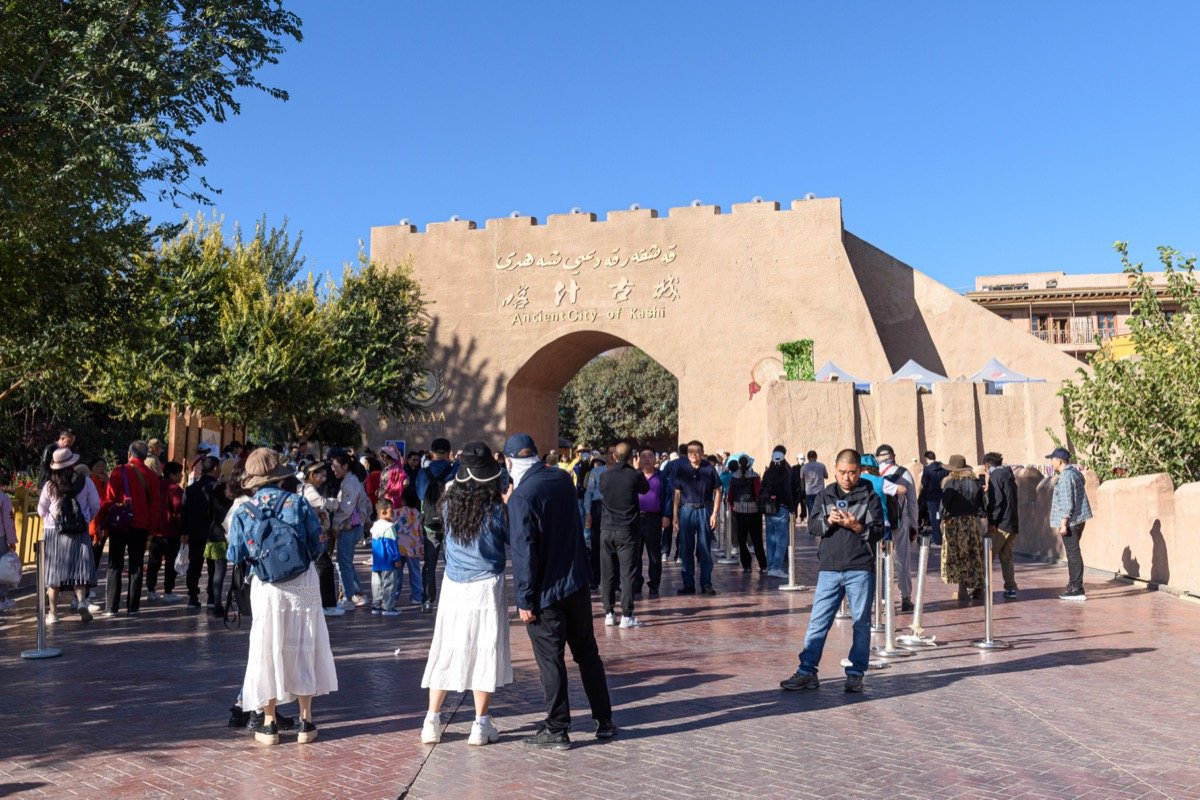
The ruins on the hill at the northern edge of town are the reason Tashkurgan has a name at all. Tash kurgan means stone fort in Turkic. The site has been fortified since at least the Han dynasty, was the capital of the Puli kingdom, and was rebuilt repeatedly through the Tang and later.
Xuanzang passed through here in the 7th century on his way back from India and wrote about it. Ptolemy’s geography references a stone tower on the trade route to the Seres, which some scholars place here, though that identification is argued about.
What survives is broken wall on a bluff, maybe 100 m across, with a boardwalk through the wetland below. Entry is around ¥30. The wetland, the Golden Grassland, is the photograph everybody takes, especially in late afternoon when the light comes across the Pamir and the yaks are out. Our Tashkurgan Stone City guide covers the site in detail.
Give it 90 minutes. Go at 19:00 Beijing time in summer, which is about 17:00 by the sun, for the best light and almost nobody else there.
Getting There, and the Permit
Tashkurgan requires a border permit for foreign passport holders, because the county borders three countries. This is not optional and it is checked.
The permit is arranged in Kashgar, either through a travel agency (¥150 to ¥400 depending on who you use) or at the public security border office, which for foreigners is generally easier through an agency. Allow one working day. Bring passport, visa page copies, and your Kashgar accommodation registration.
Checkpoints on the G314 at Ghez and again nearer Tashkurgan will inspect passport, permit and sometimes vehicle documents. Budget 20 to 45 minutes at each.
Kashgar to Tashkurgan options:
- Public bus from Kashgar international bus station, roughly ¥60 to ¥80, 6 to 7 hours with checkpoints, one or two departures daily.
- Shared car, ¥120 to ¥200 per seat, 5 to 6 hours, leaves when full.
- Private car with driver, ¥800 to ¥1,400 per day, which is what I do because it lets you stop at Karakul Lake and at the Ghez canyon.
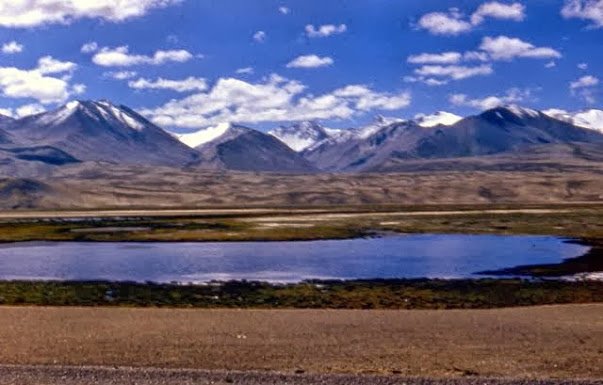
The road climbs from 1,290 m at Kashgar to 3,100 m at Tashkurgan, passing Karakul Lake at 3,600 m under Muztagh Ata, which is 7,509 m. That is a 1,800 m gain in one day, and it is enough to give some people a headache by evening.
Beyond Tashkurgan the highway continues 125 km to the Khunjerab Pass at 4,733 m, the highest paved border crossing in the world.
Altitude, Honestly
Tashkurgan is high enough that a meaningful minority of visitors feel it. Headache, poor sleep, breathlessness on stairs. I have had a mild headache on three of my five visits, always the first night, always gone by morning of day two.
What works: arrive and do nothing strenuous for the first afternoon, drink 3 litres of water, skip alcohol entirely, eat carbohydrate. What does not work: pushing through a hike on arrival day, which I tried once at the Golden Grassland boardwalk and regretted for four hours.
The county hospital has oxygen. Hotels often have canned oxygen for ¥30 to ¥50 a can, which is largely psychological but harmless. Our altitude sickness guide goes into the medication question properly.
Staying and Eating
Tashkurgan town has perhaps a dozen hotels ranging from ¥120 basic to ¥500 for the newer places with heating that works. Winter heating matters here more than anything else on the list. Check it specifically.
Tajik family homestays exist, generally ¥100 to ¥250 including meals, arranged through guesthouses or drivers. Registration rules for foreign guests apply, so some village families will decline, and that is administrative rather than personal. If you want the yurt-and-pasture version of this kind of stay, that is a Kazakh tradition further north and covered in our guide to Kazakh nomadic life and yurt stays.
Food is high-altitude food. Yak meat, mutton, thick wheat noodles, buttered milk tea, dried curd. A dish called shirchai, milk tea with bread and butter worked into it, is the standard breakfast and is heavier than it sounds. Meals run ¥25 to ¥50. Vegetables are trucked in and limited.
Yak yoghurt at the market is ¥8 and better than anything you will get in Kashgar.
Photography and Basic Courtesy
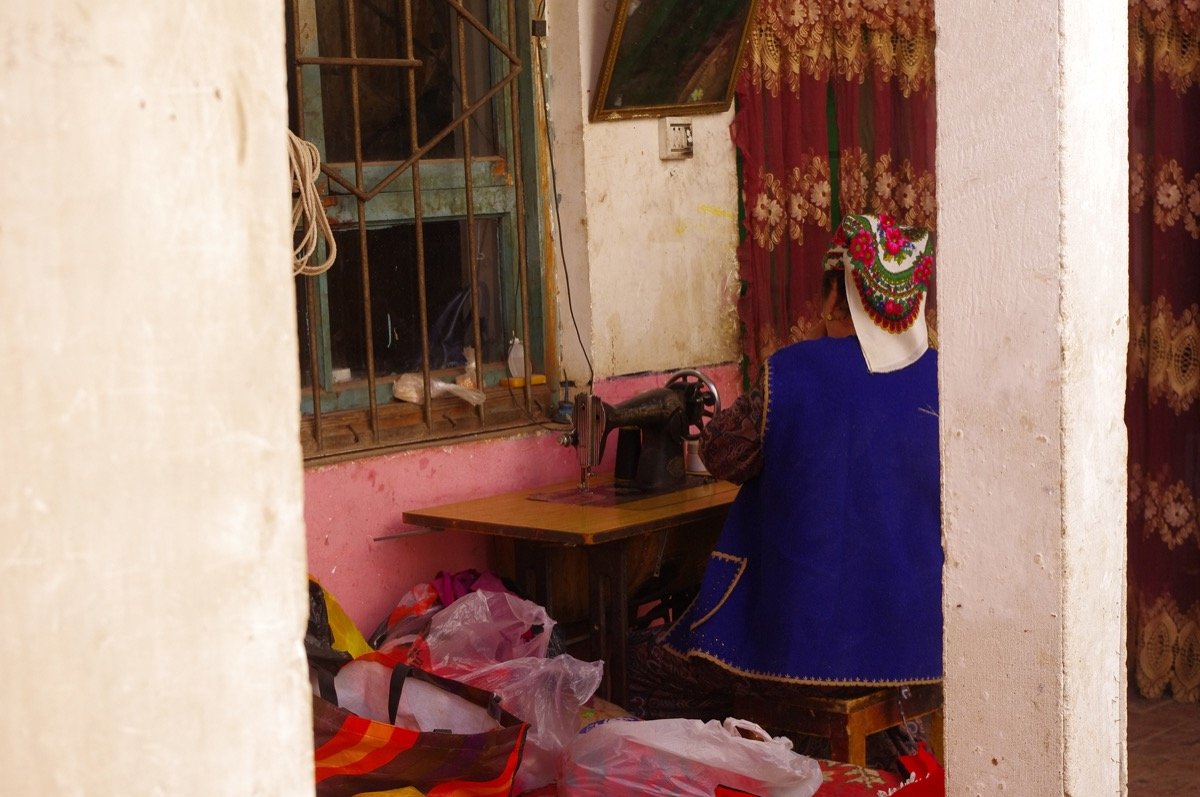
Tajik dress is visually striking, particularly the women’s embroidered kulta hat with its trailing white headscarf, and this attracts a lot of cameras. Ask first. Every time.
My experience: asking gets a yes maybe half the time from women, more often from men, and almost always from children whose parents are present and agree. Not asking gets you a turned back and a story that spreads through a small town quickly.
Do not photograph inside homes without explicit permission. Do not photograph checkpoints, border installations or military vehicles anywhere on this road. That last one is not a cultural point, it is a legal one, and people have had phones inspected over it.
Offer to send the photo. Get a WeChat. This turns an extraction into an exchange and takes ninety seconds.
Where Tashkurgan Fits in a Route
Two sensible shapes.
Three-day out and back from Kashgar. Day one Kashgar to Karakul Lake, overnight in a yurt or guesthouse at 3,600 m. Day two Karakul to Tashkurgan, afternoon at Stone City. Day three back to Kashgar. Costs roughly ¥2,500 to ¥3,500 for two people with a private driver, permits and accommodation.
Overland exit to Pakistan. Tashkurgan is the last Chinese town before Khunjerab. Immigration formalities are done in Tashkurgan, not at the pass. The border operates seasonally, generally 1 April to 30 November, weather permitting.
If you have more time in the region and want a geological counterpoint, the granite canyons of Koktokay in the far north are the other end of Xinjiang’s mountain spectrum, roughly 2,000 km away and a completely different world.
What I Would Tell a First-Time Visitor
Stay two nights, not one. The first afternoon is lost to altitude and the second morning is when the town starts making sense.
Learn the greeting. Watch someone do it, copy it, accept that you will fumble the first attempt. It changes how you are received more than any amount of Chinese does.
Skip the staged eagle dance performance if a real gathering is happening anywhere within reach. Ask your guesthouse. In a county of 40,000 people, somebody always knows about a wedding.
And bring a warm jacket in August. I have been cold at 21:00 in Tashkurgan in every month I have visited, including July, when the daytime high was 24°C and the overnight low was 6°C.