
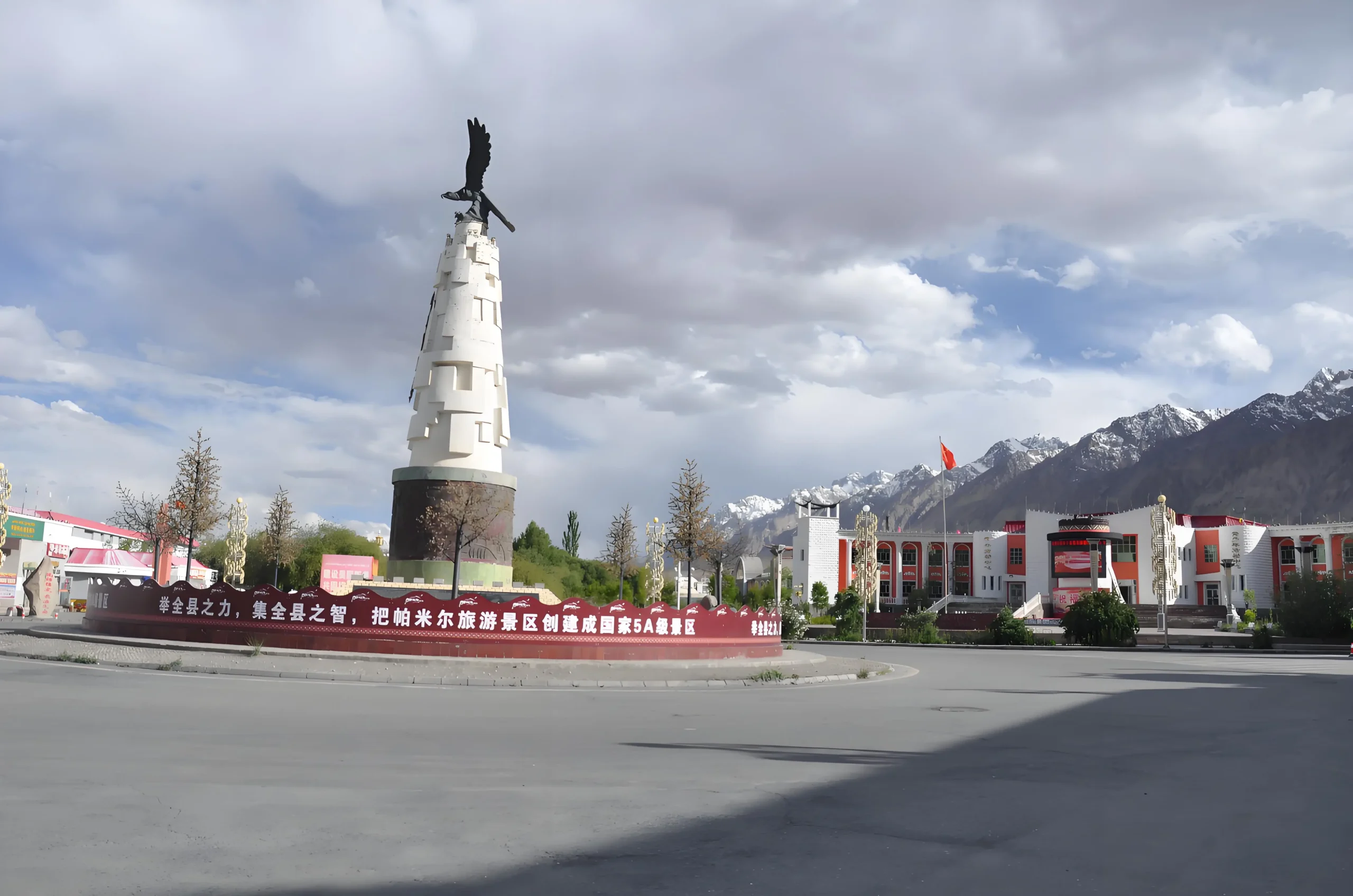
Tashkurgan: Stone City, Golden Grass Beach & Pamir Tajik Heritage
At 3,090 meters on the wind-scoured edge of the Pamir Plateau, Tashkurgan (Taxkorgan / 塔什库尔干) is where the ancient Silk Road literally runs out of road. The name means “Stone Tower” or “Stone Fortress” in Persian and Uyghur — and the town delivers exactly that: a 2,000-year-old stone fortress ruin, golden wetlands framed by snow peaks, and the warmest Tajik (Pamiri) hospitality you’ll find in China.
 Golden Grass Beach Tashkurgan Xinjiang Pamir”/>
Most travelers treat Tashkurgan as a sleep-stop between Karakul Lake and Kashgar. That’s a mistake. The town itself rewards slowness — morning light on the stone fort, the sound of Tajik flutes drifting from a courtyard, the eerie gold of the grasslands at dusk. If you’re planning a Xinjiang road trip, this is the place to pause for two nights, not one.
Why Tashkurgan Belongs on Your Itinerary
For our complete Xinjiang solo travel Guide, see our dedicated Xinjiang Solo Travel Guide with practical details on safety, costs, and planning.
Tashkurgan is the last settled outpost before the Pakistan border — a living crossroads where Iranian-speaking Tajik herders, Kyrgyz nomads, and Han Chinese traders overlap. It’s one of the few places in Xinjiang where you can:
- Walk a 2,000-year-old fortress ruin with a 360° panorama of the Pamir spine
- Stroll wooden boardwalks through golden wetlands where whooper swans nest (seasonal)
- Drink yak milk tea in a Tajik mud-brick courtyard
- Stand at the westernmost edge of China’s highway network
The cultural layer is what sets Tashkurgan apart. The local population is predominantly Tajik (Pamiri) — an Iranic-speaking, Ismaili Muslim mountain people distantly related to Tajiks of Tajikistan, not the Turkic Uyghur majority elsewhere in Xinjiang. You’ll notice it immediately: the architecture, the facial features, the music, the food.
Stone City (石头城) — The Fortress Above Town
What remains of the Stone City is a Sui-Tang era fortification on a massive earthen platform, with stone perimeter walls and watchtower foundations that once guarded the most strategic river crossing on the southern Silk Road. The view from the top is the real draw: a 360° panorama of river valley, mud-brick Tajik houses, and the snow line of the Kongur and Muztagh Ata massifs.
Tickets: The Stone City + Golden Grass Beach combo ticket is approximately ¥90 per person (2025–2026 rates). The ticket covers both the fortress ramparts and the adjacent wetland meadow.
Best time to visit: Sunrise (06:30–08:00 in summer) or golden hour (90 minutes before sunset). Midday glare washes out the earth tones. The fortress faces east-west, so morning lights the approach; evening lights the inside textures.
Walking time: 45–90 minutes for the fortress alone. Add another 60–90 minutes if you continue into the wetland boardwalk (see below).
Golden Grass Beach (金草滩) — The Wetland at Dusk
A fertile strip of wetlands fed by snowmelt, crisscrossed with wooden boardwalks — that’s Golden Grass Beach. In late spring and summer it glows iridescent green-gold; in September it turns copper. The boardwalk loops about 2–3 km through reed beds and shallow pools where whooper swans and other waterfowl are present from May to September.
Tajik families sometimes offer informal yak-milk tea tastings along the edge paths. If invited, accept gracefully and offer a small tip (¥20–50). It’s one of the most genuine cultural exchanges you can have in Xinjiang — no staged performance, just a warm drink and a few words of Tajik or Uyghur across the language gap.
Photography tip: The wetland faces west. Late afternoon is when the grass glows and the water reflects the snow peaks. Bring a polarizer.
Getting to Tashkurgan — The Karakoram Highway Experience
Tashkurgan sits ~290 km (~5.5–6 hours) southwest of Kashgar along the Karakoram Highway (G314). The drive is half the point — you’ll pass Baisha (White Sand) Lake, crest the Subash Pass at ~4,000 m, and skirt the northern shore of Karakul Lake en route.
Private 4×4 charter from Kashgar: ¥1,200–1,800 per vehicle per day including driver. This is the recommended option — the driver handles checkpoint paperwork (see “Permits” below), gives you flexibility for photo stops, and knows which viewpoints are worth the detour.
Public bus: Kashgar long-distance station runs a daily bus to Tashkurgan town (~¥60–80), but it won’t wait for photos and drops you at the county seat, not the scenic areas. Not ideal for a proper visit.
Self-drive: Foreign-plated cars need proper paperwork and an approved itinerary. Check current rules with your agency before setting out.
Permits — Don’t Skip This Step
Tashkurgan is in a border zone. You need a PSB border permit (边防证) that explicitly notes “Taxkorgan” or “Tashkurgan County.” Most travelers arrange this in Kashgar through their hotel or a travel agency (usually free or a nominal service fee of ¥20–50). Bring your passport — the permit is checked at least twice between Kashgar and Tashkurgan.
Important: Without the border permit, you will be turned back at the checkpoint ~60 km before Tashkurgan. Arrange it in Kashgar the day before you travel.
Where to Stay — And Why Tashkurgan Is Worth Overnight
Tashkurgan has no luxury resorts — accommodation is functional but adequate:
- Budget–Mid (¥150–400/night): Qogir-style hotels and guesthouses in town. Expect solar-heated water (works when sunny), intermittent Wi-Fi, and simple Chinese/Xinjiang breakfasts. The accommodation guide has more context on what to expect from mid-range Xinjiang hotels.
- Yurt stay (seasonal): A few Kyrgyz and Tajik yurt camps operate May–September near the wetland area (¥80–200/person for a mattress on the floor + meals). Atmospheric but rustic; bring your own sleeping bag liner.
Why stay two nights? Because the light changes everything. Day 1: arrive, check in, visit Stone City at golden hour. Day 2: Golden Grass Beach morning light, then continue toward Kashgar or loop back via a different route. The best time to visit Tashkurgan specifically is June through September, when the grass is green and the passes are fully open.
Tajik Culture — What to Expect and How to Engage
Tashkurgan’s Tajik community is proudly distinct. A few things to know:
- Dress modestly: Shoulders covered, no short shorts. This is a deeply traditional community. Women aren’t required to cover their hair, but a headscarf is appreciated at religious sites.
- Photography etiquette: Always ask before photographing people. A smile and a raised-eyebrow gesture works across the language gap. If someone waves you off, smile and move on.
- The Friday market (if your timing aligns): Not as famous as Kashgar’s Sunday livestock market, but the local market day in Tashkurgan offers dried fruit, wool rugs, and a slice of Pamiri life without the tour buses.
- Eagle hunting heritage: Ask your guesthouse about any scheduled demonstrations. It’s not a daily show — typically tied to local festivals or pre-arranged for tour groups.
Food in Tashkurgan — High-Altitude Comfort
The food scene is simple but hearty. Must-tries:
- Yak meat hotpot (牦牛肉火锅): Warming, rich, and altitude-appropriate after a day in the wind
- Hand-pulled rice (抓饭) with yak meat: The Pamiri version uses yak instead of lamb — slightly gamey, very satisfying
- Yak milk tea: Salty, filling, and sold everywhere in town for ¥5–10 per bowl
- Naan from the tong (馕): Baked fresh in clay ovens; buy one for ¥3–5 and eat it warm
There are no international restaurants or craft coffee shops. Come for the authenticity, not the menu variety.
Altitude & Health — Tashkurgan Is Higher Than You Think
Tashkurgan sits at 3,090 m (10,140 ft). It’s lower than Karakul Lake (3,600 m) but high enough that altitude sickness is possible, especially if you ascend directly from Kashgar (1,280 m) in one day.
- Acclimatize: Spend a night in Kashgar first. Or break the journey at Karakul Lake (tented yurt stay) before continuing to Tashkurgan.
- Symptoms: Headache, nausea, dizziness. If vomiting or confusion sets in, descend immediately to Kashgar.
- Essentials: SPF 50+ (the UV at this elevation is punishing), lip balm, a warm layer (it drops below 10°C at night even in July), and 2L+ water per person per day.
- No alcohol at altitude. It accelerates dehydration and worsens altitude symptoms.
When to Go — A Month-by-Month Breakdown
May (mid-month onward): The grass is just turning green. Cold nights (below freezing), but the light is crystalline and the crowds are nonexistent. If you have a proper sleeping bag, this is a magical time.
June–August: Peak green, warmest weather (daytime 12–22°C), swans present at the wetland. This is also peak domestic travel season — expect some tour groups at Stone City, though nothing like Kashgar or Turpan.
September: Many would argue this is the best month. The grass turns gold, the mosquitoes disappear, the swans are still present (early September), and the light has a warm, honeyed quality. Nights are cold — bring a proper jacket.
October–April: Too cold for most visitors; some guesthouses close. The road from Kashgar stays open year-round, but heavy snow can close the stretch toward the Pakistan border.
How to Combine Tashkurgan Into Your Itinerary
Tashkurgan sits at the southwestern end of the Karakoram Highway. A classic Pamir loop looks like:
Day 1: Kashgar → Baisha Lake → Karakul Lake (overnight in yurt or lakeside guesthouse)
Day 2: Karakul → Subash Pass → Tashkurgan (Stone City sunset)
Day 3: Tashkurgan Golden Grass Beach morning → return to Kashgar (evening)
If you’re short on time, you can do Kashgar → Tashkurgan → Kashgar as a very long day trip (depart 06:00, return 22:00), but you’ll be exhausted and you’ll miss the golden hour at the fortress. Not recommended.
For a broader Xinjiang itinerary, Tashkurgan works best as the southwestern anchor of a counterclockwise loop that continues north via the Duku Highway or east via the Taklamakan Desert Highway.
What You Won’t Find in the Guidebooks
Tashkurgan’s magic isn’t in the ticking of a sightseeing list. It’s in the small moments: the way the light hits the stone fort at 07:30, the sound of a Tajik flute from a courtyard you can’t see, the fact that you’re standing at the crossroads of four ancient civilizations (Chinese, Tibetan, Central Asian, and South Asian) and it feels completely ordinary to the people who live there.
Come for the Stone City. Stay for the stillness. And bring a warm jacket — the Pamir wind doesn’t care what the calendar says.