
Xinjiang Silver: The Filigree, Buckles and Bangles of the Silk Road’s Silversmiths
Xinjiang Silver: The Filigree, Buckles and Bangles of the Silk Road’s Silversmiths
I picked up my first piece of Xinjiang silver by accident. On a cold March afternoon in Kashgar’s old town I ducked into a narrow alley to escape the wind, and a grandfather bent over a small charcoal stove looked up and held out a bangle so fine it looked spun from sugar. That was six years and a dozen trips ago. Since then I have chased silver across the bazaars of Hetian, the winter markets of Yining, and the high summer pastures above the Ili valley, and I have learned that the metal tells the story of the whole region better than any museum plaque.
The piece in the old man’s hand was Uyghur filigree, and it is the style most travellers meet first. Filigree means the silver is drawn into hair thin wire, twisted into loops and scrolls, then soldered point by point until the surface looks like frozen lace. The work is slow. A single bangle can take a craftsman three full days, and the cheapest honest example I have bought ran me ¥280 at 2024 prices; machine pressed copies sell for ¥40 and fall apart within a season.
Uyghur filigree and the oasis hand
Oasis silversmiths work in a tradition that came west along the trade routes and settled into something distinctly local. The bangles are heavy for their size because the wire is solid, not hollow, and the joints are real solder rather than glue. When you hold one to the light the scrollwork throws shadow like embroidery, which is no accident: the same families that shape silver often also weave the bright Uyghur embroidery and atlas silk you see hanging in every Kashgar doorway.
I learned to tell the good from the bad in a cramped workshop off the Id Kah square. The master there, who has been at his bench since he was fourteen, tapped a bangle with a brass tool. Real filigree rings clean and bright; the fused copies give a dull clunk. He laughed when I asked about stamps and hallmarks. There are none here, he said. You judge silver with your eyes and your ears, not a stamp.
The motif vocabulary is small but meaningful. You will see the pomegranate, the grape vine, the eight petal flower, and the endless knot. The pomegranate is fertility and a full table; the grape vine is the oasis itself, the wet green thread that holds life together in a desert. None of it is random decoration. A bride’s set is built around these symbols on purpose, and the old smiths still refuse to sell a wedding bangle to a man who cannot name the flowers on it.
The Kazak belt buckle
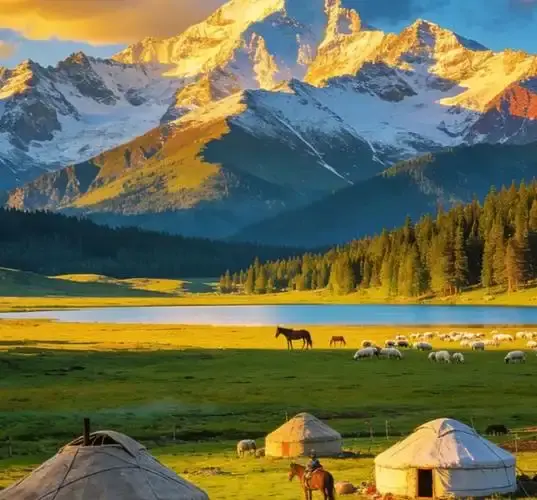
Drive north out of the Taklamakan and climb into the Tianshan, and the silver changes character. Up on the summer pastures above Yining and along the road to Sayram Lake, the nomads wear silver that is built to be seen from across a field. The Kazak belt buckle is the loudest piece of all.
Mine came from a herder’s yurt at about 2,100 metres, where the only light was a solar bulb and the only heat was a stove burning dried sheep dung. The buckle is a heavy round plaque, maybe nine centimetres across, stamped and repousseed with a running deer and a sunburst. It weighs close to 200 grams and cost me ¥650 after an hour of tea and refusing the first price. The herder’s wife told me the deer is the mark of a family that moves with the seasons, and that a man without a buckle is a man whose horse nobody trusts.
Kazak silver is thicker and less delicate than the Uyghur work, and that is the point. It has to survive being worn on horseback through thorn and sleet for a hundred kilometres between pastures. The buckles are usually set with coral or turquoise coloured glass, and the best ones carry a maker’s hand stamp on the back even though, again, there is no official standard. If you want to understand the wider world of steppe making, the same camps produce the felt and leather crafts that outfit a yurt and a saddle, and the silver is only one bright part of it.
I have worn that buckle on every trip since. The silver has darkened to a soft grey, which the smiths call honest age, and the deer is still sharp. A backpacker in a Dushanzi hostel once asked if it was Tibetan. It is not. The steppe has its own grammar, and the running deer is one of its sentences.
Where the silver is actually made
Here is the part guidebooks blur. Most of the silver you buy in Xinjiang is not poured and drawn in the shop where you find it. The real workshops sit in a handful of places, and knowing them saves you money and gets you closer to the makers.
Kashgar and the surrounding villages of the old southern route are the heart of Uyghur filigree. Hetian, about 500 km east of Kashgar on the edge of the desert, is famous for the same family trade plus the jade market that pulls in buyers from everywhere. In the north, Yining and the smaller towns of the Ili valley supply most of the Kazak and Kyrgyz work, and you can sometimes watch a buckle being stamped in a back room behind a winter market stall.
The metal itself is usually a high silver alloy, often called 925 by the sellers though the testing is informal. Some pieces are lower, closer to 800, and the price should reflect that. I once stood in a Korla jewellery lane where three shops within thirty metres sold the identical bangle at ¥260, ¥310, and ¥420. The middle one was the honest one; the cheapest was a plated alloy and the dearest was the same alloy with a confident smile.
I timed one trip for October on purpose. The Ili pastures empty after the first snow, and the smiths who followed the herds down to Yining fill the winter market with fresh buckles by late October. Kashgar, by contrast, works all year, and the finest filigree turns up once the summer tourist rush thins in September, when the masters finally have time for custom orders again. Aksu and Kuqa stay quiet and cheap in every season, which is exactly why I like them.
If you want to see silver beside its cousin trades, the copper and brassware of the southern oasis towns is worked by many of the same families, often in the same courtyard, and the hammer rhythm is identical. A day spent in one of those courtyards taught me more about metal than a year of museum visits. The pottery and ceramics studios of Turpan, meanwhile, share the oasis love of the grape and the pomegranate, so the motifs rhyme across materials even when the craft does not.
Reading the motifs
By my third trip I had started a small notebook of symbols, because the motifs repeat so steadily that learning them turns shopping into reading. The eight petal flower shows up on almost every Uyghur piece and reads as balance and good fortune. The running deer belongs to the nomads and to movement. The sunburst and the crescent together are older than either faith that now claims them, a mark of sky and the turning month.
The grape cluster is the single most common image in southern silver. It is never just a grape. In a land where a vine means water means life, the cluster is a quiet prayer for rain. The endless knot, borrowed long ago from the eastward Buddhist routes and kept because it is pretty, now stands for a bond that does not break, which is why it appears on pieces given at weddings and on the silver a mother pins to a child’s collar.
I am not a scholar of any of this. I am a traveller who kept asking questions, and the smiths were glad to answer. The motif language is not a secret. It is simply something the sellers rarely explain because the buyers rarely ask, and a ten minute conversation in any workshop will teach you more than a page of description.
How to buy fair
Buying fair means two things: paying a price the maker can live with, and not mistaking a factory copy for a handmade piece. The first is easier than it sounds once you leave the airport souvenir counters and walk into the working bazaars. The second takes a little nerve.
Start by watching before you buy. In the covered bazaar of Kashgar, and the smaller markets of Kuqa and Korla, the genuine smiths work in the open, tools laid out on a cloth, a small anvil within reach. That bazaar bargaining is its own skill, and the short version is this: offer about sixty percent of the first price on a copy, about eighty percent on a real handmade piece, and never be rude about it. A smith who loves his work will meet you partway; a reseller with a tray of identical looking bangles will drop the price by half the moment you turn to leave.
Fair also means knowing what you are funding. The handmade economy in these towns is small and local. The ¥650 I paid for my buckle went straight to the herder’s family; the ¥40 bangle at a Urumqi mall went to a factory I will never see. Both are real silver in some loose sense, but only one keeps a workshop open. I try, when I can, to buy from the hand and not the shelf, even if it means a longer day and a colder wait.
Weight is your friend. Solid silver feels wrong in the hand at first, heavier than jewellery should be, and a piece that feels light for its size is almost always plated base metal. Ask to see the back; handmade filigree has tiny uneven solder points, while a moulded copy is perfectly smooth. None of this requires expertise. It requires a slow afternoon and a willingness to look uncertain while you learn.
Carrying it home
The practical end is simple. Silver travels well. I have carried bangles in a sock at the bottom of a backpack from Altay to Karamay without a scratch, and a buckle in my carry on through three airports. Most countries let you bring in personal silver without duty if it is clearly used and not a commercial quantity, but the rules differ, so check before you fly and keep a receipt that shows a personal price, not a wholesale one.
Clean it rarely. The smiths I trust say a soft cloth and a little baking soda once a year is plenty, and that the dark patina is the metal remembering where it has been. I polish mine before a wedding and otherwise let it age. Six years on, the Kashgar bangle and the pasture buckle sit on my desk, and together they are the most honest souvenir I own, because each one came with a name, a price I am not ashamed of, and a story I can tell without guessing.
If you take one thing from all this, take the habit of asking. The silver of Xinjiang is not a product on a shelf. It is a conversation that has been running for a thousand years across the same deserts and pastures, and the only way to buy it fair is to join the conversation instead of skipping past it.