
Fermented Foods and Pickles of Xinjiang: Suan Cai, Pickled Garlic and More
On my first long drive through Xinjiang I ate more grilled lamb in ten days than in the previous ten years combined. Every night ended with kebabs, and every lunch seemed to be fried noodles or hand-pulled belt noodles swimming in oil. What saved my stomach, and my appetite by day five, was something I barely noticed at first: a small bowl of sour, salty, cold vegetables set down beside the meat. Those pickles are the quiet backbone of the regional table, and once you start looking you find them everywhere from Urumqi diners to Kazakh yurt kitchens near Altay.
This is a food culture built for balance. The grilling and frying that defines so much of the local menu needs something sharp and acidic beside it, and fermented vegetables fill that role. If you want the deeper context, our longer piece on Silk Road culinary traditions explains where the sour-and-rich pairing comes from across Central Asia. For travelers, the short version is that the pickles are not a garnish. They are part of the meal.
Pickled garlic and sour cabbage on the northern table
The north, especially around Ili and Yining, leans hard into soured vegetables. Walk into almost any noodle shop in Yining in winter and you will get a free side of pickled cabbage so cold it makes your teeth ache, cut into thin ribbons and dressed with a little chili oil. Northern families here keep a crock in the courtyard from October through March. The climate does the work, swinging from a warm kitchen in autumn to a frozen porch by January.
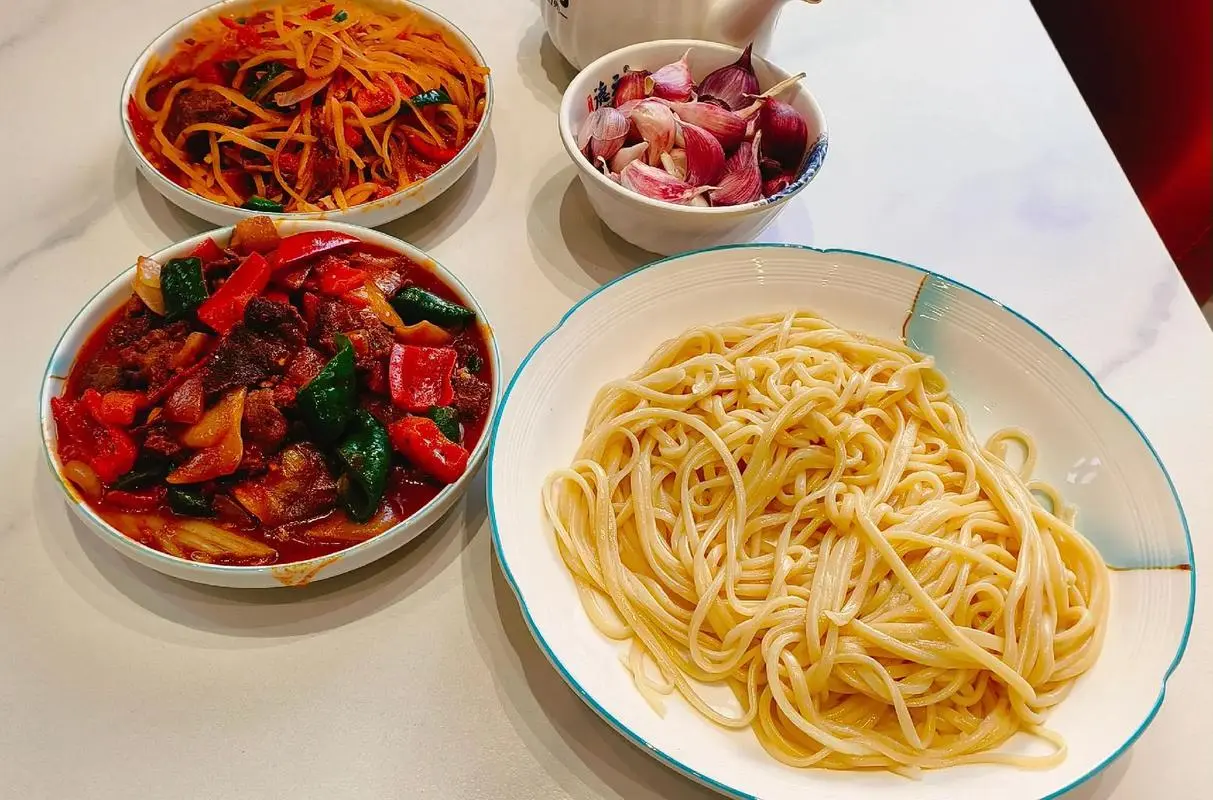
Pickled garlic is the other staple. Whole cloves are cured in a salt brine until they turn a pale jade and lose most of their bite, keeping only a sweet, almost creamy sharpness. I once bought a paper cone of them from a woman outside the Yining morning market for 5 yuan and ate the whole thing walking back to my guesthouse. They go with everything: laghman noodles, boiled dumplings, even plain bread and tea. In small towns north of Ili I started judging a restaurant by the quality of its garlic, and the best batches came from places that clearly fermented their own.
Sour cabbage, often sold simply by weight from barrels at the bazaar, anchors winter cooking. It is nothing like the sweet sauerkraut of Europe. The local version is lighter, saltier, and fermented just long enough to sour without collapsing. You will see it stirred into soups, laid under fish, or piled onto a plate next to polo rice. At a highway stop near Sayram Lake I watched a cook tip a ladle of the stuff straight into a wok of tomato and beef, and the whole roadside diner smelled right after that.
Down south, around Kashgar and Hotan, the pickle habit is quieter but present. There the table is more likely to offer a quick salted cucumber or a vinegary carrot and radish mix rather than long-fermented cabbage. The difference tracks the old divide between the wetter north and the drier south, and it shows up in almost every home I visited. A family in Turpan told me they preferred fresh vegetables most of the year because the heat made fermentation unreliable, then switched to salted preserves in the deep summer when the markets thinned out.
There is also a Russian and Tatar thread in the north that I did not expect. Around Yining and the old settlement areas, some families make a sharper, more vinegary pickle closer to a European sour than the northern Han style. That crossover is one small sign of how many food cultures met on this ground, and it is worth tasting both versions back to back if you have a few days in the city. The contrast taught me more about the region in one lunch than any museum, and the sour versions sat better with the heavy meat than the fresh ones ever did.
How they are made at home
Most families do this the simple way, and the simplicity is the point. Cabbage is shredded, salted lightly, pressed by hand to bruise it, then packed into a clean ceramic or glass crock with a heavy stone on top to keep everything submerged. No vinegar is added. The sourness comes only from wild fermentation, the same logic as any lacto-ferment anywhere in the world. Within a week in a warm kitchen you get a soft tang; left in a cold porch through January it deepens into something bracing.
Garlic gets its own treatment. Whole bulbs are separated, peeled to the clove, and dropped into a brine of salt water, sometimes with a slip of vine leaf to keep them crisp. The crock sits in a cool spot for a month. I watched this in a Kazakh home stay near Altay where the host pulled the cloth off a jar that had been sitting since November. The cloves had gone translucent and mild. She called it the best thing for a heavy mutton stew, and she was right.
One detail that surprised me: a lot of households add a handful of the previous year’s brine to start the new batch, the way sourdough bakers keep a starter. That shared culture means the flavor in one valley can taste slightly different from the next, and locals notice. On my second trip I learned to ask what was in the jar before assuming it would taste like the last one. It often did not, and a family near Hoboksar proudly told me their brine was thirty years old, passed from a grandmother to a daughter without a break.
If you cook for yourself on the road, the technique travels. A glass jar, a head of cabbage, two tablespoons of salt, and patience is all it takes. I fermented a small batch in a rented apartment in Urumqi in late February and had sour cabbage in nine days sitting by the window. It will not match a grandmother’s year-old crock, but it is a good reminder of why the stuff matters here, and it costs almost nothing. The only failure I had was a too-warm kitchen in July that turned the cabbage soft in four days, a lesson in why winter is the real pickle season.
Where to try them
Restaurants rarely list pickles as a dish, so you have to know where they hide. In Urumqi, the older Hui-run noodle houses near the south side of the city set down a complimentary plate of salted vegetables with every bowl of beef noodles. In Yining, ask for “suan cai” with your laghman and they will stir in fermented cabbage cooked briefly with a little tomato. The cooked version is softer and less aggressive than the raw side, a good entry point if raw fermented cabbage is new to you.
Home stays are where you taste the real thing. Out past Bayinbuluke and toward the Kazakh settlements, the yurt families I stayed with served fermented vegetables at every meal without being asked. One host near Nalati put down seven small dishes for three guests, and the sour cabbage was the first to disappear. These are not tourist shows. The food is what the family eats, and the pickle is treated as seriously as the meat. A second host near Kalajun served pickled garlic with a herb cheese and called it breakfast, and I have copied that combination at home ever since.
For a fuller picture of what to order, our breakdown of a Uyghur restaurant menu lists the grilled and fried mains that cry out for a sour side. Pair the two and the meal makes far more sense. And if you are exploring on a budget, the same logic applies to street snacks under 20 yuan, many of which taste flat until you add a bite of pickle from a nearby stall.
Kashgar’s old town is the easiest place in the south to find them. The evening food streets near the mosque put out trays of salted carrots, turnip and cucumber that cost a couple of yuan and reset your palate between skewers. I made a habit of buying one tray per evening and working through it while the charcoal smoke rolled down the lane. The vendors soon recognized me and started adding an extra spoon of the bright red chili-pickled cabbage without being asked, which felt like a small promotion in the neighborhood.
Markets beat restaurants for variety. The bazaar in Yining has a whole row of crocks in winter, each labeled only by the family name of the maker, and you point at the one you want. I tasted six in a single visit and bought a kilo of the one from a woman whose cabbage had a clean sour snap and none of the mushiness the weaker batches showed. That row is where I learned to tell good from bad by eye: pale, crisp ribbons good, grey and soft bad. A kilo there ran me 6 yuan, less than a single skewer of meat across the square.
Balancing the rich grilled food
The reason this matters to a traveler is digestive, not just cultural. A day of kebabs, fried rice and oil-heavy noodles is heavy, and the sour vegetables cut through it in a way that water or tea cannot. My rule on the road became: if the plate has no pickle, I ask for one. Most places are happy to bring a small dish, sometimes for free, sometimes for 3 to 5 yuan.
Polo, the carrot and rice dish cooked with lamb fat, is the clearest example. On its own it is rich to the point of sleepiness. With a spoon of sour cabbage beside it the whole thing wakes up. I saw the same pattern with the big boiled mutton dinners in Hoboksar, where a bowl of salted garlic was passed around the table like a condiment everyone trusted. The older men ate it with everything and laughed when I reached for it a third time. A hot pot of boiled lamb in winter, the kind you order by the half kilo, is nearly uneatable without the sour side, and the locals know it.
There is a deeper logic too. Fermented vegetables carry the lactobacillus that the meat-heavy local diet otherwise lacks, and travelers coming from a fiber-light Western diet feel the difference. I am not a doctor and this is not medical advice, but I can tell you that the two weeks I leaned into the pickle habit were the two weeks my stomach behaved best on the trip. For the broader framing, the Xinjiang cuisine guide covers how sour, grilled and grain elements fit together across a normal day of eating, and the pickle turns up in nearly every balanced plate they describe.
Try this experiment on your next long drive. Buy a jar of pickled garlic at a morning market, keep it in the car, and eat a clove before each heavy meal. It sounds small. It changes the trip, and it costs less than a coffee. I kept a jar in the door pocket from Urumqi to Kuqa and finished it somewhere near the red hills, then bought another in the next town. The habit traveled better than any spice I packed.
Buying jars to take home
You can absolutely bring some home, and you should. The sealed glass jars of pickled garlic sold at bazaars are stable for months and survived the flight back in my checked bag without leaking, though I wrapped mine in two plastic bags just in case. Expect to pay 12 to 20 yuan for a 400 gram jar in most city markets, more in tourist spots near the lakes, where the same jar can run 30 yuan at a scenic-platform shop.
Sour cabbage is harder to travel with because the brine leaks and the fermentation continues, which can burst a weak lid. If you want to try, look for the vacuum-sealed plastic packs from a proper shop rather than the open barrels at a market. The sealed packs from Yining supermarkets kept for a year in my European fridge and tasted close to fresh. I once carried three of them home in a backpack and they were fine, but the open crock I was tempted by would have been a disaster on a plane, and the airline would not have thanked me for the smell either.
A word on customs: jarred, shelf-stable pickles are usually fine to import, but rules differ by country and change often. Check your own agriculture restrictions before you pack a suitcase full of cabbage. I once had a friend lose a beloved jar at Sydney airport, and the officer was not moved by the story. Dried and vacuum-sealed products tend to pass more easily than wet brine, so plan around the format rather than the wish, and keep your receipt in case you need to prove the contents.
For the wider picture of what keeps well, our notes on dried-fruit preservation cover the other foods travelers cart home by the kilo, and the same sealed-jar rules apply. Pickles sit naturally beside dried apricots and raisins in a Xinjiang pantry, one sour and one sweet, both born from the same need to keep food through a hard winter. A shelf with both is the closest thing to the region you can build at home, and it costs less than a single nice dinner out.
If you only take one habit home from Xinjiang, make it this one. A crock of sour cabbage on your counter is a cheap, living souvenir that tastes of the trip every time you lift the cloth. Mine is on the go right now, and the batch from last November is still the best I have made. The grilled lamb is a memory. The pickle is still dinner, and every cold spoonful takes me back to that first Yining morning market and the woman who sold me a cone of garlic for 5 yuan. Start one this winter. By spring you will understand the north without ever leaving your kitchen.