
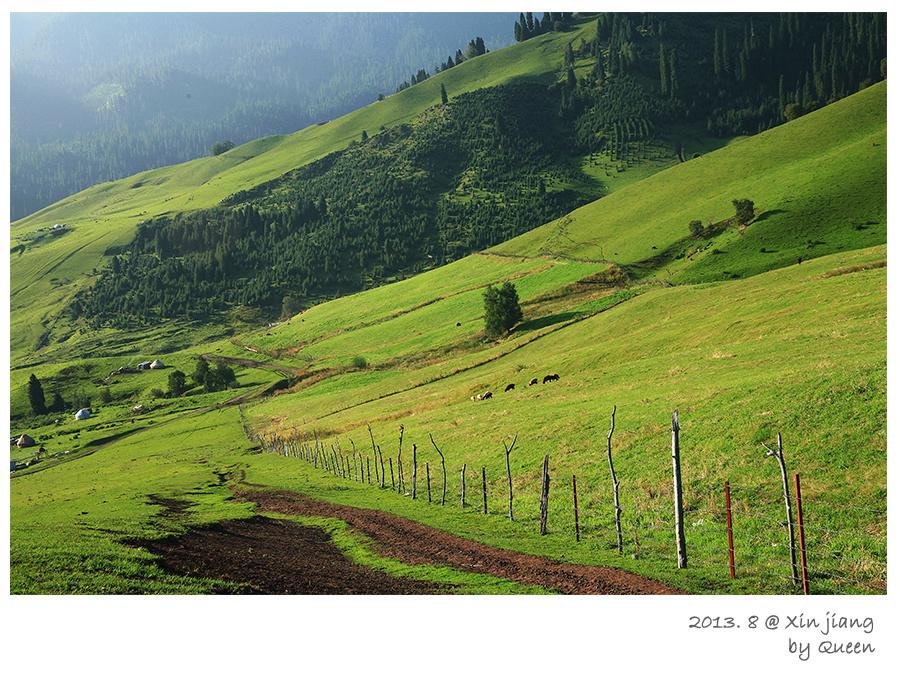
Toli County Self-Drive: Grassland, Wind and Kazakh Summer Camps
The county I drove past three times before I stopped
The first time I covered the road from Karamay to Tacheng city I did not stop in Toli at all. I topped up the tank, bought two bottles of water and a bag of dried apricots from a shop with a dusty fridge, and kept driving, because Toli looked like the kind of county town you pass through on the way to a place with a proper name attached to it. I did the same thing the second time. And the third.
What changed my mind was a flat afternoon in late May when a river of sheep came over a low rise and simply took the road away from me. Two riders on horseback, one teenager on a motorbike, maybe six hundred animals, and behind them a flatbed truck stacked with rolled felt, bent poles and a cast-iron stove. I sat there with the engine off for close to forty minutes. It was the best forty minutes of that trip.
Toli, spelled Tuoli on some road signs and older maps, is a grassland and low-mountain county in the southern half of Tacheng Prefecture. It sits on the southern flank of the Barluk and Jair mountain country, the county seat a little over 1,000 m up, with pasture running away from town in every direction and almost nothing in the way of famous sights. That is exactly the point. If you have been grinding through the big-ticket circuits and want two days where nobody is queueing for a photo, this is the pocket of the north-west I would send you to.
The drive from Karamay: 120 km that deserve better than a fuel stop
From Karamay the run west to Toli is roughly 110 to 130 km depending on which line you take, and the expressway version on the G3014 corridor eats it in about ninety minutes. The older parallel road is slower and much better. You lose maybe forty minutes and gain the ability to pull over whenever the light does something, which on that stretch of country it does constantly. Long low ridges, khaki in August, and the odd tin-roofed sheep shed sitting alone in a bowl of grass.
Fill up in Karamay. I say that with feeling. Fuel here comes with a routine that catches first-timers out: at most stations you register at the gate, passengers may be asked to step out and wait behind a line while only the driver stays with the car, and you show ID before the pump is unlocked. Not hostile, just slow, and a small-county station may be shut for lunch. Filling jerry cans is generally not allowed without paperwork.
Checkpoints on this route were light on my last drive, in July, compared with anything south of the Tianshan. Expect one or two, expect them to want your passport rather than a photocopy, and expect a wait behind a line of trucks if you arrive at shift change. Build slack into the day and it stops being a problem.
What the road surface is actually like
Tarmac, mostly good, with the usual Xinjiang caveat that repair sections appear without warning and the gravel transition can be abrupt. Two things caught me out: livestock, and frost heave damage on the older road, where a stretch that was smooth in September had turned into slow ripples by the following May. Nothing a normal car cannot handle at sensible speed. Everything that will crack a rim at 100.
The wind here is the weather
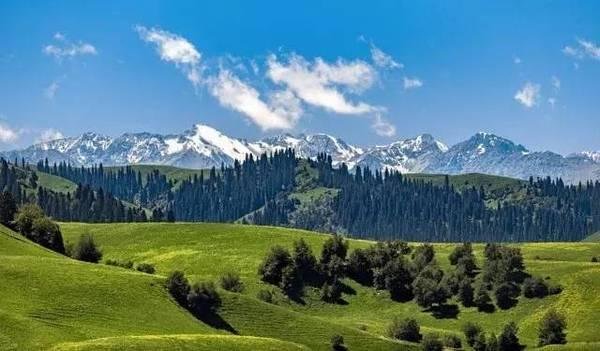
You will see the turbines before you see anything else. Whole ridgelines of them, hundreds, turning at that slow deliberate pace that makes you underestimate how much air is moving. This corner of the north-west is a wind corridor, funnelled between mountain blocks, and the same gaps that make it good for power generation make it interesting for drivers.
If you are in a normal sedan you will feel it as a steady lean and the occasional shove. If you are in a high-sided vehicle, and plenty of visitors here rent a van or a body-lifted SUV with a roof box, take it seriously. The dangerous moments are not the constant blow, they are the transitions: emerging from a cutting, coming out from behind a long line of trucks, or crossing an unshielded bridge. The car goes light and then a hand pushes the side of it. Two hands on the wheel, ease off the speed, and give trucks a wide berth rather than sitting alongside them. On one April afternoon I watched a light truck with an empty box body get walked most of the way into the oncoming lane and correct itself with a lurch. The driver looked embarrassed. He was lucky.
Spring and autumn are the gustiest. In deep winter, gales combined with drifting snow occasionally shut sections of road entirely, and the closures are not negotiable. Coming out of Karamay, the oil city gateway, ask at your hotel desk or the fuel station whether the road west is open before committing to a long day. People here track this as routine.
When the migration takes the road
Twice a year the pasture moves. Kazakh herding families in this county shift stock up towards summer grazing roughly from mid to late May and bring them back down in late September and early October, and the timings wobble by a fortnight depending on how the snow behaved. If you are here in those windows you will meet livestock on tarmac. Not occasionally. Repeatedly.
How to handle it is simple and mostly a matter of patience.
- Slow to walking pace well before you reach the animals, then keep rolling gently rather than stopping dead in the middle of them.
- No horn. It scatters a flock and makes the herder’s afternoon much worse.
- Watch for the person on horseback or motorbike and follow their hand signals. They will wave you through a gap when one exists.
- Never try to split a moving flock. Lambs bolt back towards their mothers across your bonnet.
- Give the dogs room. They are working, not greeting you.
Camels and horses need more space than sheep and will not hurry for anyone. If a family is loading a truck at the roadside, leave them to it. A nod through the windscreen is welcome. Climbing out with a long lens is not.
Where the pasture tracks leave the highway
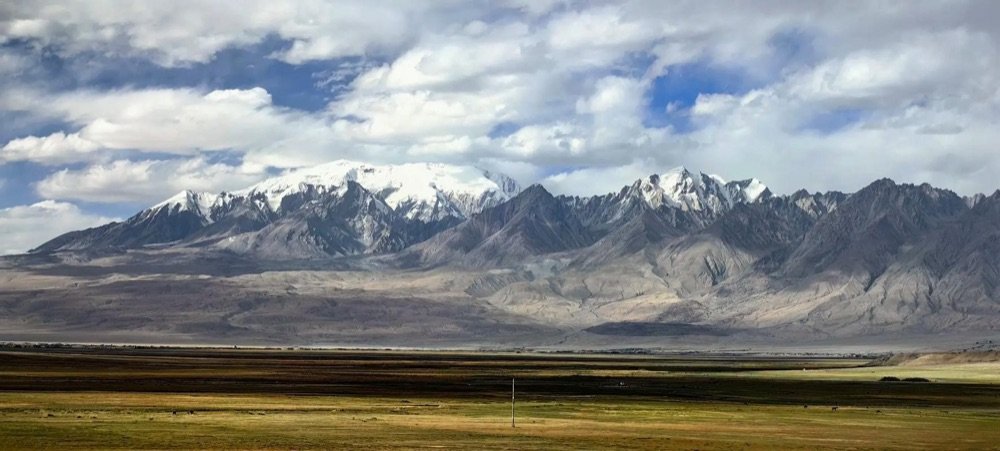
This is the real reason to come. Every ten or fifteen km along the main road, a gravel spur peels off north or south towards a well, a shed, a summer camp or nothing identifiable at all. None of them are signposted in English. Most are not signposted at all. Satellite maps show some and miss others, and the ones they show may have been cut by a washout since the imagery was taken.
My habit is to take one of these tracks for three to five km, park somewhere I can turn around, and walk. That is usually enough. The noise drops away and you get the thing this county actually sells: a horizon with no infrastructure on it. In June the grass was up past my boots, and I could hear a lark and nothing else.
How far should you push a 2WD?
Not far, and I mean that. Hard-packed gravel is fine, and a hire sedan will manage several km of it without drama. The moment any of the following appears, stop and reverse out:
- Ruts deeper than your ground clearance, which on a rental Passat is very little.
- Soft sand or the fine grey silt that turns to grease after rain.
- A creek crossing you have not walked first.
- Washboard corrugation bad enough to blur your mirrors, which will loosen bolts and cook a tyre.
There is no recovery service out here. There is no phone signal in a lot of the folds between ridges. If you get stuck, your rescue is whoever happens to drive past, and on a minor pasture track that might be tomorrow. I carry a tow strap, 6 L of water, a compressor and a proper spare, and I still turn round earlier than my ego wants me to.
One more thing. Do not drive off the track across open pasture: that grass is somebody’s livelihood, tyre scars last for years, and cutting across grazing land is resented even when nobody says so to your face. To approach a camp, stop at a distance and wait to be waved in.
Sleeping and eating in the county town
Toli town is small, tidy and functional. Wide streets, a couple of squares, a bazaar area that gets busy in the morning, and rooms in the ¥120 to ¥250 range for a clean business-style double as of my last stay in summer. Bring cash as a backup, though almost everything runs on phone payment now.
Here is the friction nobody warns you about: not every small-county hotel is set up to register foreign guests, and you may be politely turned away at reception after a five-minute look at your passport. It is not personal and arguing achieves nothing. Have two or three options in mind, and if the town is not working out, push on to Tacheng, the quiet north-west border town, which has far more beds and a much higher chance of a straightforward check-in.
What to eat
Kazakh dairy is the local specialty and it is worth the effort of asking for it by pointing. Qurut, the hard salted dried curd balls, taste like a punch of salt and sour the first time and become oddly addictive by day three. Airan, thick soured milk, is superb after a hot drive. There is cream sold in jars, fresh flatbread pulled straight off the wall of a clay oven, boiled mutton with onion, and in autumn cured horse sausage that I like far more than I expected to. Milk tea comes salted with a lump of butter in it.
Hand-pulled noodles run ¥20 to ¥35, a plate of stir-fried noodles about the same, and a shared plate of mutton is more like ¥80 to ¥150 depending on how much bone you get. My worst meal in the county was a lunch at a truck-stop canteen on the edge of town: grey, oily, tepid laghman for ¥28 and a bowl of soup with three cabbage leaves in it. Walk two streets into the residential grid instead and the food improves immediately.
Spring green against deep-summer gold
Late April into early June is the county at its best. Grass is up, the low hills are green rather than khaki, snow still sits on the higher Barluk ridges to the west, and the flowers come in waves. If you plan your timing around anything, plan it around this window, and if wildflowers are the point of your trip then swing north-west for the spring wild tulips of the Barluk Mountains, which peak for a short and frustratingly unpredictable couple of weeks in April and May.
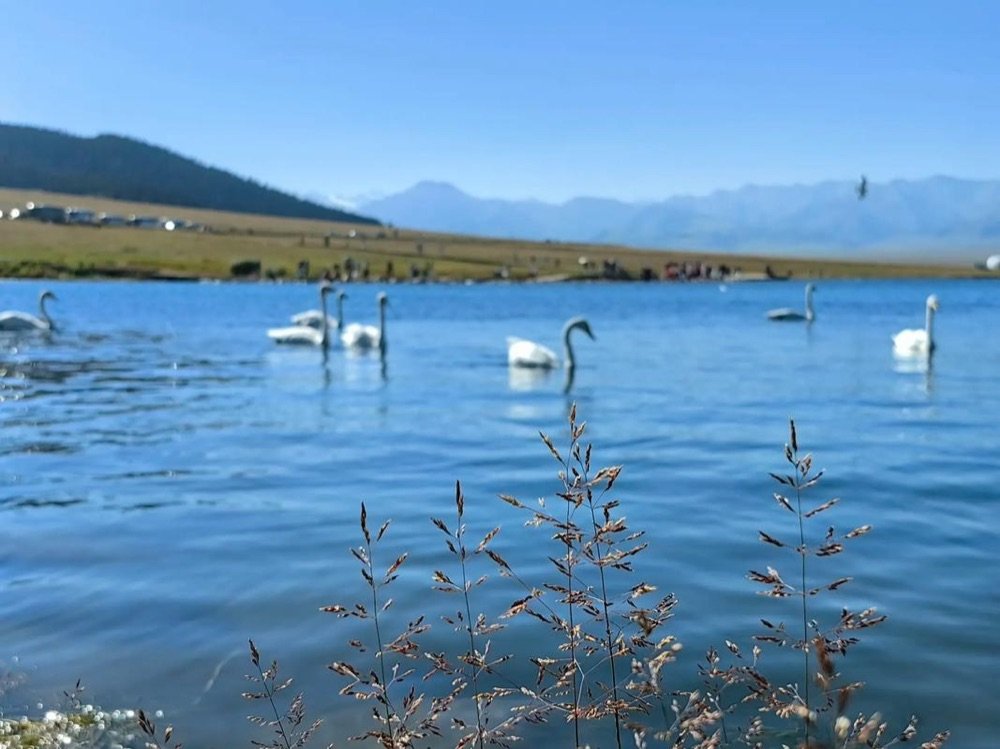
Spring is also when the shallow lakes and reservoirs in this part of the prefecture fill with water birds on passage. Swans, various ducks, waders working the muddy margins. Keep your distance, use a long lens from the car, and do not walk out onto the flats towards them.
By mid-July the pasture has turned the colour of dry straw and the whole landscape shifts from pretty to austere. I like it just as much. Afternoons hit the low thirties, evenings drop fast enough to want a fleece, and the light between 19:00 and 21:30 is absurd, because Xinjiang runs on Beijing clock time while sitting several time zones west of it. September gives you gold plus the return migration plus the first snow dusting on the peaks. Winter is for people with proper tyres and no fixed schedule.
Fitting Toli into a Karamay and Tacheng loop
Three days is enough for a satisfying circuit and four is more comfortable. Start from the oil city, take the slow road west with a night in Toli, then continue the remaining 130-odd km north-west to the border town for two nights, using it as a base for the lakes and the Emin valley. Come back south on a different line so you are not repeating scenery.
If you have more time, two detours are worth the fuel. North-east of Karamay lies the Mongolian steppe of Hoboksar, which is even emptier and has a completely different cultural feel. And on the way back east towards Urumqi you pass close enough to justify stopping for a cold one in Wusu’s beer town, which is a silly, fun, very local end to a dusty week.
Go with low expectations about sights and high expectations about space. Toli has no signature photograph waiting for you. It has an afternoon where the only sound is wind in grass, a herder who nods at you from a horse, and a road you will not have to share. It took me three passes to work that out.