
Marmots and Ground Squirrels of the Xinjiang Steppe: Reading the Grassland’s Smallest Engineers
The first whistle of the morning
I had been following the southern Tianshan for four days in my rented SUV when the grassland finally opened up near Bayinbuluke. It was the first week of July and the air smelled of wet sedge. I killed the engine at 2,480 metres and stepped out into a silence so complete that the click of the door lock sounded rude.
Then a whistle cut the quiet. Sharp, two notes, almost like a referee’s call from a football match played a kilometre away. I froze. A fat brown shape sat upright on a mound of dirt maybe 60 metres from the car, its paws folded against its chest, watching me with the calm suspicion of a toll-booth clerk. That was my first meeting with a long-tailed Himalayan marmot, the animal local herders call the steppe’s little sentry.
Over the next three weeks I would see hundreds of them. They became the quiet soundtrack of my self-drive through Xinjiang’s high country, present on almost every grassland I visited between June and September. This is a guide to finding them, photographing them, and respecting the real risks they carry.
What the marmot actually is
The long-tailed Himalayan marmot is a rodent of serious proportions. Adults run 50 to 70 centimetres from nose to rump, with a tail of 13 to 20 centimetres that gives the species its name. A fat one can weigh close to nine kilograms, heavier than the smallest laptop in my bag.
They belong to the same family as squirrels but live a very different life. Where a tree squirrel darts and vanishes, a marmot is a ground creature built for the open cold. In Xinjiang they occupy alpine and sub-alpine meadows from about 2,000 metres up to 4,200 metres, favouring the lush valleys where the grass stays green deep into summer.
Colour varies with the country. Animals on the northern grasslands wear a grizzled yellow-brown coat that blends with dry fescue. Higher populations near the snow line turn greyer, almost slate, as if the mountain had dusted them with its own ash. The face is flat, the eyes round and dark, and the whole impression is of a furry loaf that has decided, against the odds, to stand up.
The engineers of the meadow
Marmots are not just residents of the grassland. They build it. A single family digs a burrow system that can stretch 5 to 15 metres underground, with separate chambers for sleeping, for raising pups, and for the long winter sleep that lasts from September until the thaw in May.
I once lay on my stomach 20 metres from a colony near Narat and counted the mounds. There were eleven entrance craters in a patch no larger than a basketball court, each one a volcano of loose soil a metre wide. Those mounds change the water. Rain that would sheet off hard ground instead pools in the crater and seeps down, feeding the roots of plants the herds depend on.
The digging also turns the soil. Burrow dirt is richer in the minerals grazing animals need, so a marmot town becomes a small fertility hotspot, a ring of thicker grass that attracts gazelles and antelopes to graze nearby. You rarely find one without the other. When you spot a marmot colony, scan the edges for something larger moving on hoof.
Reading the alarm whistle
The whistle is the marmot’s gift to every traveller with ears. Each colony posts a sentinel, usually an older animal that sits high on a mound and scans while the rest feed. At the first hint of a dog, a fox, or a human, it lets out the two-note call and the whole field goes still.
Then the magic happens. Every head pops up. The feeding stops. For perhaps ten seconds the grassland holds its breath, a dozen brown loaves frozen upright, and you realise you are being assessed by a committee. If you stay still, the sentinel drops its pitch to a softer chatter and the colony relaxes. Move too fast and the whistle sharpens and every animal slides into a hole with a speed that embarrasses your camera’s autofocus.
I learned to use the whistle as a clock. The morning chorus peaks around 8 a.m., when the animals surface after the cold night. A second smaller peak comes near 7 p.m. as they fatten up before retreating underground. Midday, when the sun pushes past 28 degrees, most adults lie flat in the shade of a rock and the steppe goes quiet.
The smaller cousins: ground squirrels
Marmots get the fame, but the grassland’s other engineers are smaller and faster. The red-cheeked squirrel, a slim striped ground squirrel with rust-coloured patches below the ears, is the one you will actually trip over. They are everywhere on the open meadows, darting between burrows in parties of a dozen or more.
Unlike the marmot’s deep fortress, a red-cheeked squirrel’s burrow is a shallow quick dig, rarely more than a metre down, often reused and enlarged across seasons. They feed on seeds, green shoots, and the insects that rise from the grass, and they cache food in cheek pouches that bulge like a toddler’s. Watching one stuff its face before bolting underground is the closest thing the steppe offers to comedy.
You will also meet the slender, pale Central Asian ground squirrel on drier ground toward the northern basins, and the tiny narrow-skulled vole that flickers through the stems. None of them whistle. They squeak, or simply vanish. But together they are the machinery of the meadow, the small shifting population that turns sunlight and grass into flesh and then back into soil.
Where to find them on a self-drive
Xinjiang is huge, and the grasslands that hold these animals are scattered across its spine. A self-drive gives you the freedom to stop whenever a whistle catches your ear, which is the only real method that works. Here are the four meadows where I had my best luck.
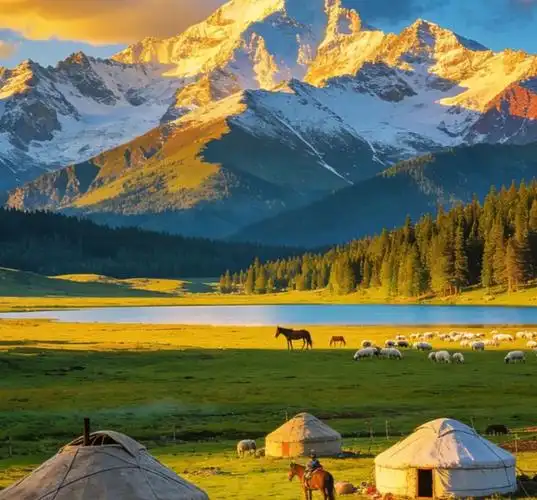
Bayinbuluke is the headline. The swampy grassland around the bend of the Kaidu River sits at 2,400 to 2,500 metres and supports marmot colonies by the hundred. The loop road from the ticket gate runs about 28 kilometres to the famous nine-bend viewpoint, and marmots line the verges the whole way. Stop at the pull-offs, not on the road, because the swamp softens fast after rain.
The Balikun grassland in the east is colder and quieter, a high plateau near 1,650 metres backed by the snow ridge of the Barkol mountains. Fewer tourists reach it, which means the animals are less practised at ignoring cars. I spent a calm morning there watching a colony work a south-facing slope while no other vehicle passed for an hour. If you plan the eastern loop, read up on the Balikun grassland before you go, because fuel and water are sparse out there.
Narat and the wider Gongnais grasslands in the Ili Valley are the greenest of all. The access road climbs from about 1,200 metres at the valley floor to over 2,200 metres at the high pasture, a drive of some 60 kilometres that passes through three vegetation bands. Marmots favour the middle band, the damp meadow around 1,800 metres where the grass grows knee-high on a tall person. Arrive early. The coaches roll in after 10 a.m. and the animals retreat.
For a wilder edge, the grasslands south of the Gongnais near the forest line hold both marmots and the red-cheeked squirrels in the same field. That mixing zone, where meadow meets spruce, is also where I saw my only fox of the trip, working the colony edges for an easy pup.
Best seasons and the daily window
Time your visit between June and September and you will catch the animals at their most active. May is too early. The thaw is barely complete and most marmots are still sluggish from the long sleep, surfacing only in the warm afternoons. By June the pups are above ground, small copies of the adults tumbling at the burrow mouth, and the colonies are loud and busy.
July and August are the peak. Days are long, the grass is lush, and the animals feed almost from sunrise to sunset. This is also when the mountain wildflowers open across the meadows, so your marmot photos come framed in colour. September brings a different mood. The animals eat frantically to build fat for winter, and the first cold nights thin the whistle chorus.
Within any day, the window is the first three hours after sunrise and the last two before sunset. I rarely saw good behaviour between noon and 4 p.m., when the heat drives everything underground. Carry water and a thermos. The grasslands sit high and the sun is merciless even when the air feels cool.
Photography without the stress
You do not need a huge lens, but you will want reach. A 100 to 400 millimetre zoom on a cropped sensor gave me frame-filling portraits from 25 metres, which is about as close as you should try to get. The trick is to park, shut the door gently, and wait. The marmots come back out within minutes if you hold still.
Use a fast shutter, at least 1/1000th of a second, because the whistle jump and the bolt for the hole are sudden. Shoot into the low sun of early morning to catch the rim light on the fur, and keep your shadow off the animals. A beanbag on the car window is steadier than a handheld grip and keeps you inside the vehicle, which the marmots treat as a boulder rather than a threat.
For behaviour shots, watch the sentinel and prefocus on its mound. When the colony relaxes and the pups start to play, you will get the pictures that actually say something. Patience beats pursuit every time on the steppe. This approach is the backbone of wildlife photography in Xinjiang, where the animals set the schedule and the light decides the rest.
The serious part: plague and safety
Here is the fact that no pretty photo captures. Marmots across Central Asia are a known reservoir of plague bacteria, carried by the fleas that live in their fur and their burrows. The risk to a passing traveller is low, but the consequence of a bad choice is severe. This is not folklore. It is a real public-health warning posted in several grassland counties.
Never touch a dead marmot. Never poke one with a stick, never pick one up, never let a dog grab one. The bacteria survive in a carcass and a single flea bite can infect you. If you see a dead animal on the track, drive past and mention it to a ranger at the next stop. Do not turn it over for a photo, no matter how compelling the shot.
Keep your distance from live ones too. Thirty metres is a good minimum, both for your safety and for the animal’s peace. Do not feed them. Feeding draws them to people and to roadside picnic spots where the flea exchange with dogs becomes likely. These rules sit at the core of staying safe around wild animals, and they apply doubly to the rodents of the steppe.
If a companion develops a fever or a swollen lymph node within a week of a grassland visit, name the place you went and the animals you saw. Tell the doctor plainly. Early treatment for plague works. Silence does not, and the window for effective care is shorter than most travellers expect.
Where they sit in the wider picture
Marmots and ground squirrels are not the headline animals of Xinjiang, and they know it. They share the meadows with larger, louder neighbours, and part of the joy of watching them is reading the whole system at once. A marmot colony is a feeding station for foxes, wolves, and eagles, and the open ground around it is prime grazing for the hoofed animals.
On the same grasslands you may spot goitered gazelles on the drier flats and argali sheep higher on the ridges. The gazelles and antelopes often drift toward marmot towns because the grass is better there, so one sighting leads to another. Learn the whistle and you learn where to point your binoculars next, because the grazers follow the green rings the burrows create.
The bigger predators tie the story together. Wolves still range the northern basins, and bears and wolves both use the meadow edges at dawn. I never saw a wolf take a marmot, but I watched an eagle fold its wings and drop onto a colony, and the explosion of whistles that followed was the loudest the steppe got all trip. The small animals are the alarm system for everything around them.
Without the burrow engineers turning soil and the sentinels warning the field, the grassland would be a quieter, poorer place, and the hunters would have less to hunt. Sit with a colony for an hour and you are watching the machinery that the whole valley runs on, a system older than any road that now crosses it.
Closing the door softly
My last marmot was at Bayinbuluke on a September evening, the light going long and red across the Kaidu. A single animal sat on its mound and gave the soft evening whistle, not the alarm, just the keep-in-touch call to a colony already halfway to sleep. I started the engine, nudged the SUV back onto the gravel, and left the steppe to its engineers.
If you drive Xinjiang’s grasslands between June and September, slow down at the whistles. Stop, wait, and let the small engineers show you how the meadow works. Bring a long lens, keep your distance, and never touch what you find. The steppe rewards the patient traveller with a show that costs nothing and teaches everything.