
Snow Chains and Winter Driving Rules in Xinjiang: What Every Driver Needs to Know
The first time I drove a Xinjiang mountain pass in deep winter, I learned the hard way that four-wheel drive is not the same thing as four-wheel control. It was a Tuesday in late January, the thermometer in my rental read minus twenty degrees Celsius, and a checkpoint officer at the foot of the Tian Shan was pointing at my bare all-season tires and shaking his head. He did not speak much English. He did not need to. The message was clear: no chains, no pass.
Most visitors picture Xinjiang as a summer destination of blue lakes and golden deserts. The colder half of the year is just as rewarding, but it asks more of you behind the wheel. From November through March, the northern routes and the high crossings between the plains and the south can turn brutal without warning. This guide is the one I wish I had read before that checkpoint stopped me.
When the mountains turn white
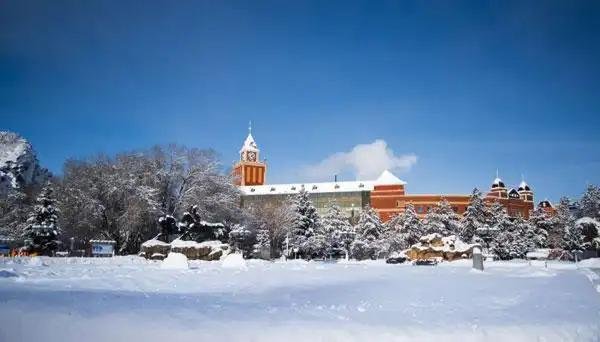
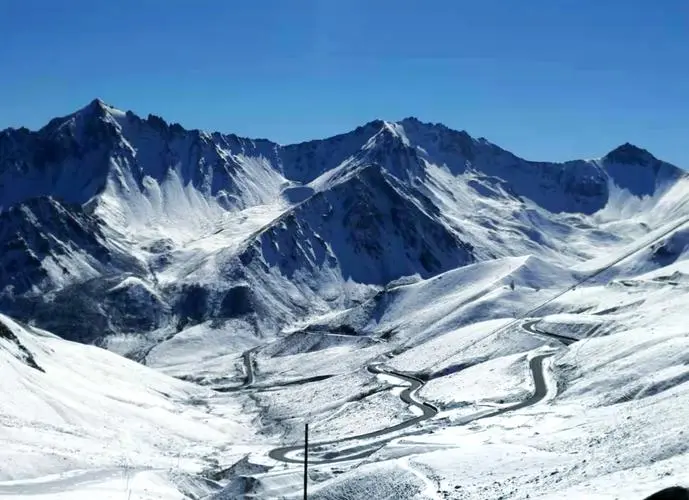
Snow arrives early in the Tian Shan and the Altai. By mid November the passes above 2,500 meters often carry a permanent pack, and a single night’s snowfall can drop thirty centimeters on a stretch of road that was clear at noon. The season does not really end until March, and even in April you can meet snow on the highest sections.
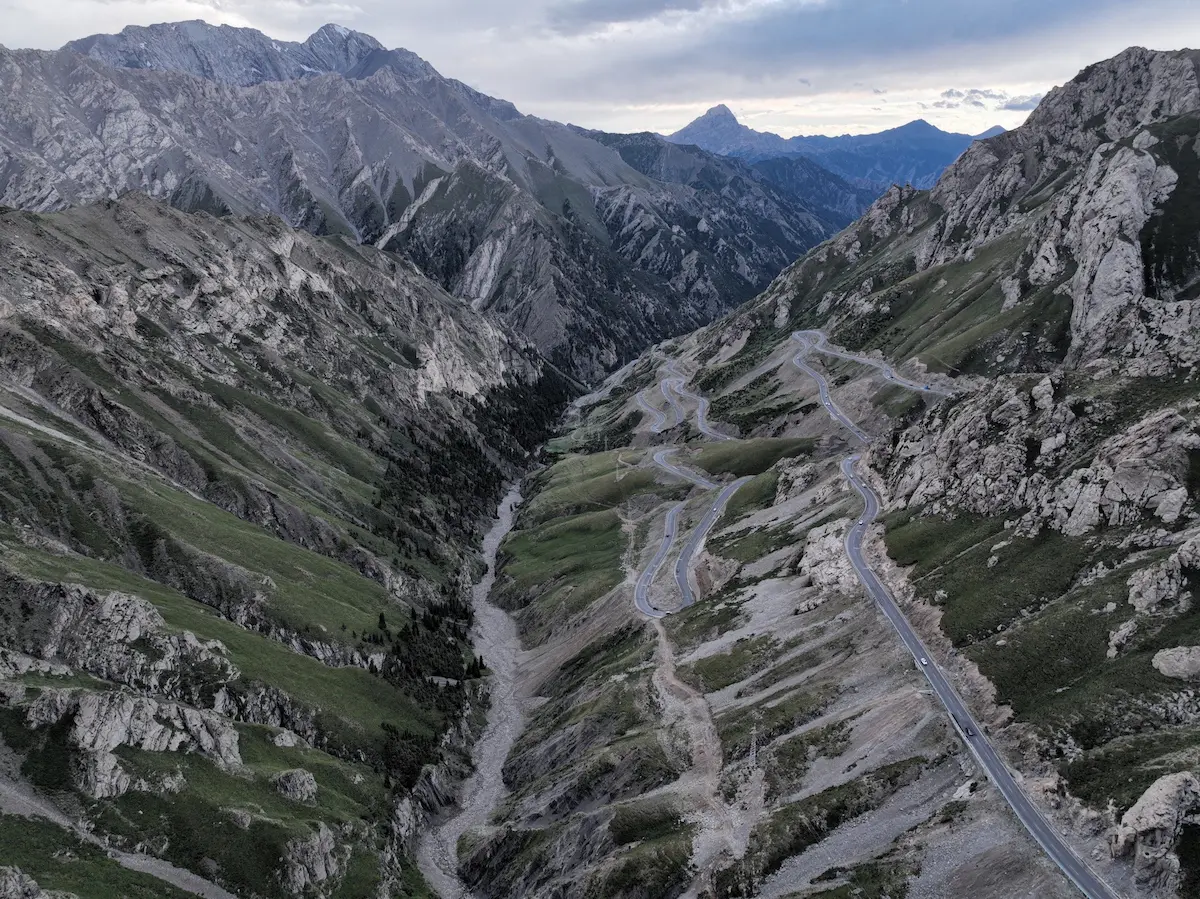
The danger is not only depth. It is the combination of steep grades, blind curves, and plows that simply cannot keep up with a mountain storm. On a clear day the Dushanzi–Kuqa Highway is one of the great drives on earth. After a snowfall it becomes a different road entirely, and parts of it close for the whole winter.
The Dushanzi–Kuqa Highway and the Tian Shan passes
The Dushanzi–Kuqa Highway climbs from the northern plains to over 3,400 meters before dropping toward the Tarim basin. The highest stretches are gated and closed from roughly early October to late May, so plan your north-south crossing for summer. The sections that stay open in winter still demand respect. After any fresh snow, police at the lower gates frequently require visible snow chains on at least the driven wheels before they let you proceed.
I have seen the same rule applied on the passes around Ili and on the road west toward the Karakoram corridor. The officers are not being difficult. A two-wheel-drive sedan without chains becomes a roadblock the moment it slides, and on a single-lane mountain road there is nowhere to pull over.
Checkpoints that can turn you back
Northern Xinjiang runs a lot of police and army checkpoints, especially on the approach to high country and near border areas. Most are quick ID checks. A few, in winter, are chain inspections. If you cannot show chains or fit them on the spot, you will be sent down. That is not a fine you can argue away. It is a safety call, and the officer has the final word.
The smart move is to assume you will be checked and arrive already equipped. Carrying chains you never use is annoying. Being turned around sixty kilometers from the nearest town because you do not have them is worse.
Buying and fitting chains before you leave
You can buy chains in Xinjiang, and you should not rely on the rental counter to hand you a good pair. The selection at Urumqi auto parts markets and the larger service stations along the northern ring road is decent, with prices running from about 150 yuan for a basic set to 400 yuan for sturdier ladder-chain styles that survive rough asphalt. Buy them in Urumqi on day one if your flight lands there. Once you are out in the small towns, the shelves thin out fast.
Size matters. Chains are sold by tire dimension, so read the numbers on your sidewall before you shop. A set that fits a 215/60 R16 will not stretch onto a 225/65 R17, and the clerk may not notice the mismatch.
Practice in a car park, not on the pass
The single most useful thing I did before my second winter trip was spend twenty minutes in a quiet car park fitting chains to a borrowed car. Cold hands fumble. Snow blinds you to which hook goes where. If your first attempt happens at the roadside in a minus fifteen wind, with trucks stacking up behind you, you will hate every second of it.
Lay the chain flat, drape it over the top of the tire, pull the ends around, and tension it from the inside out. Drive forward half a car length, re-tension, and check again after the first kilometer. A loose chain shreds a wheel arch faster than you would believe.
Winter tires versus chains
This is the question every first-time winter driver asks, and the honest answer is that you usually want both, not one or the other. A good read on the winter tires versus all-season trade-off is worth your time before you book. Winter rubber keeps you moving on packed snow and gives you the grip to stop. Chains are the insurance for the moments winter tires are not enough: fresh powder on a grade, an iced switchback, a plowed wall at the edges of the lane.
If I had to choose one for a short visit, I would take winter tires for general driving and chains for the passes. But on the highest closed-then-open sections, chains are what the checkpoint asks for, and no tire in the world substitutes for them in the officer’s eyes.
Black ice and the curves nobody warns you about
The scariest surface I met was not a blizzard. It was a shaded bend at about 2,700 meters where meltwater had frozen overnight into a sheet so clear I thought the road was simply wet. Black ice loves north-facing curves, bridge decks, and any stretch the sun misses before ten in the morning. You find out you are on it when the steering goes light and the back steps out.
Slow before the corner, not in it. Keep a long following distance. If the car starts to slide, steer into it gently and resist the urge to stab the brakes. ABS will chatter; let it. The mountain roads punish panic, and they reward patience.
The rental car problem
Here is the uncomfortable truth most travel blogs skip. The majority of rental cars in Xinjiang are not winter-equipped. You will be offered a front-wheel-drive sedan or a small SUV with summer or all-season tires and, if you are lucky, a tin of de-icer in the boot. Winter tires are rare, and chains are rarer still. One national-chain desk in Urumqi told me plainly that chains were not included and could not be added.
That means the responsibility sits with you. When you book, ask specifically about winter tires and whether chains are supplied. If the answer is no, buy your own set on arrival and factor the cost into the trip. A 400 yuan pair is cheap compared with a recovery truck on a closed pass.
For the broader picture of winter travel and ice festivals across the region, the seasonal events are wonderful, but every one of them starts with a safe drive to get there.
Fuel, range and the long empty stretches
Winter changes the math of distance. The towns of northern Xinjiang sit 80 to 150 kilometers apart, and in the cold months some village stations close or run short on supply. I treat a half tank as empty and fuel at every chance, because the next open pump might be further than the gauge suggests. From Urumqi to the Dushanzi gate is roughly 250 kilometers, and the run from Yining across the western passes toward the south is a long, fuel-hungry day with few options in between.
If your rental is a diesel, ask about the winter fuel grade. Ordinary diesel gels when the temperature drops toward minus twenty, and a gelled filter leaves you stranded at the worst possible moment. Petrol cars are the simpler choice for a short winter visit, and I steer visitors toward them for exactly this reason. Carry a full jerry can only if your rental allows it and you know how to secure it; an unstrapped can in the boot is its own hazard.
The empty stretches are also where a breakdown turns serious. Tell your guesthouse the route and your expected arrival, and do not count on mobile signal once you are past the last town. A paper map and a charged power bank have bailed me out more than once.
Descending without sliding
Going up a pass is the part everyone worries about. Coming down is where winter drivers actually lose control. On a 3,400 meter descent with packed snow, the instinct to ride the brake is the mistake that cooks the pads and then fades them to nothing. I drop to a low gear before the top, let the engine do the slowing, and touch the brake in short beats rather than a long press.
Chains help on an icy descent more than people expect, because they bite where a tire just polishes the surface. If the road is a glare of refrozen melt, I crawl in first gear and accept that the truck behind me will pass eventually. Speed is the enemy; a controlled twenty kilometers per hour beats a fast slide into the retaining wall every single time.
A scramble at 2,700 meters
I want to tell you exactly how my chain lesson went, because it still stings. I was descending the northern side of a Tian Shan crossing, having been waved through the upper gate without a check. Snow started at 3,100 meters, then turned to sleet, then to a hard pack. At a bend around 2,700 meters the car began to wander. I pulled into a plowed lay-by, heart hammering, and pulled the chains from the box I had bought in Urumqi three days earlier.
My gloves were back in the cabin. The wind was mean. The first chain I fitted was on the wrong wheel for the driven axle, and by the time I realized it, a queue of three local trucks had formed behind me, their drivers politely but firmly waiting. I refitted, drove forward, re-tensioned in the snow, and finally rolled. Total time on the roadside: twenty-eight minutes that felt like an hour. I have practiced every winter since.
If you are routing through the high country, study the seasonal mountain-pass closures before you commit to a date. A closed gate is not a suggestion. It is a wall of snow.
Reading the weather and the road
Winter driving here is as much about timing as skill. A clear morning can rot into a whiteout by early afternoon, and the wind is its own hazard. The open corridors east of Urumqi and the approaches to the Turpan basin can gust hard enough to shove a light SUV across a lane, so pair your snow plan with knowledge of Xinjiang’s strong-wind zones before you set off.
For the full spectrum of conditions, my longer notes on driving in snow, rain and wind cover what to carry and how to react when the sky turns. The short version: fuel up early, tell someone your route, and never trust a mountain forecast past the six-hour mark.
What to carry and what to do
My winter kit has settled into a short, boring list after a few mistakes. Chains sized to your tires. A real scraper and brush, not the toy that comes with the car. Two pairs of gloves, one for fitting chains and one dry pair for driving. A thermal blanket and water in the boot. A phone power bank, because cold kills batteries fast. And a paper map of the passes, since signal disappears the moment you need it.
If you slide off or get stuck, stay with the car, run the engine ten minutes each hour for heat, and clear the exhaust of snow so fumes do not build. Mark your position on the paper map and wait for the next plow or patrol. The roads here are busy enough in winter that help usually finds you before nightfall.
The payoff for all this caution is real. Northern Xinjiang in January is silent, white, and almost empty of tourists. The frozen lakes, the steam rising off hot springs, the single track of a fox across an open field. Drive it with respect and the right hardware, and winter becomes the best season you did not expect.
Karl Huang drove these routes across Xinjiang between 2019 and 2026. He updates guides when road conditions, prices, or permit rules change. You can reach him through the Contact page.