
How Xinjiang’s Scenic-Area Shuttle Buses Work (and How to Save Time and Money)
The single biggest surprise on my first Xinjiang road trip was not the distance or the food. It was the fact that, at nearly every major scenic area, I had to park my rental car at the gate and ride a shuttle bus the rest of the way in. This is how almost every paid attraction in the region works, and understanding the system before you arrive will save you both money and a full day of frustration.
Why Scenic Areas Use Mandatory Shuttles
Xinjiang’s headline destinations sit inside protected zones with strict vehicle limits. Kanas, Heavenly Lake, Sayram Lake and Nalati all restrict private cars from driving past the entrance. The stated reason is environmental protection and crowd control, but the practical effect is a bus monopoly inside the gate.
The buses do serve a real purpose. The roads inside these parks are narrow, often climbing into high alpine terrain where a jam of tourist cars would be dangerous. A single 45-seat coach moves as many people as thirty cars, and it keeps the valleys quiet. The tradeoff is that you lose control of your schedule the moment you hand over your keys at the lot.
There is also a quieter reason the parks like the arrangement: it keeps visitor numbers countable and revenue centralized. The gate is the only door, the bus is the only key, and the ticket window is the only till. As a traveler this is neither good nor bad, but knowing it removes the surprise. You are not being singled out; every domestic tourist behind you is in the same bus, on the same timetable, paying the same bundled price.
What catches foreign drivers off guard is how complete the handover is. You cannot sneak your car in, and there is no refund if you decide the bus is not worth it. The ticket you buy at the gate bundles the entry fee and the shuttle into one price, so the bus is essentially non-negotiable.
How Ticketing and Boarding Actually Works
At a typical scenic area you arrive at a large parking lot several kilometers before the sight itself. You buy a combined ticket at a central window or, increasingly, through a Chinese payment app scanned at a kiosk. The price covers entry plus the round-trip shuttle, and it is printed as one number so you cannot opt out of the bus.
Boarding is organized but rarely signed in English. You show your ticket, walk through a gate, and join a queue for the next departing bus. Buses leave when full rather than on a fixed clock, which means a wait of ten minutes in peak season or forty minutes if you arrive at lunch. I learned to roll up right at the 9 a.m. opening, when the first wave of buses is already loaded and moving.
Inside, the bus drops you at a hub, and from there you often transfer to smaller loop buses that circle the main viewpoints. At Kanas the system is a genuine network: one bus from the gate to the village, then separate hop-on buses to the three bays. Keep your ticket stub. You will be asked for it at every transfer, and a lost stub means buying a new segment.
Where Your Car Goes
Your rental stays in the lot, watched by attendants who charge a small daily fee, usually ¥10 to ¥20. The lot is safe, but it is exposed, and in winter your windshield will be frozen solid by the time you return. I carry a scraper and a window cover now, because nothing wastes the end of a good day like a frozen car.
One detail that matters for self-drivers: the lot closes on the same schedule as the park. If the last bus leaves the inner hub at 7 p.m., you must be on it, or you walk out. I have seen travelers stranded because they assumed their car was available at any hour. It is not.
Real Examples From My Own Trips
Heavenly Lake, Near Urumqi
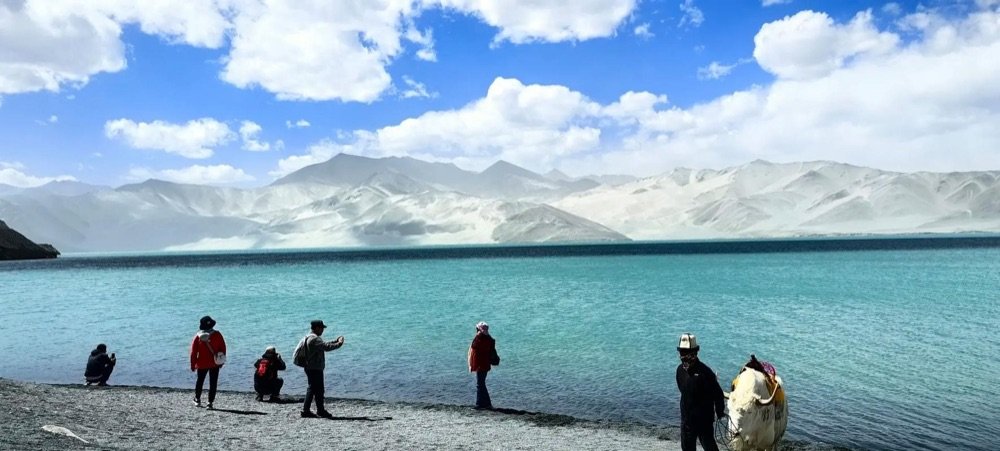
Heavenly Lake sits about 110 km from Urumqi, a 90-minute drive that ends at a massive tiered parking complex. From there the shuttle climbs roughly 40 minutes up a switchback road to the shore. The bus ticket adds around ¥60 to the entry, and the whole transfer eats a good two hours of your day before you even see water.
The payoff is real: the lake is a glacial mirror under the Bogda peaks. But the shuttle means you arrive on the operators’ timetable, not yours, and the return queue at 5 p.m. can stretch an hour. Get the full picture before you go by reading our Heavenly Lake travel guide, which lays out the timing I wish someone had handed me on day one.
Kanas and the Three Bays
Kanas is the most complicated shuttle network in the region, and the most rewarding. The gate is far below the lake, and the bus ride up takes over an hour through pine forest. Once at the village you transfer again for the bays: Shenxian Bay, Moon Bay and Guanyu Bay, each a separate stop on a one-way loop.
The loop buses run frequently but fill fast between 10 a.m. and 3 p.m. I rode the loop at 8 a.m. and had Moon Bay nearly to myself, then watched the same platform drown in tour groups by noon. Our Kanas three bays guide explains which stops deserve your time and which you can skip on a tight schedule.
Sayram Lake and Nalati
Sayram Lake is different: the shuttle here is a ring road you drive as part of a guided loop, and private cars are sometimes allowed on the perimeter with a separate permit. Nalati grassland runs a similar system, with buses climbing to the river valley viewpoints where the grass runs to the horizon. Both are covered in depth in our Sayram Lake guide and our Nalati grassland guide, which I recommend reading together because the two shuttles share the same operator quirks.
How to Save Time on the Shuttle System
Time is the currency you lose to buses, so protect it. Arrive at the gate within twenty minutes of opening. The first buses are loaded and rolling before the lots fill, and you beat both the crowds and the midday heat that slows everything down.
Buy your ticket online the night before through the park’s app or a hotel that resells them. The on-site window is where the longest lines form, and a pre-purchased code lets you walk straight to the gate scanner. I once saved ninety minutes at Sayram Lake just by buying ahead while eating breakfast.
Ride the loop in the opposite direction from the tours. Most groups go clockwise starting at the first bay, so I go counter-clockwise and meet empty platforms. It is a small trick, but on a one-day pass it can mean seeing three viewpoints in the time it takes others to see one.
Finally, treat the bus as part of the day, not an obstacle. Bring water, a charged phone, and snacks, because the hubs have overpriced cafes and long lines of their own. A prepared traveler spends the transfer resting; an unprepared one spends it stressed.
How to Save Money
The shuttle is bundled into the ticket, so you cannot avoid it, but you can avoid paying twice. The classic mistake is buying a gate ticket, riding in, then deciding to leave and re-enter later in the day. Re-entry means a new ticket at most parks. Plan a single in-and-out and you keep your wallet intact.
Look for off-season pricing. From November through March, entry and shuttle combos at places like Heavenly Lake drop by as much as half, sometimes to ¥90 from a summer ¥215. The buses run less often, but the savings are real if your schedule is flexible. Winter also means you share the bus with a handful of people instead of a hundred.
Some areas sell a two-day pass that spreads the cost if you want to linger. Kanas in particular rewards a second morning, and the multi-day ticket beats paying the gate fee twice. Ask at the window, because the option is rarely advertised in English and the staff may assume you want the single-day rate.
When Your Own Car Still Wins
The shuttle is mandatory inside the parks, but your car is king on the roads between them. The drive from Urumqi to Korla is 460 km of open highway where no bus will ever help you. The run from Kashgar to Tashkurgan is 290 km of Pamir switchbacks that you will want to stop along at your own pace.
I think of it as two separate travel modes. The car gets me to the gate; the bus gets me to the view. Trying to do the whole region by tour bus would cost more and trap me on someone else’s clock. Keeping my own wheels for the long hauls is what made the trip feel like mine.
There are also scenic stretches where no shuttle exists at all. The Duku Highway, the Karakoram route toward the border, and the desert roads of the south are pure self-drive territory. Knowing which legs are car-only and which are bus-only is the real skill, and it is why I always map the gates before I map the sights.
The freedom cuts both ways, of course. With no bus to lean on, every breakdown, every missed turn, every closed pass is yours alone to solve. That is the bargain of the self-drive trip: the long roads give you the region, and the shuttle buses give the region back to you at the gate. Hold both facts and the system stops feeling like an obstacle and starts feeling like the shape of the place.

Crowds, Holidays and the Worst Days to Ride
The shuttle experience swings wildly with the calendar. On a random Tuesday in late September I shared the Kanas loop with maybe twenty people. During the October National Day week the same platform held a thousand, and buses ran bumper to bumper from dawn. If your dates are fixed, accept the wait; if they are flexible, aim for the shoulders of the season.
Chinese public holidays are the enemy of a calm bus ride. The two big ones, the May holiday and the October week, turn every hub into a queue that can run two hours. I once spent longer waiting for a bus at Nalati than I spent on the grassland itself. Midweek in shoulder season, by contrast, the buses feel private.
Weather compounds the crowds in winter. Snow closes some loops entirely, which sounds bad until you realize the open ones are empty and cheap. I rode Heavenly Lake on a February morning with four other passengers and a driver who stopped the bus so we could photograph a frozen waterfall. That is the version of the shuttle system worth chasing.
Practical Things I Wish I Had Known
Carry cash in small notes. The gate kiosks and the hub snack stalls do not always take foreign cards, and a ¥5 bun or a ¥10 water is easier with paper. I keep a stack of ¥20s for exactly this, and it has saved me more than once when a scanner failed.
Download the park maps before you lose signal. The lots and inner hubs are notorious dead zones, and the bus routes make no sense without a map in hand. Our offline maps and signal guide covers the apps and downloads that kept me oriented when the screen went blank.
Pack for the wait. The platform at Kanas in October was 2 degrees and windy, and the bus was late. A windproof layer and gloves turned a miserable hour into a tolerable one. The same kit serves you on the long drives, so it earns its space in the trunk.
Lastly, lower your expectations of English signage and relax into the rhythm. The shuttle system is built for domestic tourists, and that is fine. Once I stopped fighting it and started timing my arrivals, the buses became a quiet, scenic ride rather than a hurdle. Xinjiang is big enough that the journey between sights is the trip, and the shuttle is just one more leg of it.