
Jiaohe Ancient City: Walk Through Earth’s Best-Preserved Mud-Brick City (2026 Guide)
Jiaohe Ancient City: Walk Through Earth’s Best-Preserved Mud-Brick City (2026 Guide)
 Jiaohe Ancient City ruins against the Turpan sunset — a 2,100-year-old UNESCO Silk Road capital carved from solid earth” />
Most ancient cities are rubble — a knee-high wall here, a broken column there, and a museum plaque asking you to imagine. Jiaohe Ancient City (交河故城) is different. Carved into a 30-meter-high loess plateau between two river valleys, it is not assembled from bricks but shaped from the earth itself. Walk its central avenue and you trace the same spine merchants, monks, and soldiers walked when the Silk Road was the nervous system of Eurasia. No reconstruction. No gift shop sprawl. Just wind, light, and 2,100 years of silence.
If you’re planning independent travel in Xinjiang, Jiaohe belongs on the shortlist — not as a “quick stop,” but as the cultural anchor of your Turpan leg. Here is everything you need to know before you go.
📍 Quick Facts
- Location
- 10 km west of Turpan city center, Xinjiang, China (approx. 20 minutes by car)
- UNESCO Status
- World Heritage Site — part of “Silk Roads: the Routes Network of Chang’an-Tianshan Corridor” (2014)
- Age
- Founded ~2nd century BCE; capital of the ancient Jushi (Gushi) Kingdom
- Ticket (2026)
- ¥70 entrance + ¥25 mandatory shuttle bus (last entry ~19:00)
- Walking Time
- 1.5 – 3 hours, depending on how far you explore the perimeter paths
- Best Light
- Late afternoon — the western walls catch side-light and shadows define every relief
Why Jiaohe Deserves a Spot on Your Xinjiang Itinerary
For our complete Xinjiang Solo Travel Guide, see our dedicated Xinjiang Solo Travel Guide with practical details on safety, costs, and planning.
Let’s be honest: most “ancient city” sites in China have been Disney-fied — neon, souvenir lanes, and a stage show at 15:00. Jiaohe has none of it. You walk out onto a narrow loess plateau — essentially an island of earth suspended between the Yarnaz River and its tributary — and you see a city plan that is still legible after two millennia.
What makes this the best-preserved mud-brick ancient city on Earth is a geological accident: the Turpan Basin’s extreme aridity. Annual rainfall here averages 16 mm — less than a single summer afternoon in London. Without moisture, the tamped earth doesn’t erode into mud. It hardens, cracks, and holds its shape, preserving room-by-room floor plans, temple foundations, and even carved storage pits pressed into the ground.
For travelers chasing authentic Silk Road experiences — not packaged photo ops — this is Xinjiang at its most raw and visually haunting.
The Experience: Walking Through 2,100 Years
The shuttle drops you near the South Gate, and the site reveals itself in three layers as you walk north.
Layer 1 — The Central Avenue
A wide, sunken ceremonial spine runs the length of the plateau — roughly 350 meters — flanked by the foundations of temples, administrative halls, and watchtower bases. This wasn’t a residential backstreet; it was the political and religious artery. Stand in the middle and look north: the avenue narrows toward the Stupa Mound, the spiritual anchor of the entire city. The sight line is intentional — power architecture, Silk Road edition.
Layer 2 — Residential Quarters
Branching east and west from the central axis, you’ll trace room-by-room floor plans pressed into the loess: sleeping chambers, kitchens with circular oven pits, storage rooms dug below ground level for temperature control. The density is remarkable — Jiaohe once housed several thousand people in an area smaller than a modern shopping mall footprint. Look for the carved door sockets in surviving wall sections. Those are not reconstructions; they are original.
Layer 3 — The Stupa Mound & Monastery Complex
At the northern cape, the Buddhist stupa mound rises against the sky — a massive earthen platform that once supported a multi-tiered reliquary tower. Around it sprawl monastic cells, meditation chambers, and a large assembly hall foundation. Jiaohe was a major Buddhist center by the 5th century, absorbing influences from Gandhara (present-day Pakistan/Afghanistan), India, and Central Asia. The view from here — 360° of river gorge, desert plain, and the distant Flaming Mountains — is worth the entire trip.
Tickets, Hours & Practical Information (2026)
| Item | Detail |
|---|---|
| Entrance Fee | ¥70 per person |
| Shuttle Bus (mandatory) | ¥25 per person — the parking area is ~2 km from the ruin entrance; you cannot walk in from the gate |
| Opening Hours | 08:00–20:00 (summer, Apr–Oct); 09:00–18:30 (winter, Nov–Mar) |
| Last Entry | ~19:00 (summer), ~17:30 (winter) |
| Passport Required | Yes — standard procedure for foreign visitors at all Xinjiang scenic zones |
| Audio Guide | Available for rent at the ticket hall (~¥40, English available but limited — download info beforehand) |
Best Season & Time of Day
| Season | Temperature | Verdict |
|---|---|---|
| April–May | 18–28°C | ✅ Ideal. Clear air, comfortable walking, wildflowers in the river gorges. |
| September–October | 15–25°C | ✅ Ideal. Golden light, fewer domestic tour groups, crisp shadows. |
| June–August | 35–45°C | ⚠️ Possible but brutal. Go before 10:00 or after 17:00. Carry 2L+ water. |
| November–March | -5 to 10°C | ⚡ Atmospheric but cold. Fewer visitors; some facilities may be reduced. |
Time of day matters more here than at most Xinjiang sites. The plateau runs roughly north-south, with the western walls catching side-light in late afternoon. Morning lights the approach path and the eastern residential quarters; evening lights the interior textures — wall grooves, oven pits, door sockets — with dramatic relief. If photography matters to you, aim for the last 90 minutes before closing.
Photography Tips
- Best lens: Wide-angle (24–35mm) for the stupa mound panorama; telephoto (70–200mm) to compress the central avenue and isolate wall textures.
- Polarizing filter: Essential. The Turpan Basin sky is hazy even on clear days; a polarizer cuts through and darkens the blue against pale loess.
- Drone: Restricted at most Xinjiang heritage sites. Do not launch without explicit permission from the ticket office.
- Human element: Catch a solitary figure on the central avenue at golden hour — the scale contrast makes the image.
How to Get There
| Method | Detail | Cost (approx.) |
|---|---|---|
| Private Car / Charter | From Turpan city, 20 minutes west via G312. Most flexible — the driver waits while you explore. | ¥200–300 half-day |
| Taxi / Didi | Reliable within Turpan. Arrange a return pickup time with the driver or use the app to hail back. | ¥40–60 one-way |
| Public Bus | City bus routes reach the general area, but drop-off is far from the ticket gate. Not recommended for a one-day visit. | ¥5–10 |
| Tour Group | Half-day Turpan packages often bundle Jiaohe + Karez + Flaming Mountain. Convenient but locks you into a group schedule. | ¥200–400/person |
If you’re already doing a Xinjiang free independent travel road trip, a private charter from Turpan for the day is the no-regret option. It gives you flexibility to linger at Jiaohe and then decide on-the-fly whether to add Gaochang, Bezeklik, or the Karez system afterward.
Combining Jiaohe with Turpan’s Best Attractions
Jiaohe is too close to too many sites to visit in isolation. Here is the most efficient one-day circuit:
| Time | Stop | Why |
|---|---|---|
| 08:30 | Karez Well System (坎儿井) | Cool underground tunnels, zero crowds early morning, 22°C year-round — the perfect Turpan wake-up call. (~¥40) |
| 10:00 | Jiaohe Ancient City | The main event. Still comfortable temperatures, soft morning light on the eastern quarters. Spend 2+ hours. |
| 12:30 | Lunch in Turpan Old Town | Laghman noodles, lamb skewers, fresh pomegranate juice. Rehydrate. Rest your legs. |
| 14:30 | Sugong Minaret (苏公塔) | 44-meter Uyghur Islamic tower in sun-dried brick — intricate geometric masonry, zero crowds. (~¥45) |
| 16:00 | Grape Valley (葡萄沟) | Shade, pergolas, 20+ grape varieties. Buy a kilo of seedless white grapes for ¥10–20 and collapse under a trellis. (~¥60 + ¥25 shuttle) |
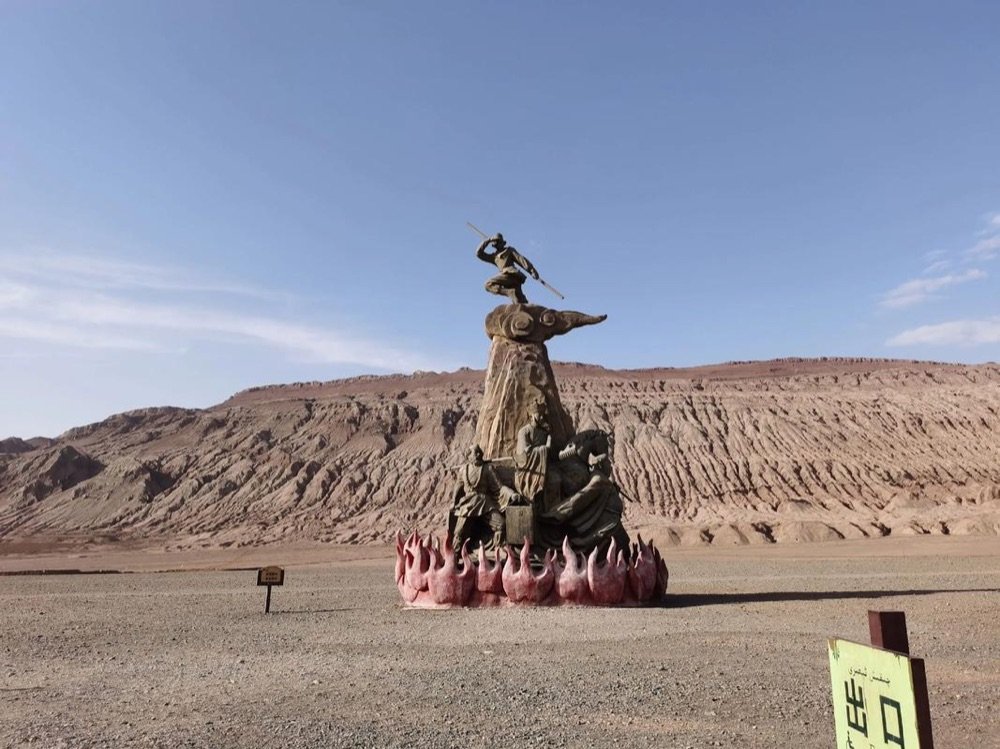
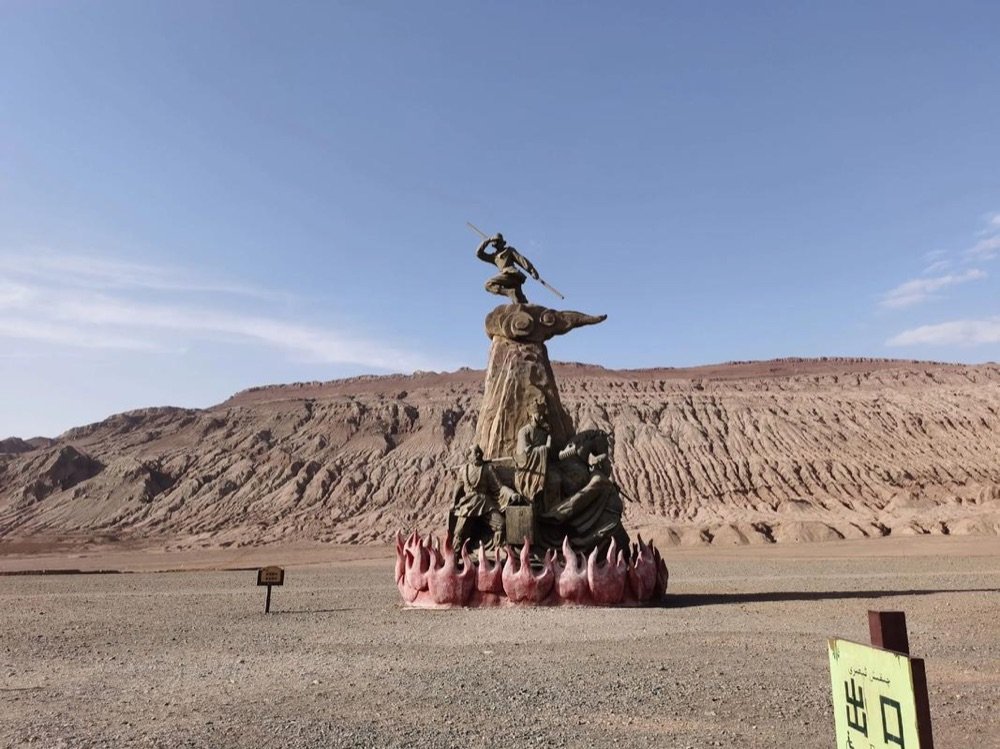
| 18:00 | Flaming Mountain (火焰山) — quick photo stop | Not a hiking destination; it’s a 30-minute photo stop for the red sandstone ridge and the giant thermometer. (~¥40) |
A Brief History: The City Between Two Rivers
Jiao-he (交河) literally means “River Confluence” — the site sits on a narrow loess plateau wedged between two branches of the Yarnaz River, which acted as natural moats. This defensive geography is why the city was never walled in the conventional sense; the 30-meter cliff faces were the walls.
The key chapters:
- 2nd century BCE: Capital of the Jushi Kingdom, a Tocharian-speaking oasis state controlling the Turpan Basin.
- 1st–5th century CE: Absorbed into the Han and Tang spheres as a key garrison on the Western Regions. Buddhism flourished — the stupa complex dates to this era.
- 9th–13th century: Under Uyghur Khaganate control, adapting to Islamic influence while retaining Buddhist elements.
- 14th century: Destroyed during Mongol conflicts and abandoned. The arid climate preserved rather than dissolved the ruins.
UNESCO inscribed Jiaohe in 2014 as part of the “Silk Roads: Chang’an-Tianshan Corridor” serial World Heritage listing. It is the finest surviving example of a loess-architecture urban center anywhere on Earth.
Safety, Etiquette & Practical Tips
- Water: 1.5L minimum. Small kiosk at the ticket hall, nothing past the shuttle drop-off. Dry air hides sweat loss.
- Sun protection: Wide-brim hat, SPF 50+, sunglasses. The loess plateau reflects UV like a salt pan.
- Footwear: Closed-toe walking shoes. Unpaved compacted earth with loose gravel — flip-flops are a twisted ankle waiting to happen.
- Do not climb on walls. Active heritage protection. Boot damage on fragile loess is cumulative and irreversible.
- Stay on marked paths. Plateau edges are unfenced in many sections. A 30-meter drop does not end well.
- Cash recommended: Carry ¥200–300 as backup. Small vendors may not accept foreign cards.
Frequently Asked Questions
Is Jiaohe better than Gaochang Ancient City?
Different experiences. Jiaohe is more compact, better preserved, and visually dramatic — the “carved from earth” effect is its signature. Gaochang (高昌古城) is much larger (163 hectares vs. ~33 hectares), better for understanding raw scale, but less detailed in its surviving structures. If you only have time for one, most travelers and archaeologists will point you to Jiaohe.
Can I visit Jiaohe without a guide?
Yes — you are free to walk independently. However, the interpretive signage in English is limited. Download background reading (like this article!) before you go, or rent the audio guide at the ticket hall.
Is Jiaohe accessible for elderly or mobility-impaired visitors?
Partially. The shuttle drops you at the plateau base, and there are stairs and inclined paths to the upper level. The central avenue and stupa area are reachable with moderate effort, but the perimeter paths involve uneven ground. Not wheelchair-accessible beyond the gate complex.
Do I need a border permit for Jiaohe?
No. Jiaohe is well within the Turpan city administrative zone — no PSB border permit is required. Standard foreign passport + visa is sufficient.
The Bottom Line
Jiaohe Ancient City is the kind of place that changes how you understand the Silk Road. It’s not the romanticized bazaar of storybooks — it’s older, quieter, and more real. You stand on a plateau where merchants from Samarkand, monks from Gandhara, and generals from Chang’an all crossed paths, and the evidence is still under your feet.
For independent travelers building a Xinjiang itinerary, Jiaohe pairs naturally with a Turpan loop — Karez in the morning, Jiaohe through midday, Grape Valley in the afternoon, and a final swing past the Flaming Mountains at golden hour. It’s one of the most efficient and visually rewarding one-day circuits in all of Xinjiang.