
Turpan: Grape Valley, Karez System & the Ingenuity of the Desert

Turpan (吐鲁番) sits in a depression below sea level (−154 m / −505 ft), ringed by flame-colored mountains, and holds the record for the hottest place in China — regular summer highs of 45°C+ (113°F+). Yet it’s also one of the Silk Road’s most ingeniously lived-in landscapes. The secret? The Karez (坎儿井) — a 2,000-year-old underground gravity-fed irrigation network that carries snowmelt from the Tian Shan through tunnels under the desert to surface as flowing streams in the oasis.
This is a place where extreme climate forced human ingenuity to its highest pitch. The Turpan Depression is geographically unique in China — the only major sub-sea-level basin in the country, created by the same tectonic forces that raised the Tian Shan mountains to the north. For travelers interested in how civilizations adapt to environmental extremes, Turpan is a living textbook.
Why Visit Turpan
For our complete Xinjiang travel guide, see our dedicated Xinjiang Travel Guide with practical details on safety, costs, and planning.
Turpan delivers a triple punch: ancient hydraulic engineering, a living agricultural oasis (grapes, melons, apricots), and a cultural blend (Uyghur, Chinese Han, and Central Asian threads) that feels straight out of One Thousand and One Nights. For independent travelers who want to understand how life persists in one of China’s most extreme climates, Turpan is absolutely unmissable.
The city has been a Silk Road crossroads for over 2,000 years. Merchants moving between Chang’an (modern Xi’an) and the western regions stopped here to rest, trade, and resupply. The legacy of that era is visible everywhere: in the ruins of Jiaohe and Gaochang, in the underground water channels that still feed the vineyards, and in the Uyghur courtyard culture that makes Turpan’s old town one of the most welcoming places in Xinjiang.
Grape Valley (葡萄沟) — Where the Desert Blooms
Grape Valley is the green heart of Turpan. A narrow canyon threaded with pergola-shaded walkways hung with 20+ grape varieties, it’s where the oasis economy becomes visible. Uyghur families have tended these vines for generations, and walking through the dappled shade in July or August — when the clusters hang heavy and dark — is one of the most sensory experiences in all of Xinjiang.
The valley stretches for about 8 kilometers along a seasonal watercourse, with mud-brick homes and vine trellises creating a continuous ribbon of green against the ocher surround hills. The grape varieties grown here include seedless white, Black Monukka, and local Xinjiang cultivars that don’t have direct equivalents outside the region. Many families sell freshly picked bunches from roadside stands — ¥10–20 gets you a bag that will ruin supermarket grapes for you forever.
Ticket: approx. ¥60 entrance + ¥25 shuttle (some packages bundle them). Hours: typically 08:30–20:00 (summer).
The best way to experience Grape Valley is to slow down. Don’t try to “do” it in 45 minutes. Find a shaded spot near a running canal, buy some fruit, and sit for a while. If you’re there during the cultural performance season (July–August), catch a Uyghur folk dance set against the mud-brick courtyard backdrop. It’s not staged — these are local harvest traditions set to music, and the energy is genuine.
For travelers planning a self-guided Xinjiang itinerary, Grape Valley works perfectly as a half-day stop between Turpan city and the Flaming Mountain scenic area. The contrast between the cool vine shade and the blast-furnace heat of the parking lot is something you have to feel to believe.
The Karez System (坎儿井) — Invisible Engineering Marvel
If you see only one thing in Turpan, make it the Karez system. These aren’t just “wells” — they’re vertical shaft → horizontal tunnel systems stretching tens of kilometers, excavated entirely by hand through packed earth. UNESCO-listed as part of the broader Silk Road corridors, the Karez represents one of humanity’s most impressive desert-survival technologies.
The principle is elegant: snowmelt from the Tian Shan foothills is captured at elevation via an intake shaft, then carried through a gently sloping underground tunnel (gradient: ~1:1000) that stays below the water table, emerging as surface flow only when it reaches the oasis. The underground routing means virtually zero evaporation loss — critical in a landscape where summer temperatures exceed 45°C and open canals would lose half their water to the sky before reaching the fields.
Ticket: approx. ¥40 / person (several preserved Karez sites are open to visitors; the one at Jiaohe / Turpan City or Karez Folk Custom Garden are the typical choices).
Walking into the cool tunnel air (about 22°C year-round) after the blazing street heat is a visceral lesson in desert survival. You’ll see how the vertical shafts were dug every 20–30 meters for ventilation and maintenance, and how the gentle gradient of the underground channel carries snowmelt water from the Tian Shan foothills all the way to the oasis fields — without a single pump.
The Karez system is not just a historical curiosity. It’s still in use today, supplying water to Turpan’s vineyards and orchard plots. When you see a roadside ditch with clean running water in the middle of the desert, there’s a Karez branch feeding it. Even more reason to plan your Xinjiang independent travel route with Turpan as a centerpiece.
Some of the better-preserved Karez sites allow you to walk 100–200 meters into the tunnel itself. The experience is humbling: the shafts were dug by hand, using only iron tools and determination, over a period of decades for a single system. The total length of all Karez systems in Turpan region is estimated at over 5,000 kilometers — more than the total length of the Great Wall.
Flaming Mountain (火焰山) — The Red Spine
The Flaming Mountain (Huoyan Shan) is a striking red sandstone ridge that genuinely radiates heat. The site has a large thermometer sculpture and some kitschy Sun Wukong (Monkey King) theme elements. Worth a 30-minute photo stop if you’re passing on the way to/from Grape Valley, but it’s not a “hike” destination in summer.
The mountain gets its name and color from iron oxide in the sedimentary rock, which glows an intense brick-red under the midday sun. It’s the same geological formation that runs through parts of Gansu and Xinjiang. The literary connection to Journey to the West (where the Monkey King fights the Bull Demon King near here) is why the site has the Sun Wukong sculptures — it’s pop culture meeting geology.
Ticket: approx. ¥40 / person. Tip: Visit in the late afternoon for the best light on the red rock face; mornings are harsher and hotter. Bring sunglasses — the reflected heat and light off the red rock is intense.
Sugong Minaret (苏公塔) — Brick Geometry in the Desert
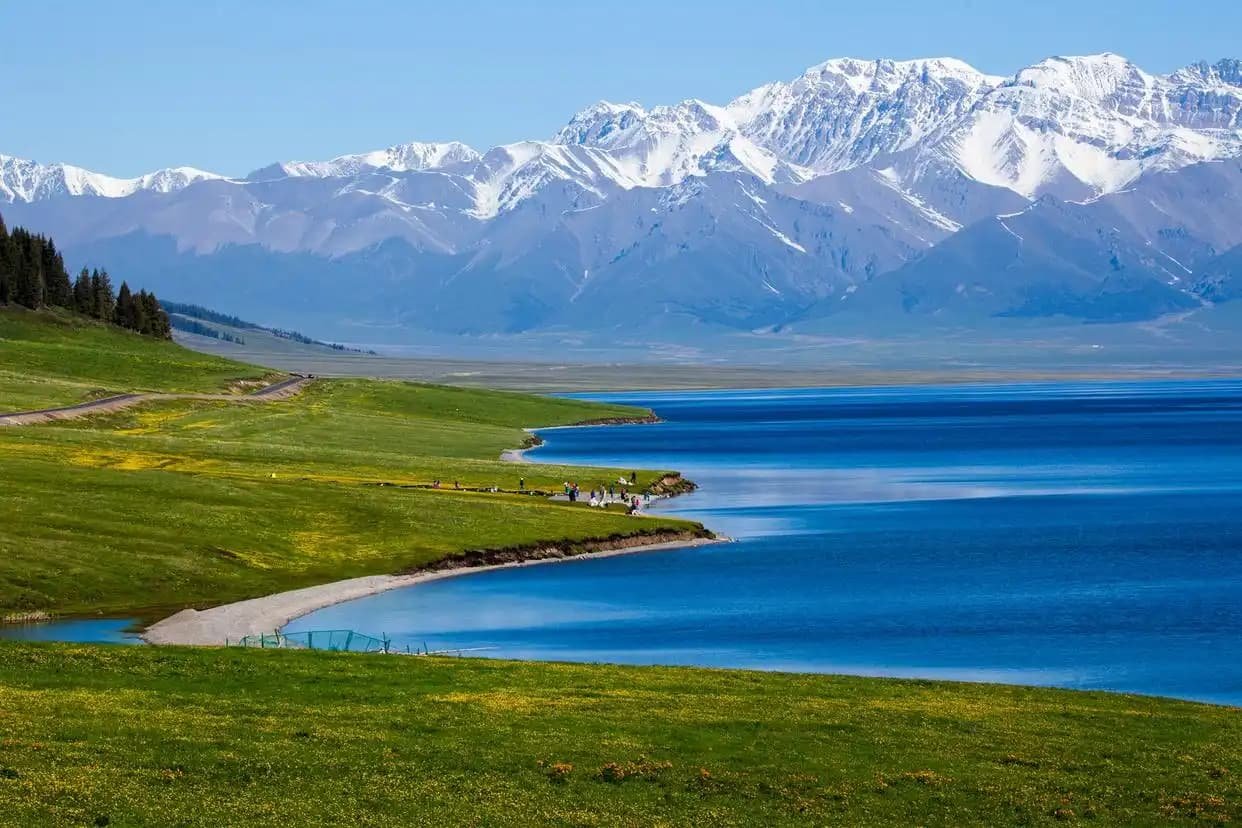 Sayram Lake alpine scenery Xinjiang China”>
A stunning 18th-century Uyghur Islamic tower in sun-dried brick, standing 44 m tall, with intricate geometric masonry and almost zero crowds. One of the most photogenic architectural subjects in Xinjiang. Built in 1777 by the local ruler Emin Khoja as a tribute to the Qing emperor Qianlong, the minaret combines traditional Uyghur brickwork with Central Asian Islamic design.
Ticket: approx. ¥45 / person. The site includes a small mosque and the mausoleum complex. Dress modestly (shoulders covered, knees covered) — this is an active religious site, not just a tourist stop.
Where to Eat in Turpan
Turpan’s food scene is a highlight. The oasis climate produces some of the best fruit in China — grapes, Hami melons, figs, and apricots that are sold by weight in the old town markets. For cooked food, look for:
- Laghman noodles (拉条子): Thick hand-pulled noodles with stir-fried vegetables and meat. Every local restaurant does their own version — the best ones use grapesiven vinegar in the sauce.
- Chuanr (烤肉串): Mutton skewers, grilled over charcoal in the open-air night market. The meat is seasoned only with salt, cumin, and chili — no marinade needed when the lamb is this good.
- Zhuafan (抓饭): “Pilaf” — rice fried with mutton fat, carrots, and onions, then steamed. The Turpan version uses raisins and apricot kernels for sweetness.
- Fresh fruit: Buy it by the kilo from roadside stands in Grape Valley or the old town market. Wash it in the canal water first (or use bottled water — better safe than sorry).
Best Season to Visit Turpan
| Season | Reality | Temperature |
|---|---|---|
| March–May & September–early November | Pleasant, 15–28°C | Ideal |
| June–August | Intensely hot but culturally active; dawn/dusk sightseeing only | 35–48°C+ |
| Winter (Dec–Feb) | Cold but crowd-free; grapevine trellises look sculptural without leaves | −10–10°C |
Practical Tips for Turpan
Hydrate aggressively. The dry desert air hides sweat loss. You can lose a liter of water an hour and not notice because it evaporates instantly. Carry 1L+ water per person at all times.
Sun protection: Wide-brim hat, sunglasses, SPF 50+. The UV index here is punishing — you can get a serious burn in 20 minutes in June–July.
Dress code for comfort: Lightweight long sleeves > tank tops (they keep sun OFF you and actually feel cooler by creating an air channel). Lightweight long pants > shorts for the same reason.
Timing your sightseeing: In summer, do your outdoor walking before 10:00 or after 18:00. The midday hours (12:00–16:00) are for indoor activities, air-conditioned restaurants, or resting in your hotel.
Getting around: Turpan’s sights are scattered. A half-day or full-day private car (¥300–500/day from Turpan station/airport) is the hassle-free choice. Didi/rideshare works within the city core but won’t take you to remote sites like the Karez Folk Garden or Gaochang Ancient City.
Suggested Half-Day Circuit
Morning (coolest): Karez system → Sugong Minaret → Grape Valley for lunch under the vines → late afternoon swing past Flaming Mountain for the light → evening back in Turpan old town for laghman noodles and chuanr (kebab).
This circuit gives you the full Turpan experience: engineering wonder, architectural beauty, agricultural abundance, and Silk Road atmosphere — all in one unforgettable day. For more Xinjiang travel tips and destination guides, explore our complete collection of independent travel resources.
Getting to Turpan
Turpan is accessible by high-speed rail (from Urumqi, ~1 hour), regular train, and by road from the G30 expressway corridor. The city itself is compact; most hotels are within ¥10–20 Didi ride of the main scenic sites. If you’re driving yourself, note that parking is available at all major sites but can fill up by 10:00 in July–August.
For foreign travelers, Turpan is one of the most accessible Silk Road destinations — no special border permit is required, and the tourist infrastructure is well-developed without feeling over-commercialized (except at the peak mid-summer window).
Featured image: Grape Valley canopy walkway. All images in this article are from our Xinjiang travel collection. Plan your trip with our complete Xinjiang solo travel and DIY guide.