
Luntai’s Tarim Poplar Forest: Driving into Xinjiang’s Golden Autumn Wilderness
Every October the poplars along the Tarim River turn the desert to gold, and in late October 2021 I finally pointed my rented car south from Korla to see it for myself. Luntai County sits in the heart of Bayingolin and protects the largest wild populus euphratica forest on earth, a place locals simply call the Tarim poplar forest. If you are driving Xinjiang on your own, this is a stop you should not skip.
Getting to Luntai from Korla
The drive from Korla to the Luntai entrance runs about 180 km, and I took the G314 north before connecting to the G3012 expressway and then dropping onto the desert road. The highway is smooth and well marked, so the hardest part is resisting the urge to stop every time the poplars appear along the way. Plan two and a half to three hours with a fuel and noodle stop, because there is not much once you turn off the main road.
Kuqa is another sensible launch point, roughly 200 km away to the west, and many travelers combine the forest with the Kuqa canyons on the same loop. If you are building a longer route, the run between Kuqa and Luntai makes a relaxed half day of easy tarmac and constant color. Our guide to Korla covers where to fuel up and which hotels are worth the money before you head into the dry country.
The desert road surface was in good shape in 2021, but a few sections had loose gravel where the wind had pushed sand across the lane. I dropped to sixty km/h there and had no trouble, though a low car would have scraped. Fill the tank in Luntai town before you commit, because the next pump of any size is a long way back the way you came.
Why this forest is the real thing
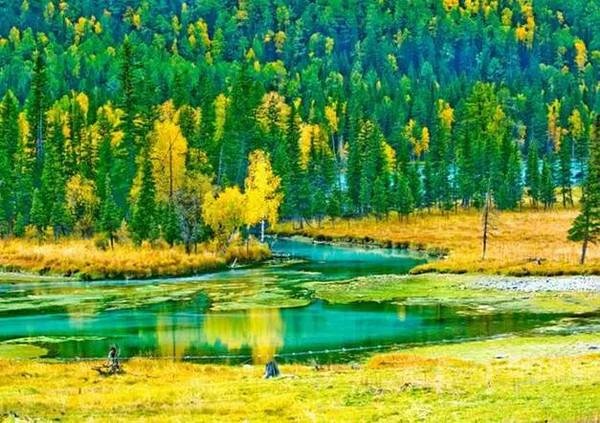
Luntai County protects around 400 square kilometers of wild populus euphratica, the desert poplar that can live for a thousand years and survives where almost nothing else will. This is not a planted park with a few pretty trees, it is a living riverbank forest that stretches as far as the eye can follow. The Tarim River feeds it, and when the leaves turn the whole floodplain becomes a band of fire against the sand.
Scientists call the species one of the toughest hardwoods on the planet, and standing among trunks that have seen a thousand autumns makes that claim feel small. I spent a long time just watching the light move across the water and the gold. Our broader Tarim poplar forest page goes deeper on the ecology if you want the background before you go.
The best window for color
The reliable window runs from about 20 October to 10 November, and late October gave me near perfect conditions in 2021. Go too early and the canopy is still half green, go too late and the wind has stripped the leaves onto the sand. Local rangers told me the peak can shift by a week depending on the first cold snap, so it pays to watch the forecast.
If your dates are fixed, aim for the back half of October and you will likely catch the peak. I arrived on the 24th and the gold was at full burn, with not a bare branch in sight. A day or two of wind can change everything, so build some slack into your route and do not book the forest as a one shot plan.
The cold is real once the sun drops, with nights near freezing by early November, so pack a warm layer even if the day feels soft. Mornings are the best light and the coldest air, a trade worth making. I wore a light down jacket over a shirt and was comfortable from eight until noon.
Tickets, the loop, and what is inside
The scenic area entry cost about 45 RMB when I visited in 2021, paid at a gate where the desert road meets the forest. From there a shuttle bus carries you to the start of a boardwalk loop of roughly 13 km that winds through the densest stands. A watchtower near the middle lets you climb above the canopy for a view that is worth every step.
The boardwalk loop
The boardwalk keeps your shoes out of the mud and gives the trees a break from foot traffic, and I found the pacing gentle enough for a slow wander. Most people walk a section and ride the shuttle back, but if your legs are fresh the full loop is a half day well spent. Bring water, because there are almost no services once you are inside the gate.
I walked about 4 km out and back and still felt I had seen the heart of the place, with the river on one side and the dunes on the other. The path is flat and wide, fine for older travelers and for kids who like to run. Take your time and let the quiet do the work.
The watchtower
Climb the tower early in the morning before the tour buses fill the base, and you get the forest as a single sheet of gold with the desert behind it. The light at sunrise is soft and the reflections in the Tarim’s side channels are clean. I stayed up there longer than I meant to, just turning slowly to take in the whole basin.
Driving the Taklamakan desert highway
The southern start of the Taklamakan desert highway sits near Luntai, and the route runs straight south to Minfeng across the largest shifting sand desert in China. I did not drive the whole thing, but standing at the start with the road vanishing into the dunes gave me a real sense of the scale. It is one of the great lonely drives on the continent if you have the fuel and the nerve.
The highway is paved and maintained, but services are hundreds of kilometers apart, so treat it as an expedition, not a casual detour. Many self drivers pair the forest visit with the first stretch south to test the road and the silence. If you want the bigger picture of the region’s fast roads, our write up of the Turpan to Kashgar expressway explains how the expressway network connects these remote corners.
Trees line the highway for the first part, a green hedge planted to hold the sand, and then they stop and the open desert begins. That moment, when the last poplar disappears in the mirror, is the one I remember. Plan fuel, water, and a satellite aware map before you commit to more than a taste.
Photography without the frustration
Go early for the light, because the midday sun flattens the gold and the tour groups arrive by ten. I shot most of my keepers between eight and nine in the soft angled light. A polarizer helped cut the glare off the water, but the real trick was patience and a tripod for the slow river shots.
Sand is the enemy of every camera out here, so bring a simple filter or a cloth and keep the body zipped when you are not firing. I learned this the hard way when a gust filled a lens cap with fine dust that took an hour to clean. A small blower brush lives in my bag now on every desert trip, and it has saved two sensors since.
Where to sleep and eat
Luntai town has basic hotels and a few noodle and kebab spots, and that is where I based myself for two nights in 2021. Do not expect luxury, but the beds are clean and the lamb skewers are excellent after a day in the cold. Korla, two hours north, has the wider range of hotels and a proper supermarket for supplies you forgot to pack.
Inside the scenic area you will find almost nothing to buy, so pack water, snacks, and a full tank before you turn off the expressway. I carried three liters of water per person and still finished the day thirsty, because the wind dries you out faster than you expect. A thermos of hot tea was the best thing in the car once the temperature dropped at dusk.
The town market near the bus station does a good hand pulled noodle for about 15 RMB a bowl, and the kebab stalls open around dusk. Eat early if you can, since the kitchen closes when the last bus leaves. Cash helps at the smallest stalls, though the bigger ones take phone pay.
Side trips worth the detour
If you have extra days, the Xayar County stands to the north offer a quieter, less built alternative with the same gold but fewer buses. I met a Dutch couple who preferred it precisely because the boardwalks were shorter and the silence deeper. Our guide to the Xayar County poplars maps the turnoffs and the best pullouts along that route.
Aksu lies further west and makes a natural next stop if you are continuing toward Kashgar, with its own oasis culture and a good museum. The road from Luntai to Aksu follows the northern edge of the Tarim basin and is an easy half day of flat driving. We cover the practical stops in our Aksu guide for anyone extending the loop toward the south.
If you have a week, the full swing from Korla down to the forest and then west to Aksu makes a clean arc with no backtracking. I met a German cyclist doing the reverse, and he said the basin road was the flattest riding of his whole China trip. Four wheels beat two legs out here, but the country rewards any slow traveler who lets the seasons set the schedule.
Logistics that save the day
Fuel up in Luntai before you enter, because the forest gate has no station and the desert road is long. Cash is useful at the smaller food stalls, though the entry gate took my card in 2021 without a problem. Tell someone your plan if you drive the desert highway section, since phone signal thins out past the first villages.
A spare tire, a full jerry can, and a downloaded offline map turned out to be the difference between a story and a problem for a friend who later drove to Minfeng. The scenery is forgiving, the distance is not. Plan like you are crossing real wilderness, because you are, and the forest is only the friendly edge of it.
My take after the drive
Luntai gave me the single best autumn day of my three trips to Xinjiang, and I say that as someone who has chased color from Ili to the Pamirs. The combination of a world class forest, a smooth self drive approach, and the edge of the Taklamakan is hard to beat. If you are in the region in late October, point the car south and do not look back.
The poplars will be there for a thousand more years, but your window is only about three weeks wide each year. Book the hotel, watch the forecast, and leave early. That gold is worth the planning, and the drive to reach it is half the pleasure.