
Yutian County: Keriya Oasis and the Road to the Deep Desert
Yutian sits where the southern rim of the Tarim Basin meets the foot of the Kunlun Mountains, and it is the last town of any size before the road runs north and simply disappears into the sand. Old maps call it Keriya, and the name still fits the mood. I came down the G315 from Hotan with a full tank and a half-formed plan to chase the desert track, and what stopped me was the town itself: a green, loud, working oasis with more going on per block than places ten times its fame.
This is a self-drive guide to Yutian as I actually drove it, the oasis and the road that points into the empty center of the Taklamakan. The town is easy, welcoming, and worth a day. The track north is a different animal, and I will be plain about where a casual rental car has to turn back.
The drive in from Hotan
Yutian lies southeast of Hotan, down the G315 that runs along the southern edge of the basin toward the Qinghai corridor. The distance from Hotan city is about 180 km, and on good pavement it took me just under three hours, with one fuel and tea stop in a roadside town. The road is flat and straight, lined first with Hotan’s orchard country, then with a thinning band of fields, then with the open gravel plain that warns you the sand is close.
I left Hotan after an early breakfast and was parked under a poplar in Yutian by late morning. The G315 here is in better shape than its reputation suggests, but the wind can throw sand across the lanes after a storm, so ask at your hotel the night before if the road was open. Closures are short but real, and a closed G315 means a long wait in the wrong town.
If you are building a southern loop, neighboring Pishan county lies further east along the same road and pairs naturally with Yutian as a two-stop run, with the Kunlun foothills behind both and the desert in front of both.
The oasis and its farms
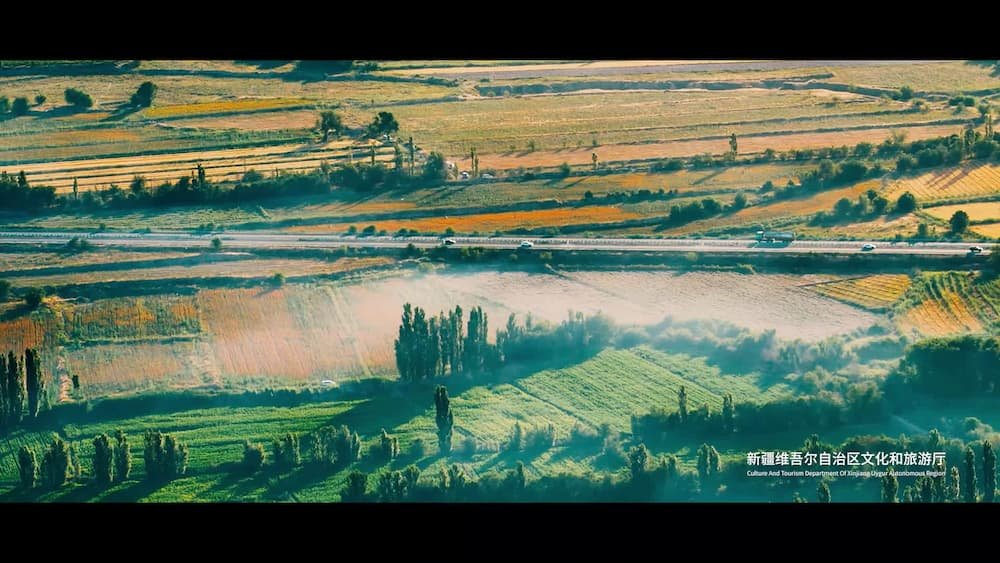
Yutian’s oasis is fed by the Keriya River, which rises in the Kunlun and dies in the sand somewhere north of town, never reaching the heart of the basin. That river is the whole reason the place exists. Along its lower reach the farms run thick: wheat, corn, and above all the mulberry and apricot plots that feed the town’s silk and dried-fruit trades. Standing on the oasis edge, you watch the green stop hard against the dunes, the same line I chased in Shaya three weeks earlier, three hundred kilometers west.
The farms are working land, and the farmers are used to a foreign face in a car but not performer of one. I pulled into a roadside plot where a family was laying apricots out on a reed mat to dry, and within minutes I was handed a warm flatbread and a handful of the fruit. That is the exchange Yutian offers freely. You bring curiosity, they bring hospitality, and nobody charges for it.
What the fields grow through the year
Spring puts apricot and mulberry blossoms across the oasis, and the air smells sweet for weeks. Summer is the melon season, when the roadside stalls pile up with the local variety that travels badly and tastes best within a day of picking. By autumn the corn dries on the roofs and the drying racks fill again, this time with grapes and the last of the apricots. Winter is quiet and cold, with the Kunlun snow visible straight above the town and the river running low.
Time your visit to the fruit and you eat better than any restaurant can manage. The when the melons ripen calendar is the simplest planning tool, and Yutian’s roadside melons in July and August are the argument for coming then. I ate one squat, pale melon bought from a trike for ¥6 that was better than anything I paid ten times as much for in a city.
Crafts: silk, carpets, and Kunlun jade
Yutian has made Atlas silk for generations, and the narrow workshops off the main street still run the old treadle looms, the weaver throwing the colored weft by hand and the pattern climbing row by row. You can watch for free and buy a length of cloth straight off the loom for far less than the bazaars downstream will ask. The carpet workshops are nearby, with wool dyed in the courtyard vats and stretched on horizontal frames, and the good ones will show you the knot count on the back without being asked.
The jade here is the quiet treasure. The Kunlun range behind town is one of the sources of what the trade calls Hetian jade, the creamy, dense stone that has been prized across China for thousands of years. Yutian sits on the Keriya River, and the riverbeds below the mountains still turn up rough pebbles after the melt. Most of what you find in the town stalls is cut and polished local material, not the famous river-rolled seed jade, but the real thing is there if you know the look. Before you spend, read the Hetian jade buying guide so you can tell a genuine pale piece from the bleached imports that flood the cheap shelves. I bought one small, uneven pendant for ¥180 from a stall holder who let me weigh it in my palm, and the density told the truth before the price did.
For the edible haul, the same dried apricot and raisin trade that fills the roofs in autumn fills the bazaar all year. My dried fruit from the south write-up covers which stalls near the Hotan road keep the cleanest stock and how to pack it for the drive home, and Yutian is the better, cheaper end of that same supply line.
The road north: toward the desert’s heart
Here is the part that pulls people in and spits some of them out. North of Yutian the Keriya River track runs straight at the center of the Taklamakan, following the dying river through a corridor of poplars, then tamarisk, then nothing. This is the route toward the last desert village of Keriya Darya, a small settled place called Boyi that lives out in the sand where the river finally fails, hundreds of kilometers from any other town. Reaching it is one of the great overland journeys in the basin, and it is not a day trip.
The first 40 km north of town are firm, packed sand and gravel, passable in a decent SUV with airing-down tires if the season is dry. Past that the surface breaks into soft dunes, the track forks and fades, and the margin for error drops to zero. I drove the first stretch, watched the poplars thin to scrub, and turned around where the track vanished into a dune field I had no business crossing alone. The village beyond is real, and people live there, but the only sensible way in is with a supported expedition: two or more vehicles, satellite communication, spare fuel carried in jerry cans, and a guide who has run the line before.
Why a rental car is not enough
The deep track has no fuel, no signal, no water, and no forgiveness. Temperatures swing past 40 Celsius in summer and below freezing on winter nights. Soft sand strands a two-wheel-drive within minutes and a careless four-wheel-drive within an hour if the driver misreads the dune face. The river corridor shifts year to year as the water moves, so last season’s GPS track can lead into a dead pan. I have driven a lot of lonely roads in Xinjiang, and this is the one I will not do solo in a rented car, full stop.
If the deep route calls you, plan it as its own trip, not a detour from Yutian. Arrange the expedition in Hotan or Kuqa, carry real recovery gear, and tell someone your outline before you leave signal range. The oasis will still be here when you come back, and the village will still be out there. The desert does not care whether you were careful, only whether you were.
Best season to visit
Spring and autumn are the windows. April and May bring the blossoms and tolerable heat, with the Kunlun still capped and the oasis at its greenest. October is my favorite: the corn is in, the days are cool, and the light on the dune line at sunset is the color of fired clay. Summer is brutal for the open road and pointless for the deep track, where the heat turns the cab into an oven and the soft sand into a trap. Winter is cold but clear, good for the town and the crafts, useless for the north run.
The melon and apricot timing overlaps spring and early summer, so a May or June visit eats well and drives easy. I came in late October and would do it again without hesitation, trading the fruit for the calm and the color.
Fuel, food, and overnight
Yutian town has reliable fuel, including at least one station that stayed open past 10 p.m. when I passed. Top off here no matter what, because north of town there is nothing, and the G315 east toward Pishan is long between stations. I keep the tank full leaving Hotan and fill again in Yutian, then carry two liters of water per person on top of that for the town wandering.
Food is the easy pleasure. Hand-pulled noodles with tomato and egg run ¥15 to ¥22. A plate of mutton kebabs and flatbread lands around ¥35 to ¥50. The morning market is the move: hot buns, boiled eggs, cups of sweet milk tea for a few yuan, and piles of the local dried fruit you can bag and carry. For fresh melon in season, buy from the roadside trikes, not the shops, and eat it the same day.
Hotels are basic and clean. A spare room with a working bathroom runs ¥100 to ¥150 a night, and you can walk in without a booking. The town quiets early, so eat before 9 p.m. The silk and jade workshops keep daytime hours and close for the long midday rest in summer, so shop in the morning or after four.
Cash, signal, and respect
Carry cash in small bills. The workshops, the trike sellers, and the bazaar stalls take yuan notes and little else. I keep ¥300 in tens and twenties for exactly this. Signal holds in town and fails the moment you turn north off the paved road, so download offline maps before you leave Hotan and do not trust the phone past the oasis edge.
Respect runs both ways here. The craftspeople are proud of the work and happy to show it, but they are not exhibits. Ask before you photograph a weaver or a stall holder, and accept a no with the same ease you would want. The desert village up north is home to people living a hard, chosen life; read about it, wonder at it, but do not treat it as a photo stop you are entitled to reach. The caution about the track is not timidity. It is simple respect for a place that can kill a careless visitor and for the people who actually belong to it.
How I’d run the day
Arrive from Hotan by late morning. Eat at the market, then walk the silk and carpet workshops through the early afternoon. Buy a length of Atlas cloth or a small jade piece, drink tea with the stall holders, and let the town set its pace. In October, drive the first paved-and-gravel stretch north toward the river corridor for an hour, turn at the dune line, and be back in town for the sunset on the oasis edge. Eat kebabs, sleep clean, leave after breakfast with the car full and the fruit bag heavier than it should be.
If the deep desert is your real goal, skip the casual version and book the expedition properly. Yutian is the last good place to do that, the last fuel, the last signal, the last hot meal before the sand takes over. Treat it as the gateway it is, and the town will give you more than the desert ever will.
Why Yutian earns the stop
Most travelers race the G315 and remember only Hotan at one end and the Pamir turnoff at the other. Yutian is the town they skip, and skipping it loses the best of the southern rim: a living oasis, looms that have not changed in generations, and a road that points honestly at the empty center of the largest shifting-sand desert on the continent. I came for the track and stayed for the town, and the town is the part I tell people about.
Drive it from Hotan with a full tank, a loose schedule, and an open mind about turning back at the sand. The oasis will feed you, the crafts will surprise you, and the desert will still be there, vast and patient, waiting for the people who came properly prepared. That balance is the whole of Yutian, and it is worth the three hours down the road.