
Shaya County: A Tarim Desert Oasis on the Edge of the Taklamakan
I first rolled into Shaya County at the tail of an October afternoon, when the poplars along the irrigation canals had gone the color of struck matches. The road out of Kuqa had flattened into the Tarim’s endless plain, and then, without warning, the sand gave way to a green seam of farmland stitched with water. That seam is Shaya. It sits on the northern rim of the Taklamakan, one of the driest places on earth, and yet here the fields run right up to the dune line. Driving it myself taught me more about the Tarim Basin than any map ever did.
Most foreign travelers blow through this stretch of the G3012 on their way to somewhere louder. That is a mistake. Shaya rewards the person willing to slow down, fill the tank, and take the county roads that thread between the groves. This is a working oasis, not a postcard set, and the working part is exactly what makes it worth the detour.
Getting there from Aksu and Kuqa
Shaya lies northeast of Aksu city, tucked against the desert’s northern edge. The cleanest approach is the G3012, the desert expressway that runs along the northern foot of the Tian Shan and skirts the Taklamakan. From Kuqa, the drive south and east toward Shaya runs about 60 km and takes roughly an hour on decent paved road. From Aksu itself, plan on 220 km and a comfortable three hours behind the wheel, most of it straight and fast once you clear the city sprawl.
I prefer entering from Kuqa. The old town there makes a natural launch point, with fuel, a proper breakfast, and the last good coffee for a while. The road east passes fields of cotton and the occasional walled orchard before the desert begins to press in. Watch the kilometer markers; the turnoffs toward Shaya’s oasis core are signed, but the signs come quick and the light at dusk makes them easy to miss. Fill up in Kuqa regardless, because small-county fuel stops keep short hours.
The G3012 is the thread that ties the northern Tarim together, and Shaya is one of its quieter beads. If your larger plan is looping the Taklamakan, this county is the natural breather between the highway stretches, a place to swap four days of desert for an evening of green and water.
What Shaya actually is
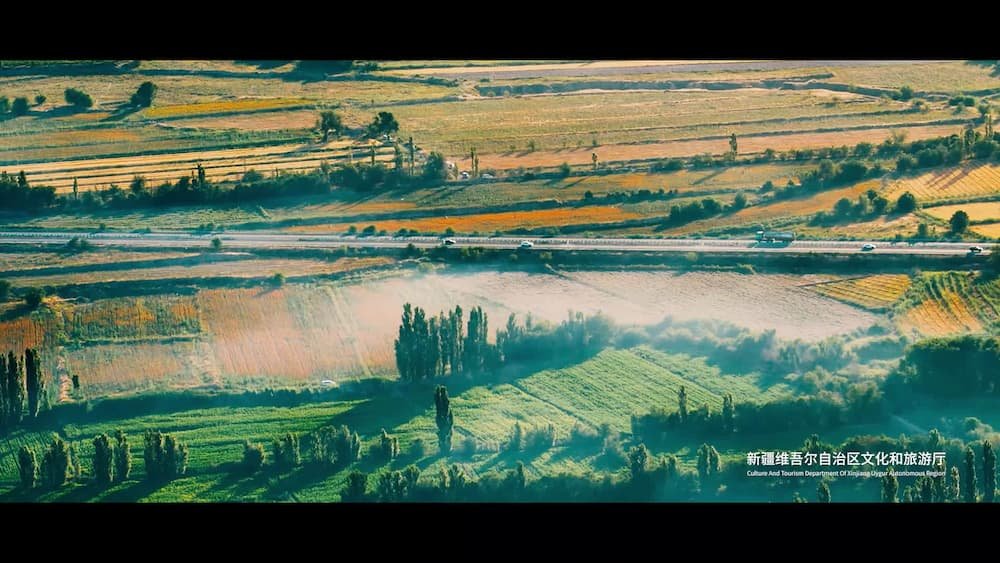
Shaya is an old oasis town, and old is not a figure of speech here. People have farmed this pocket of the Tarim for close to two thousand years, diverting river water through a lattice of canals so fine that, from the air, the farms look embroidered. The Tarim River system feeds the whole thing. Where the water runs, poplars grow, and where the poplars grow, the sand stops. Standing in a field at the oasis edge, with dunes a hundred meters behind you and wheat in front, you feel the line the desert is always trying to cross.
The town itself is modest. A grid of low buildings, a few busy noodle houses, a weekly market that swells on the fixed bazaar day, and a long main street that smells of roasting seeds in the evening. What it lacks in monuments it makes up in texture. Nobody here performs the oasis for tourists. You are simply the foreigner in a pickup, and that gets you better conversations than any ticketed sight.
The poplar groves along the canals
The populus euphratica, the desert poplar, is the tree that defines this country. It grows where almost nothing else will, sends its roots deep toward the water table, and turns a violent gold for about three weeks each autumn. In Shaya the groves line the canals like hedgerows, some standing alone in a field, some gathered into small forests that you can walk into on foot. I spent a morning following a canal path south of town, and the light under those trees at 9 a.m. was the kind you stop the car for.
These are not the famous fenced forests you pay to enter elsewhere. Many of Shaya’s groves are working windbreaks, and you can pull off and walk among them freely, as long as you stay out of the planted fields and leave the gates as you found them. The best light is early, before the wind picks up and the dust haze softens the edges. Bring water even in October. The dryness here steals it from you.
Canal-fed farmland and the rhythm of water
The farmland is the real story. Shaya’s fields are fed by a hand-built canal network that splits the river’s flow into a thousand thin threads. In spring the channels run full and the wheat and corn go in. By late summer the melon plots along the road shoulders swell, and by autumn the cotton rows turn the plain white as frost. Driving the county roads, you pass weighing stations, donkey carts, and children riding bicycles home from school between the furrows.
I stopped once at a roadside canal where an old man was washing vegetables, and he waved me over to taste a just-pulled carrot, cold and sweet from the water. That is the Shaya most guides never mention. The agriculture here is not a backdrop. It is the reason the oasis exists, and the reason the desert has not won.
Best time to drive in
Two windows beat all others. The first is mid-to-late October, when the poplars turn and the heat finally breaks. The gold lasts roughly three weeks and draws the most local photographers, but the roads stay calm and the light is absurd. The second is April and May, when the orchards around the oasis bloom and the air carries pollen and irrigation smell. Spring is cooler, greener, and far less crowded, and it lines up neatly with a spring blossom itinerary that starts up north and works its way down the basin.
Summer is survivable but punishing, with daytime temperatures that sit well past 35 Celsius and a sun that flattens the landscape. Winter is quiet, cold, and sometimes closed by blown sand on the open stretches. If you want the postcard, come for the gold. If you want the place, come in spring.
Either way, the seasonal fruit calendar tells you what you will actually eat on the road. Shaya’s roadside melons in August and September are worth a planned stop, and the early apricots in May are the kind you buy by the bag from a trike parked under a tree.
Fuel, food, and where to stop
Shaya county town has two or three fuel stations, and at least one stays open late. Do not leave the Kuqa or Aksu side low. On the open G3012 between cities the stations thin out, and a half tank in the Taklamakan is a worse problem than it sounds. I keep the needle above half the whole way across the north rim, and top off whenever I see a station that looks busy.
Food in town is straightforward and good. Hand-pulled laghman noodles run about ¥15 to ¥25 a bowl. A plate of mixed kebabs with flatbread sits around ¥30 to ¥45. The morning market sells hot sesame buns and boiled eggs and cups of sweet milk tea for a few yuan, and that is the breakfast I now plan around. For fruit and nuts, the bazaar day fills the side streets with carts, and you can load a bag of local melon or dried apricot for under ¥20.
There is no Western-style supermarket worth the name, so carry your own water by the liter. I pack four liters per person per day when driving the desert margins, and I have never regretted the weight. The heat and the dry air together drink it faster than you expect.
A note on the road itself
The paved county roads around Shaya are in fair shape, but the unsealed tracks that lead toward the dune line are another matter. They are loose sand over hardpan, and a two-wheel-drive sedan will strand you within a kilometer if you leave the asphalt after rain or wind. I drove them in a raised hatchback and turned back twice. A proper SUV with low-range and a shovel would have gone further, but the point of Shaya is the oasis, not the deep sand, and the oasis is all on tarmac.
Carry a paper map or downloaded offline tiles. Signal fades the moment you leave the main road, and the canal network forks often enough that a wrong turn costs you an hour of backtracking through fields. Locals are generous with directions, and a wave through a window usually gets you pointed right.
How it fits a Taklamakan loop
Shaya works best as a north-rim pause. Most loops run the G3012 east from Aksu through Kuqa, drop south if you are attempting a desert highway crossing, or continue to Korla and the eastern basin. Shaya sits comfortably on the Kuqa-to-Aksu leg and asks for a half day to a full day, depending on how long you linger in the groves. I treated it as an overnight, stayed in a small local hotel for around ¥120, ate twice at the same noodle house, and left the next morning with the car smelling of melon.
If poplars are your reason for coming, know that Shaya’s groves are the scattered, free cousin of the Luntai poplar forest, the famous fenced reserve an hour or two east. Luntai is the spectacle; Shaya is the everyday version, and seeing both in one trip gives you the full picture of how this tree holds a desert together.
For travelers basing out of the west, the Aksu region makes the obvious hub, with canyon country to the north and the oasis road south to Shaya as an easy day run. Pair the two and you get red rock and green water in a single loop without doubling back.
Practical things I wish I’d known
Hotels in Shaya are basic but clean. Expect a spare room, a kettle, and a bathroom that works, for ¥100 to ¥150 a night. Book nothing in advance; walk in and you will have your pick. The town winds down early, so eat before 9 p.m. or you are down to instant noodles and the all-night tea stand.
Cash still matters at the small stalls and the roadside carts. The big fuel stations and hotels take cards and phone pay, but the old man selling carrots by the canal does not. I carry ¥300 in small bills for exactly this, and it has saved a dozen small purchases.
Respect the water. The canals are working infrastructure, not scenery, and the fields behind them feed the county. Stay on the verges, close any gate you open, and do not drive through a planted plot to get a photo. The locals tolerate a curious foreigner far more readily when they can see you are careful with the thing that keeps them alive.
One more thing about the light. The Tarim flatters a camera at the ends of the day and punishes it at noon, when the glare washes every distance to white. I shot my best frames between 7 and 9 a.m. and again from 6 p.m. on, and slept through the worst of the midday brightness in the hotel. Build the schedule around the sun and the oasis gives you more than you planned for.
Why Shaya stays with you
I have driven longer, higher, and louder roads in Xinjiang, and none of them stuck the way this quiet county did. There is a particular feeling to standing at the exact line where green yields to gold yields to sand, knowing the whole thing is held together by a thousand threads of canal water and the stubbornest tree on the plateau. Shaya does not announce itself. It just keeps the desert out, one furrow at a time, and if you slow down long enough to notice, that quiet work becomes the trip.
Give it a half day at minimum, an overnight if you can, and enter from Kuqa with a full tank and an empty schedule. The Taklamakan will still be there, vast and patient, on every side. The oasis is the rare thing worth stopping for, and Shaya is one of the best of them.