
Mulei Grassland: Self-Driving the Empty North of Hami
Most drivers treat Hami as the eastern gate of Xinjiang and keep moving west. I did the opposite: I pointed the car north out of Hami and climbed into the Tian Shan, and three hours later I was standing in a green bowl of grassland that the road maps barely mention. Mulei is the kind of place that rewards the traveler who asks “what is up that road?” instead of “where does the highway go?”
Mulei Kazakh Autonomous County sits north of the Tian Shan, a high grassland pocket that most tour itineraries skip entirely. I understand why — it is far, the roads are long, and there is no famous photo to justify the detour. That is exactly why I love it. On the Hami guide route most people never turn off; the ones who do find a quiet that the headline destinations lost years ago.
The drive north from Hami
Leave Hami on the G335 heading north. The road climbs out of the basin through a canyon of red rock, then onto a high pass where the air turns cold even in July, then down into Mulei’s green basin. Budget three to four hours for the 280 km, not because the road is bad — it is paved and sane — but because you will want to stop. I pulled over twice: once where the canyon opened into a view of the whole eastern range, and once at a herder’s tent where a boy sold me a cup of yoghurt for 5 yuan and refused to take more.
The pass can be windy enough to push the car. I cover the wind behaviour in my bad-weather driving guide, but the short version is: grip the wheel, drop your speed by a third, and wait out the gusts at the next pull-off rather than fighting them. On my first crossing a crosswind shoved me halfway into the opposite lane before I slowed down; I have not made that mistake since.
The grassland itself
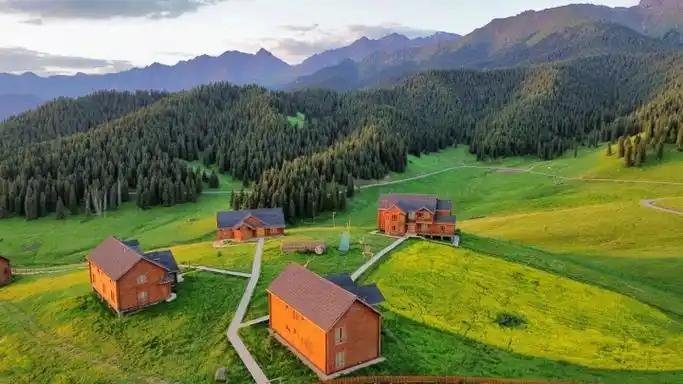
Mulei’s basin is gentler than the alpine meadows farther west. The grass is thigh-high in July, scattered with wildflowers — blue borage, yellow buttercup, the occasional red poppy — and walled by low spruce hills. Kazakh families put up yurts here from June to September, and if you wave and smile you will likely be invited for tea. I spent an afternoon with one family whose herd of sheep filled the near slope, and the grandfather, through a teenager’s translating, explained that the grass was “the bank” and the sheep were “the interest.” It was the clearest economics lesson I got all trip.
Why the emptiness is the point
The Barkol grassland near Hami gets the tour buses; Mulei gets almost nobody. On a three-day stay I passed maybe five other vehicles on the valley roads, and two of those were herders. For a self-driver chasing the “just me and the map” feeling, this is about as good as Xinjiang gets without leaving the paved road.
The altitude helps. At around 1,600 m the nights are cool even in August, and I slept with the window cracked, listening to nothing but wind in the grass. After weeks of city hotels and highway noise, that silence was the real destination.
The singing dunes and the poplars
Two side sights are worth the extra kilometres. The first is the Mulei singing sand dune — a solitary hill of fine sand on the basin’s edge that hums when the wind runs over it, and that you can climb for a view back across the grassland. The second is the desert poplar grove out toward the dry country west of the county, where a stand of old trees has held the sand for centuries. I reached the poplars in late September; the leaves were the colour of old brass and the only sound was a single bird I could not name.
Neither is developed. Both are free, unsigned, and easy to miss if you are not watching the GPS. That is the charm. The northern desert guide covers the bigger dune fields; Mulei’s is the intimate version.
Wildlife
Mulei’s emptiness is wildlife country. On the open grassland I saw demoiselle cranes, a fox that watched me from a rock for a full minute, and — at a distance, through binoculars — a small herd of goitered gazelle that spooked and ran before I could raise the camera. The wildlife guide lists the wider basin species; here you have a real chance at the smaller ones without a guide or a permit.
Drive slow on the valley tracks. The gazelle cross without looking, and a collision at speed would ruin your day and theirs.
Food and stay
Mulei town has the standard county spread — noodle houses, kebab stalls, a couple of hotels. Eat there. The grassland has yurt dairy and little else, so carry water and a snack. A bowl of beef noodles in town cost me 16 yuan and came with unlimited hot tea.
For sleeping, the county hotels are basic but clean; I paid 120 yuan for a double with a working heater, which mattered because the nights were cold. Camping on the grassland is legal and free if you leave no trace, and it is the better memory — I woke to mist on the grass and a herder’s dog barking a kilometre away.
When to go
June through September is the season. July and August are green and full of flowers; September is my favourite for the cool air and gold light. October can be beautiful but cold, and the yurts come down. Winter closes the northern pass with snow, and I would not attempt the Hami–Mulei crossing then without serious preparation.
Practical notes for the self-driver
– Fuel in Hami before you climb, and again in Mulei town. The in-between has nothing.
– The pass is exposed. Check the wind forecast; a strong crosswind day is not the day to learn the road.
– Carry cash. The town ATM was out of order on my visit, and the yurt families took only notes.
– Tell someone your route. Signal is gone for long stretches north of the pass, and a breakdown out here is a long walk.
– Respect the grassland. Stay on the tracks, close gates behind you, and do not drive onto the fresh grass — the herders notice, and they remember.
The road less driven
Xinjiang rewards the driver who leaves the obvious loop. The Duku, the Pamir, the desert highways — they are all worth it, and they are all crowded. Mulei is none of that: a green secret north of the mountains, reachable by a road most people never turn onto. Drive up, sit in the grass, and let the silence do the work. I came down the pass that evening convinced I had found the best stop nobody recommends, and I have sent no one else there on purpose. Some places are better kept quiet.
The Sunday horse market, deeper
I caught the Yanqi horse market by accident once; in Mulei I made a point of it. The county town’s open ground fills before 8 a.m. with pickups and trailers, and the animals are walked in a slow circle while buyers feel their legs, check their teeth, and argue prices in a shorthand I could not follow. A dealer, seeing my interest, showed me a yearling and traced its lineage on his phone — a photograph of a grandfather horse, then a father, then this one — with obvious pride. No sale followed; he just wanted me to see. That is the Mulei I came for: a working culture that does not perform for visitors because it assumes there are none.
A night on the grassland
Camping on the Mulei basin is the memory I keep. I parked off the valley track, set up away from the yurts out of respect, and cooked as the light went long. A fox came to the edge of the firelight and watched me for a full minute before melting into the grass. I slept with the window cracked and woke to mist on the meadow and the herder’s dog barking a kilometre off. The vehicle security basics still apply — lock up, hide nothing — but out here the only thief is the wind.
Costs and logistics
Mulei town hotels run 100 to 150 yuan; a yurt stay with a family is 80 to 120 yuan with a meal; the grassland itself is free to camp. Fuel in Hami before the climb, and again in Mulei if the station is open. A two-day Mulei detour — drive up, market, night on the grass, drive down — cost me under 400 yuan beyond fuel, and gave me the quietest forty-eight hours of the trip.
Weather realities
The northern pass is the weak link. In summer it is merely windy; in shoulder season it can ice over for a day; in winter it closes. I check the forecast obsessively before the crossing and have once turned back at Hami when a snow warning came through by mid-morning — a boring decision that kept me off a white road. The bad-weather guide covers the technique; the discipline is mine.
Why Mulei over the famous grasslands
The Barkol grassland is closer to Hami and better known, and it is lovely. Mulei is farther, quieter, and older in feel — a high basin the tour buses skip because there is no gate to charge. For a self-driver chasing the unmediated version of Xinjiang, that absence of a gate is the whole point. I have sent no one else there on purpose, and I will not start now; some roads are better for staying a little secret, and this is one.
The road north from Hami is the kind you remember for the climbing, not the destination. The canyon out of the basin is red and narrow; the pass is cold and windswept even in July; the drop into Mulei opens like a held breath. I once stopped at the pass just to feel the temperature fall ten degrees in as many minutes, and watched a hawk ride a thermal without a single wingbeat. Those small stops — not the named sights — are why I drive this road slowly.
For the Sunday horse market, arrive by 8 and bring nothing to sell and no plan to buy; just watch. The bargaining is a performance of respect as much as price, and a visitor who watches without interrupting is welcomed in a way a buyer is not. I left with no horse and a better understanding of the place than any purchase would have given me. Mulei rewards the passenger more than the shopper, and the grassland rewards the patient more than the punctual.
If you camp, the rule is simple: pull well off the track, leave the yurts undisturbed, and pack out everything. The basin wind will scatter any loose trash across the grass, and the herders notice. I tied my bags shut and weighed them with a rock; the morning was clean, the grassland was clean, and that was the whole contract.