
Xinjiang Wildlife Watching: Snow Leopards, Wild Camels & Birds
I have spent about 40 hours of my life looking for snow leopards in Xinjiang and I have seen one, for nine seconds, at roughly 900 metres distance, through a borrowed spotting scope. It was moving along a scree band above a valley south of Tashkurgan and my Tajik guide found it before I had even got the scope onto the right ridge. Then it went behind a rock and that was that.
Nine seconds. Worth every one of the forty hours, and I want to be honest at the outset that this is what wildlife watching here looks like. It is not a safari. Nothing is habituated, the distances are enormous, and the animals have spent centuries learning that people are a problem.
Snow Leopards
China holds a majority of the world’s snow leopard range and Xinjiang contains a large share of it — the Tianshan, the Kunlun, the Pamirs and the Altai all support populations. The Taxkorgan reserve in the far southwest is the most accessible serious habitat.
When. Winter, unambiguously. From December to March the blue sheep and ibex the cats follow come down to lower elevations, and the cats come with them. Snow also gives you tracks, which is often how a sighting starts. Summer means high, spread-out animals and long green slopes that hide everything.
Where. The valleys running east off the Karakoram Highway between Karakul Lake and Tashkurgan. Specific valleys change with local conditions and I am not going to name the one I visited, because a named valley with a stream of visitors in it becomes an empty valley.
How. Hire a Tajik guide from a village, not a tour company in Kashgar. Rates ran ¥300 to ¥500 a day in 2023. These are people who herd on these slopes and know which ridges have been holding ibex this month. Without one your chances round to zero.
Realistic odds. A dedicated five-day winter trip with a good local guide, sitting on glassing points from before dawn, gives you maybe a one-in-four chance of a sighting. That is not a discouraging figure by snow leopard standards; it is a good one.
What you will almost certainly see instead: Siberian ibex, in numbers, sometimes 40 or 50 in a group on a slope. Blue sheep. Golden eagles. Lammergeiers with three-metre wingspans working the thermals below you, which is a strange thing to look down on. Tashkurgan itself is worth the trip regardless, as our Tashkurgan guide lays out.
Take a scope. A 20-60x spotting scope is not optional at these distances and binoculars alone will leave you looking at grey dots. Mine is a mid-range 65 mm and it has been the difference between “something moved” and an identification.
Wild Bactrian Camels
The rarest large mammal on this list and one of the rarest anywhere. Camelus ferus — the genuinely wild two-humped camel, a separate species from the domesticated one — survives in a few desert pockets, with the largest in the Lop Nur Wild Camel National Nature Reserve east of the Taklamakan. Global wild numbers are estimated in the high hundreds.
The reserve covers a vast area of desert and is largely closed to visitors. This is correct and I would not want it otherwise. The animals survive there precisely because almost nobody goes.
What that means in practice: you are not going to see a wild Bactrian camel on a normal trip, and anyone offering you a tour to do so is either selling you domesticated camels or something you should decline. What you can do is understand the habitat. Crossing the Taklamakan on the desert highway between Luntai and Minfeng gives you 550 kilometres of the environment these animals live in — the shifting sand, the sparse tamarisk, the salt crust. Our Taklamakan desert highway guide covers the drive.
Along the Tarim River corridor you have better odds of goitered gazelle, which move fast and away, and of desert foxes at dusk.

Przewalski’s Horse at Kalamaili
This is the reliable one, and the story behind it is good.
Przewalski’s horse — the only never-domesticated horse species — went extinct in the wild in the twentieth century, surviving only in zoos. A breeding centre was established in Xinjiang in the mid-1980s using animals repatriated from European collections, and reintroduction into the Kalamaili reserve in the Junggar Basin began in the early 2000s. There is now a free-ranging population.
The breeding centre near Jimsar, roughly two hours from Urumqi, is open to visitors and has horses in large enclosures. It is not wild, but it is the only place most people will see the species, and the interpretation is decent.
For free-ranging animals you drive the roads through the Kalamaili area, which the G216 crosses. Early morning and late afternoon. Alongside the horses you have a reasonable chance of Mongolian wild ass — kulan — which are more numerous and easier to spot, and goitered gazelle.
Autumn and spring are best. In summer the animals concentrate near water and disperse widely at night; in deep winter the roads get hard.
Bayanbulak: Swans, and the Best Birding Day in Xinjiang
The Swan Lake reserve on the Bayanbulak plateau, at around 2,400 metres, is China’s main breeding ground for whooper swans. They arrive as the ice breaks in late March and April, breed through the summer, and leave in October.
Numbers vary year to year but you are looking at thousands of birds across the wetland complex, alongside ruddy shelduck, bar-headed geese, black storks, and a long list of waders. The viewing area gives you distant birds; a scope transforms the experience.
Timing. Late April and May for arrival and display behaviour. June and July for breeding with young. Mornings, before the wind gets up on the plateau.
Practicalities. Bayanbulak is high, exposed and cold at dawn even in July. It sits on the Duku Highway route, so most people combine it with the drive. Accommodation in the town is basic; there are better rooms in Nalati two hours away, at the cost of a very early start.
Kanas and the Altai Forest
The Kanas reserve holds the most complete boreal forest fauna in China — moose, brown bear, lynx, sable, wolverine, red deer, and a long list of species you will not see because they are forest animals and forest animals are invisible.
What you realistically get: red deer at dawn on the meadows near Hemu, red squirrels everywhere, and birds. The birding is genuinely good — three-toed woodpecker, black woodpecker, nutcracker, hazel grouse if you are lucky and quiet, and Siberian jay in the larch.
Then there is the taimen. Kanas Lake holds Hucho taimen, a large predatory salmonid, and it is the origin of the local lake monster stories. Big taimen are genuinely big — the species reaches well over a metre — and sightings of dark shapes in the water from Guanyu Pavilion have kept the legend going for decades. Fishing is prohibited in the reserve.
Walk the boardwalks early, before the shuttle brings the day’s visitors. Between 07:30 and 09:00 in September I have had entire sections of shoreline to myself and seen more in an hour than in the rest of the day. Our Kanas guide covers the trail layout.
Sayram Lake and the Northwest Wetlands
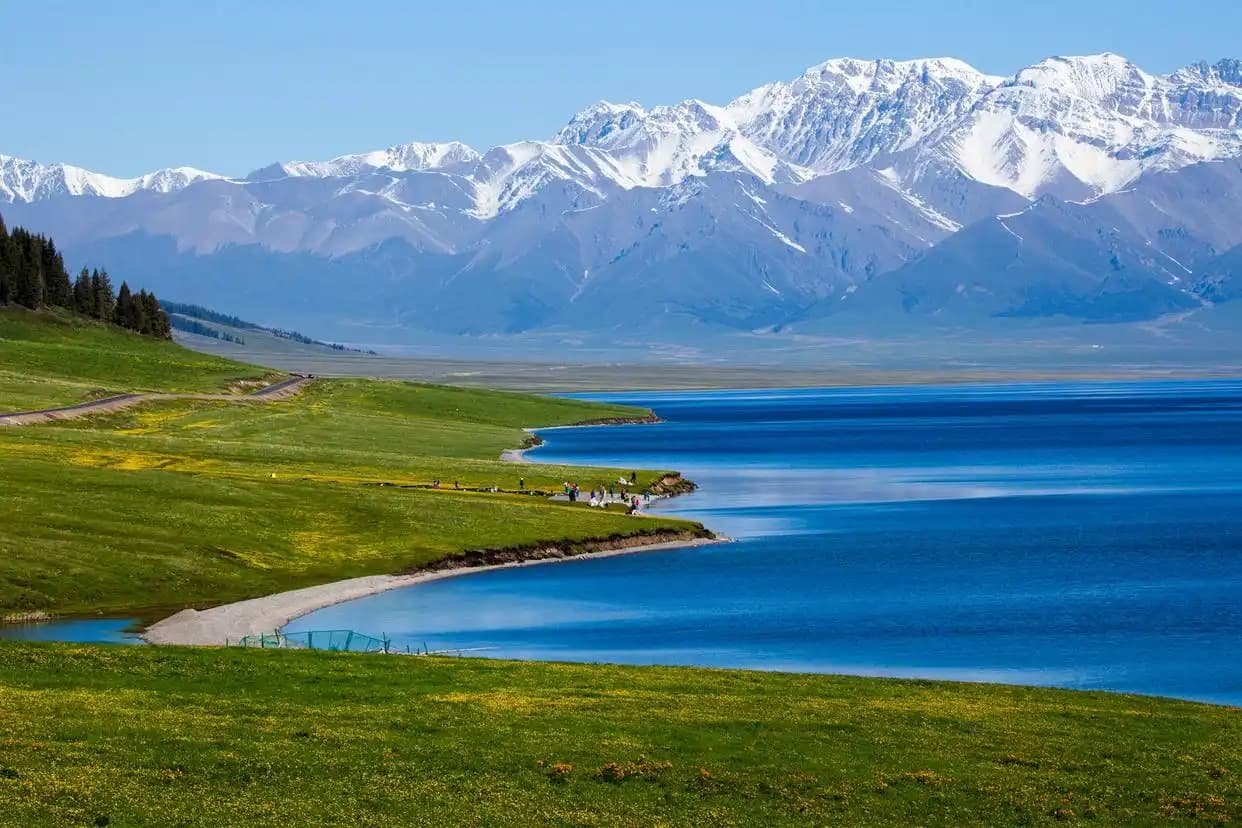
Sayram at 2,073 metres is a migration stopover and a summer breeding site. Great crested grebes on the water, ruddy shelduck on the shore, gulls, and raptors over the surrounding grassland — steppe eagle, upland buzzard, and if you are patient, saker falcon.
Marmots are the animal you will actually spend time with. The grassland around the lake is riddled with colonies and they are curious enough to sit up and watch you. Do not feed them and do not approach burrows; marmots in Central Asia are a plague reservoir and this is not a theoretical concern.
May and September are the best months. Our Sayram Lake guide covers the circuit road and where to stop.
Further west, the Ebinur Lake wetland and the Ili River delta hold larger waterbird concentrations and see almost no foreign visitors. Access is patchy and you need a car.
A Realistic Species List
What a two-week trip covering the Pamirs, the Junggar Basin and the Altai might actually produce, based on my own notes:
Likely. Siberian ibex, marmot, goitered gazelle, red fox, red deer, golden eagle, lammergeier, Himalayan griffon, upland buzzard, whooper swan, ruddy shelduck, bar-headed goose, chukar, Himalayan snowcock (heard more often than seen).
Possible with effort. Argali sheep, Mongolian wild ass, Przewalski’s horse in the wild, black stork, saker falcon, Pallas’s cat if you are extraordinarily fortunate.
Unlikely. Snow leopard, brown bear, lynx, moose, wolf.
Effectively impossible for a visitor. Wild Bactrian camel.
Setting that expectation before you go is the difference between a good trip and a disappointing one.
Ethics, Which Are Not Optional Here
Several of these species are in trouble and a badly behaved visitor does real damage.
Distance. If an animal changes what it is doing because of you, you are too close. Argali and ibex will run, and running costs them calories they cannot spare in winter.
No baiting. Anyone offering to put out meat for a snow leopard or an eagle should be refused and reported to the reserve.
Drones stay grounded around wildlife. They panic ungulates badly and they are prohibited in most reserves anyway.
No playback for birds during breeding season. It pulls males off territory.
Stay on tracks in the desert and grassland. Tyre scars in arid soil last decades and crossing crusted ground breaks a surface layer that took years to form.
Hire locally. A Tajik or Kazakh guide earning ¥400 a day from wildlife tourism is a household with a direct financial interest in the animals surviving. This is the single most useful thing a visitor does. Broader context on responsible travel here is in our sustainable tourism guide.
Kit
Binoculars in 8×42 or 10×42. A spotting scope for the Pamirs and Bayanbulak, ideally with a lightweight tripod you will actually carry. A long lens if you photograph, and understand that 400 mm is a starting point rather than a luxury at these distances.
For winter Pamir work: everything from a serious cold-weather list, plus a foam pad to sit on, because glassing means sitting still on frozen ground for three hours and that is where people give up.
Three Trips Worth Building
Winter Pamirs, seven days. Kashgar in, two nights acclimatising, then five days based in a Tajik village with a local guide, glassing morning and evening. February. Cold, hard, and the only serious snow leopard attempt on this page.
Junggar and Altai, ten days, September. Urumqi to the Jimsar horse centre, Kalamaili by road, north to Burqin and Kanas. Combines wildlife with the best of the autumn colour.
Bird spring, eight days, May. Urumqi, the Duku Highway south to Bayanbulak for swans, then west into the Ili Valley for Sayram and the Ebinur wetlands.
What Nine Seconds Buys You
My guide, whose name was Rahmat and who herded goats on the slope we were watching, had seen four in his life. He was as excited as I was, which surprised me, and he told me afterwards that his father had lost lambs to one and had still never wanted them gone.
That conversation was worth more than the sighting. The animals here survive in a landscape people also use, and the balance is negotiated locally, household by household. Turning up with a scope and paying someone ¥400 to help you look is a small contribution to that. Turning up with a drone and a bag of meat is the opposite.
I still have the note I made in the car afterwards, at 08:52, three words and a grid reference I have since blurred. The scope is still in the cupboard. I will go back in February.