
Stargazing in Xinjiang: Dark Sky Locations & Astrophotography Tips
The first clear night I spent at Karakul Lake I walked out of the yurt at what I thought was a sensible hour — half past ten — and found a sky that was still visibly blue in the west. I stood there feeling cheated, went back in, and fell asleep. When I got up at 03:10 to use the outhouse the Milky Way was directly overhead and so bright it was casting a faint shadow off the yurt.
That is the single most useful thing I can tell you about stargazing in Xinjiang. The clock lies to you, and if you plan by it you will sleep through the good part.
The Clock Problem, Again
Xinjiang runs on Beijing time while sitting up to three time zones west of it. Solar midnight — the moment the sun is furthest below the horizon, and the centre of your dark window — falls at roughly 02:55 in Kashgar, 02:10 in Urumqi and 02:12 in the Altai.
Real numbers for June, all Beijing time:
- Karakul Lake / Pamirs (38°N) — astronomical darkness roughly 00:50 to 05:00. A four-hour window and it is fully dark.
- Taklamakan / Luntai (41°N) — darkness roughly 00:20 to 04:20.
- Kanas (48.7°N) — no astronomical darkness at all in June. The sun never gets 18 degrees below the horizon and the northern sky stays washed out all night.
That last point catches people badly. Kanas is the most photogenic dark-sky location in the region and it is unusable for deep-sky work in midsummer. It comes good from around mid-August and is excellent through September and October.
By contrast the Pamirs and the Tarim rim work all summer, and their solar midnight sitting at nearly 03:00 means you can eat dinner at 21:00, sleep for three hours, and be out at midnight without wrecking yourself.
Why the Skies Here Are Good
Three things stack up. Population density across most of the region is extremely low, so there is no light dome once you are an hour from a city. Humidity is low, which improves transparency — the desert basins and the Pamir plateau both sit in genuinely dry air. And elevation helps: Karakul at 3,600 metres puts you above a meaningful fraction of the atmosphere.
This is not just my impression. Site-testing campaigns on the Muztagh Ata massif, at around 4,500 metres, have reported median seeing figures under one arcsecond, which puts the location among the better astronomical sites anywhere in the world. Xinjiang also hosts the Nanshan station of the Xinjiang Astronomical Observatory outside Urumqi with its 26-metre radio dish, and a much larger radio telescope has been under construction in Qitai County. There is a reason professionals are building here.
The Locations
Karakul Lake and the Pamir Plateau
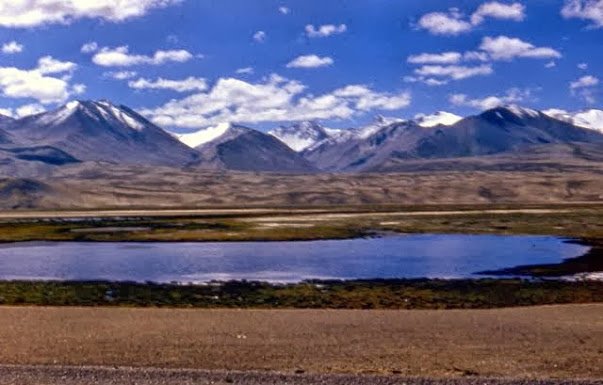
My first choice. At 3,600 metres on the Karakoram Highway, four hours south of Kashgar, with Muztagh Ata at 7,509 metres on the far shore. You get an enormous mountain silhouette, still water when the wind drops, and air that is about as clean as it gets.
Practical shape of a night: the yurt camps and small guesthouses on the lakeshore mean you can sleep on site. Wind usually drops for a period after midnight, which is when the reflection becomes possible. Temperature at the lake in September goes below freezing after dark even when the day was 18°C.
Altitude is the tax. Sleeping badly at 3,600 metres is normal, and getting up at 01:00 to stand in the cold when you already have a headache requires more resolve than the photographs suggest. Spend the previous night lower if you can. Access, permits and where to stay are in our Karakul Lake and Muztagh Ata guide.
The Taklamakan Desert Highway
Five hundred and fifty kilometres of road between Luntai and Minfeng with essentially nothing along it but sand and the shelter belt. Pull off at one of the maintenance station lay-bys, walk 200 metres from the road, and you have a horizon-to-horizon sky with no obstruction in any direction.
The flat horizon is the point. Everywhere else on this list gives you mountains that eat 20 or 30 degrees of your sky. Here you can shoot the galactic core low over dunes.
Warnings that matter: this is a genuinely remote road at night, phone signal is intermittent, and you must not park where a truck cannot see you. Carry more water than you think and tell someone your plan. Route detail in our Taklamakan crossing guide.
Kanas and Hemu
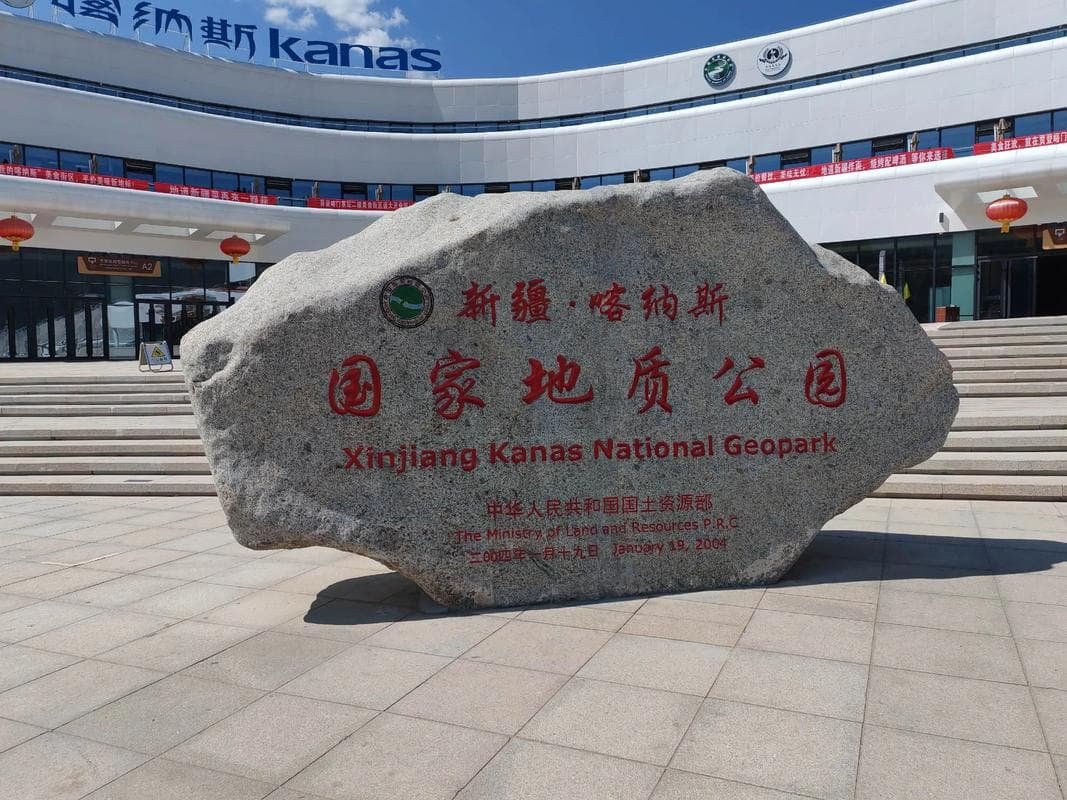
August through October only, for the twilight reasons above. What Kanas gives you that the desert cannot is foreground: larch forest, log houses, a lake, and in late September the trees are yellow, so a moonlit frame has colour in it.
The trade-off is humidity. Dew and valley mist are common and I have had a lens fog over twice in one night. Bring a dew heater strap or at minimum a supply of chemical hand warmers taped to the lens barrel.
Light pollution inside the scenic area from the guesthouse clusters is real but localised. Walk fifteen minutes from Hemu village along the valley and it drops away. Our Kanas three bays guide shows the boardwalk layout, which is useful when you are navigating it in the dark.
Kuerdening
The one nobody uses. A spruce valley south of Gongliu in the Ili Valley, at around 1,600 to 2,000 metres, with very little development and no through traffic at night. The forest gives you black conifer silhouettes against the sky, which is a completely different look from the bare mountain foregrounds elsewhere.
It is lower and greener than the Pamirs, so transparency is not as good and cloud is more frequent. It is also five hours from Karakul in difficulty terms — you can drive in, sleep in a guesthouse, and walk out into the dark without any of the altitude misery. Practical access in our Kuerdening guide.
Bayanbulak Plateau
At 2,400 metres, wide open, and on the Duku Highway route so it fits into an existing itinerary. The Nine Bend River gives you water in the foreground. It is windy and cold and there is nowhere to hide from either.
Sayram Lake
Accessible, 2,073 metres, water plus mountains, and you can drive to a shoreline position and work from the car. The nearby road carries traffic and headlights sweep across your frames, so choose a spot on the far side from the highway.
When to Go
Milky Way core season runs roughly from March to October. The core sits low in spring, climbs through summer, and by August and September it is high in the evening sky at these latitudes rather than only after midnight — which is why September is my preferred month overall. Dark skies, comfortable core position, and autumn colour for foregrounds.
Moon phase beats everything. Plan around new moon. A three-day window either side gives you six usable nights a month; anything past first quarter and you are shooting landscapes lit by moonlight instead, which is a legitimate style but a different one.
Meteor showers. The Perseids peak around 12 to 13 August and coincide with warm nights in the Pamirs. The Geminids around 13 to 14 December are stronger but you will be shooting them at minus 20°C. The Quadrantids in early January are brief and sharp.
Winter deep sky. Orion, the winter Milky Way, and the longest dark windows of the year. Also minus 25°C at Karakul, so this is for the committed.
Camera Settings That Work
Starting point for a full-frame body with a fast wide lens, untracked:
Focal length 14 to 24 mm. Aperture wide open, or one third of a stop down if your lens has ugly coma in the corners. Shutter 10 to 20 seconds depending on focal length — divide 300 by your focal length for a conservative figure rather than the old 500 rule, which was written for lower-resolution sensors. ISO 3200 to 6400.
Focus manually on a bright star using live view at maximum magnification, then tape the focus ring. Autofocus will not do this and your lens’s infinity mark is a lie.
Shoot raw, obviously, and take twenty frames of the same composition so you can stack for noise. At high ISO the difference between one frame and a stack of twenty is not subtle.
For serious work, a small star tracker changes everything. Two minutes at ISO 800 with a tracker beats twenty seconds at ISO 6400 by a wide margin, at the cost of needing a separate untracked frame for the landscape and blending the two.
Things That Go Wrong
Batteries. Cold at 3,600 metres in September will halve a battery. Carry four, keep them inside your jacket, rotate.
Dew. A problem at Kanas and Sayram, rarely in the desert. A lens heater strap and a USB power bank solves it. Hand warmers and a rubber band is the field fix.
Wind. The Pamirs and Bayanbulak both get wind that will shake a tripod. Hang your bag from the centre column, retract the thin leg sections, and get low.
Your own light. Use a red headtorch on the lowest usable setting. If there are other photographers present, this is basic courtesy; if there are not, it preserves your own dark adaptation, which takes 20 minutes to build and one second to destroy.
Altitude. Standing still at 3,600 metres for three hours in the cold at 02:00 is harder than it sounds. Eat before you go out. Take a flask.
Where You Should Not Set Up
This needs saying plainly. Large parts of southwestern and northwestern Xinjiang sit near international borders, and setting up a tripod and long exposures at night close to a border zone is a bad idea. Stay well inside areas where tourists are normally present. If a checkpoint tells you an area is not for night access, that is the end of the conversation.
Some scenic areas close at night and you cannot be inside them after closing without arrangement — Kanas and Sayram both have gate systems. Staying at accommodation inside the scenic area is usually what makes night access possible, so book accordingly.
Drones at night are prohibited in most of these locations and the rules are enforced.
A Six-Night Dark-Sky Route
Night one, Kashgar. Not for the sky — for acclimatising and buying supplies.
Nights two and three, Karakul Lake. Two attempts, because one clear night in two is a realistic hit rate on the plateau in September.
Night four, Tashkurgan at 3,100 metres for a lower-altitude recovery night, with usable sky if the weather cooperates.
Nights five and six, back through Kashgar and out to the Taklamakan highway if your route allows, for the flat-horizon version.
Target the new moon. Check it before you book anything else, because the moon is the one variable you cannot negotiate with.
An Easier Version
If the Pamirs are too much, do this instead. Fly to Urumqi, drive to Sayram Lake in a day, spend two nights there in September around new moon. You get 2,073 metres, a lake foreground, snow peaks, no permits and no altitude problem. It is a genuinely dark site and it asks almost nothing of you.
Add Kuerdening for two more nights and you have a four-night trip with two completely different foregrounds and no drive over four hours.
For daytime work in the same locations, the sunrise and sunset timings that pair with these night sessions are in our golden hour photography guide — the two activities share locations and fight over your sleep.
What It Actually Feels Like
I went back out at Karakul on the second night, properly this time, at 00:40 with a flask and a foam pad. Sat on the shore for two hours. The wind dropped around 01:30 and the lake went flat enough to hold the reflection of the mountain, and above the mountain the core of the galaxy was sitting there looking like a photograph rather than a thing you see with your eyes.
Nothing moved. There was no sound at all except my own breathing, which at 3,600 metres you become extremely aware of. A truck came down the Karakoram Highway at about 02:20 and its headlights swept the far shore for maybe forty seconds and then it was gone and the silence closed back over.
I got eleven usable frames that night and one of them is on my wall. But the thing I would go back for is the two hours of sitting, which does not photograph and does not need to.