
Bachu and Red Bay: A Self-Drive Stop on the Kashgar-Aksu Run
The drive from Kashgar to Aksu is one of those Xinjiang legs that tests your patience: nearly 280 km of dead-straight G3012 across the Tarim Basin, the desert on both sides, and not a single reason to stop — until Bachu. Most people blow through. I pulled off on a whim, followed a sign for “Red Bay,” and found water in the middle of the driest country I had driven in weeks. Bachu turned a boring transfer day into the best unexpected stop of my southern loop.
Bachu County sits on the G3012 expressway roughly halfway between Kashgar and Aksu, about 3.5 hours east of Kashgar by car. The town itself is an ordinary Tarim basin county — dust, poplars, and a long main street — but a few kilometres out, the land does something surprising.
The road in
From the G3012 Bachu exit, head north toward the county seat, then follow the Red Bay signs another 15 km on a decent paved road. The first surprise is the green: irrigation has turned the fringe of the county into a band of farmland, and the air smells of cut wheat in harvest season. The second surprise is the water.
Red Bay is a sprawl of linked lakes and reed beds fed by the Tarim River, walled on the far side by low red-ochre hills — hence the name. In summer you can rent a small boat and putter out among the reeds, where egrets lift off in twos and threes and the only sound is the motor and the wind. I went in late September, when the water was low and the mud flats glowed at sunset, and I had the whole eastern shore to myself. It is not a famous view. It is a relief, and after two days of desert that counts for more than scenery.
Why stop here at all
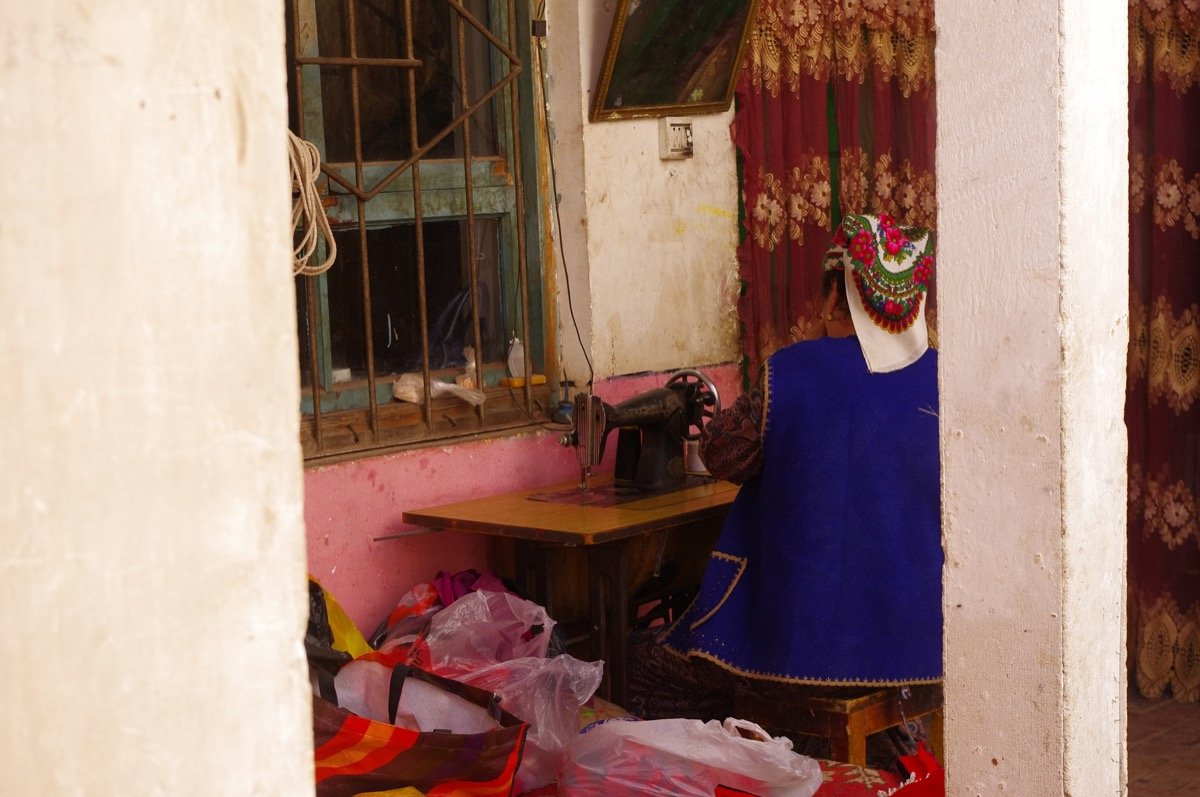
Two things make Bachu worth a half-day rather than a fuel stop. The first is the contrast — a wetland in the Tarim is the kind of geographic joke that only makes sense when you are standing in it. The second is the bazaar. Bachu keeps a lively Friday market, and if your timing is right you will see more of real southern Xinjiang life in an hour there than in a day of scenic-area ticket queues. I cover the wider bazaar calendar in my bazaar days guide, but Bachu’s is one of the easier ones to catch because the county is right on the main road.
The poplars
Around the lakes and along the approach road grow desert poplars — the same Tarim Basin trees that draw crowds to bigger poplar reserves in autumn. Bachu’s are smaller and free, and in October they turn the same violent gold. I drove the loop road slowly, window down, and counted maybe a dozen other vehicles in two hours. For a self-driver threading the long southern loop, that ratio — gold trees, no crowds — is the whole game.
What to bring
– Water and shade. The lakeside has little shelter, and the basin sun is unforgiving even in September.
– Cash for the boat and the bazaar; the lakeside vendor took only paper money.
– A full tank. Bachu has fuel, but the stations near the scenic area are sparse; I topped up in the county seat.
– Patience for the bazaar. It starts at dawn on Friday and is done by early afternoon; miss the window and you miss the point.
The Friday bazaar
If you only do one thing in Bachu, make it the market. It spreads across a dusty field on the edge of the county seat, and by 9 a.m. on Friday it is a press of tractors, donkey carts, and stalls selling everything from tractor tyres to live sheep to piles of the local melon. The melon is the point: Bachu grows a small, intensely sweet variety called “liuxiang” that you will not find in northern Xinjiang, and in August the air at the market smells of cut rind.
I bought a wedge for 3 yuan, ate it leaning against a cart, and watched a bargaining session over a goat that involved more hand gestures than words. Nobody paid me any attention, which is the highest compliment a foreign driver can hope for in a place like this. The Aksu guide covers the bigger city markets, but Bachu’s smallness is its advantage: you can see the whole thing in an hour and still make Kashgar for dinner.
Food to look for
Beyond the melon, Bachu has two local specialties worth chasing. The first is the “Bachu mushroom” — a sandy-desert fungus that appears after spring rains and turns up in noodle soups at the county’s small restaurants. I found it in a 15-yuan bowl of laghman at a shop near the bus station; earthy, a little chewy, unlike anything on a northern menu. The second is the usual southern Xinjiang kebab culture, done here with the small-fat-lean rhythm that defines the region’s chuanr.
Eat in the county seat, not at the lake. The scenic area has a single overpriced café; the town has the real thing.
When to go
April to October is the window. September and October are best — cool enough to walk, and the poplars and melons both at their peak. Summer is ferociously hot; winter is cold and the lake partly frozen, but the bazaar still runs and the town is quiet. I would not cross the basin in depth in winter without reading the expressway conditions guide first, because wind and ice can close the road.
Practical notes for the self-driver
– Bachu works as a break, not a base. Stay in Kashgar or Aksu and use it as a 3-hour stop, unless you are camping at the lake (allowed on the fringe, pack out everything).
– Fuel in the county seat, not at the scenic gate. The lake road has no reliable station.
– The G3012 is monotony with a speed camera. The limit drops in the county sections; I picked up a fine once for missing a change from 120 to 80 km/h near an exit. Watch the signs.
– Friday is the day for the market but also the busiest on the roads. If you hate traffic, come Saturday for the lake and skip the crush.
– Cash, always cash at the small stalls. The county ATM worked for me, but the lakeside vendors wanted notes.
Why it earns a stop
The Tarim Basin is a long, empty drive, and most people treat it as distance to be survived. Bachu is the exception that proves the rule — a place where the desert briefly holds water, the poplars go gold, and a Friday market reminds you that real life is happening on both sides of the highway. I have driven the Kashgar–Aksu run four times now, and the only version I remember is the one where I stopped. Pull off, walk the reeds, eat the melon, and get back on the road with the basin still ahead of you.
Camping at Red Bay
The fringe of the wetland, away from the small café, is open and free to camp on if you pack out everything you bring. I pitched a tent one October evening on a low rise above the reeds, cooked on a gas stove, and watched the sun drop behind the red hills while a line of egrets navigated the shallow water below. By full dark the basin went silent in a way the cities never do, and I woke to mist on the lake and a heron studying me from ten metres away. Carry water — the lake is brackish — and leave the shore as you found it; this place stays good precisely because nobody has built it up.
The poplar grove in detail
The trees around Bachu are smaller than the famous reserves but no less gold, and you can walk among them freely. I followed a farm track from the lake road into a stand where the trunks lean at every angle, silver and black against the yellow leaves, and the ground was carpeted with fallen ones I crunched through ankle-deep. A local told me, through gestures, that the wood was “old, old” — he held his hands far apart — and that the county protected it. Good. The Tarim loop guide routes past bigger groves, but Bachu’s are the ones you can stand inside alone.
Costs
Red Bay entry, where charged, was a few dozen yuan; the boat was about 50 yuan for a short run; the Friday market costs nothing but what you buy (melon 3 yuan, a meal 15 to 25 yuan). Fuel in Bachu town is normal price. A half-day stop — lake, poplars, market — costs under 150 yuan beyond your fuel. I consider it the best-value break on the whole Kashgar–Aksu run, because the setting is unique and the crowds are not.
A note on the wider loop
Bachu sits almost exactly halfway on the southern G3012, which makes it the natural reset point on a long basin crossing. I use it to fuel, eat something real, and walk off the highway stiffness before the next empty hundred kilometres. If you are driving the full Tarim circuit, build in the Friday if you can — the market is the human heartbeat of an otherwise empty crossing, and it is the detail that turns “I drove through Bachu” into “I stopped in Bachu and something happened.”
The basin, slowly
The Tarim is a test of patience for most drivers, a distance to survive. Bachu is the exception that rewards slowing, and Red Bay is the reason. Water in the desert, gold in the dry country, a market that has run for longer than the highway — pull off, walk the reeds, and let the basin show you its one soft spot. The Aksu guide will get you to the next city; Bachu is why you might not mind the delay.
A practical word on the Tarim crossing. The G3012 between Kashgar and Aksu is monotonous and fast, and the danger is boredom — a wandering eye, a drifting lane, a speed camera you did not see. I break the run at Bachu precisely to reset: fuel, walk, eat, and ten minutes of watching the lake before I trust myself with another hundred kilometres of straight road. The Tarim loop guide plans the big picture; Bachu is the small, human pause inside it. I have driven the basin four times, and the version with the stop is the only one I remember without checking the photos.
If you are camping at Red Bay, arrive with the afternoon light and leave before the midday heat if it is summer; the shore has no shade and the basin sun is unforgiving. Carry your own water — the lake is brackish and the small café, when open, sells overpriced soft drinks. Pack out every scrap; the wetland stays pristine only because the few who come treat it as borrowed. I left a cleaner site than I found, which is the only etiquette the place asks for, and the only one it needs.