

Mixing Self-Drive and Public Transport in Xinjiang: Park the Car, Catch the Train, Save Money
I left the car in Kashgar and took the train to Hotan
In October 2025 I drove to Kashgar, planning to haul myself and the car all the way down to Hotan. Then I ran the numbers. Kashgar to Hotan is over 400 km of highway. One way, fuel plus tolls came to about 300 yuan. Round trip, 600, and I would arrive wrecked. So I changed my mind. I left the car in a friend’s courtyard in Kashgar and took the train to Hotan myself. A hard seat was 50 yuan and the ride four hours, with the Gobi and the walnut groves rolling past the window. I spent two days in Hotan, then rode the train back and picked up the car. That one switch saved the fuel, saved my energy, and bought me an extra night’s sleep.
This is the “self-drive plus public transport” play. You drive to a hub city, dump the car, and switch to a train or bus for the surrounding area. When you are done, you come back for the car and keep driving. It suits three kinds of traveller: the one watching the budget, the one watching their stamina, and the one who doesn’t want to wrestle the car into tight, awkward spots. This piece takes the whole approach apart.
The idea: the car is the main artery, transit the capillaries
Xinjiang is huge. Pure self-drive wears you out. Pure buses never reach the deep corners of a scenic area. The combo takes the best of both. You use your own car for the long hauls, where flexibility and freedom matter. Then, once you are inside a city cluster, you park the car properly and let trains and buses radiate out to the nearby counties and sights.
The mental shift is simple but it changes the trip. A car is brilliant for the bits between towns: a quiet lake at dusk, a roadside melon stall, a detour to a canyon with no bus. It is miserable for the bit through a city at rush hour, or a four-hour slog you could sleep through. Transit is the reverse. So you hand each leg to the tool that fits it. Nobody gets a medal for driving every kilometre.
Take the northern loop. You drive the small northern circuit to Yining, park there, and catch a bus to Zhaosu for the rapeseed flower sea and the heavenly horses, or to Tekes to walk the bagua (eight-trigram) city grid. Both are easy same-day returns. Or you reach Kashgar and take the train to Aksu or Hotan, and a coach toward the start of the Tashkurgan road. On how to ride the trains, what lines exist and what they cost, we wrote a Xinjiang train travel guide. On coach routes and stations, the intercity bus guide will help. Those two, paired with the park-and-switch thinking here, mean almost nowhere in Xinjiang is unreachable.
Before you park the car, sort these out
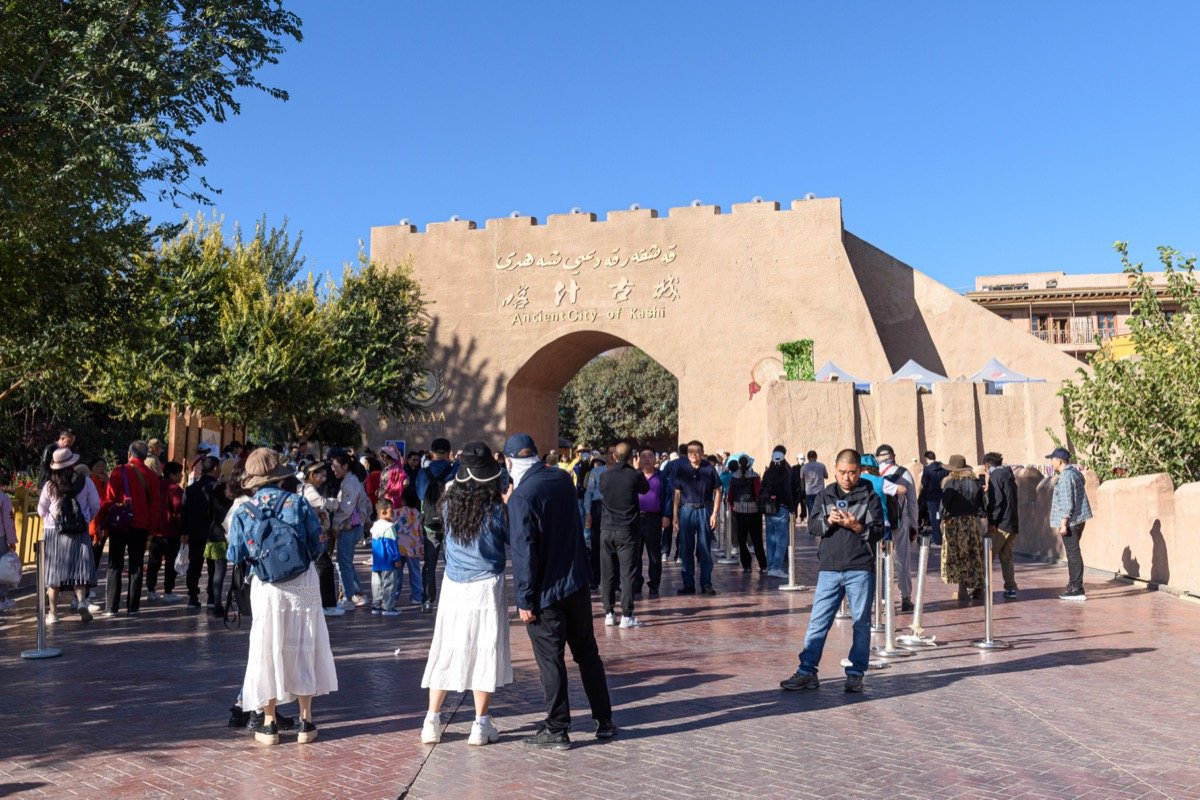
Dumping the car only works if the car is safe where you leave it. I use three options. A friend’s courtyard is the most relaxing. A hotel with long-stay parking is next; many hotels park guests free for several days. A paid long-stay lot at the train station or airport runs about 20 to 30 yuan a day and is camera-covered. Never just leave it on a street. Come back and you might find a new scratch or a parking ticket. On parking safety specifics, the offline navigation guide also covers how to find a reliable lot.
One more thing. Tell the hotel or the lot roughly when you’ll be back. A car that sits two weeks in a spot meant for one draws questions, and in a small town someone may move it or, worse, assume it is abandoned. A quick word avoids that. I also leave a window slightly cracked for ventilation if I’m parking in summer heat, and I take the dashcam memory card with me so the footage isn’t sitting in a car I’ve walked away from for days.
If you park at a station lot, photograph the bay number and the car’s condition on arrival. Should anything happen, you have a record from the moment you left. It takes thirty seconds and has saved me one dispute already.
Combo routes I have tested myself
Kashgar as the hub. Drive to Kashgar, park, take the train to Aksu (the big canyon) and to Hotan (the jade old streets and the desert edge). The coach toward Tashkurgan, in the Pamirs, needs a group tour or a carpool booked from Kashgar. On my run, the train to Hotan saved 600 yuan in fuel and showed me scenery from the window that a driver never sees. The train also drops you right in the city centre, whereas driving in Hotan means hunting for parking near the old jade market and sweating in the heat.
Yining as the hub. Self-drive to Yining, park, then bus to Zhaosu (summer rapeseed fields and heavenly horses), to Tekes (the bagua city), or to Xinyuan (Nalati). These buses run often, so a same-day return is easy. The roads out to Zhaosu and Tekes are pretty but winding, and after a week of mountain driving the chance to sit back and watch the poplars go by is a real rest. On how to reach Kashgar and these hubs, the how-to-get-to-Kashgar guide explains the train and coach connections.
Urumqi as the hub. Fly or drive to Urumqi, then train to Beitun (near Kanas) or to Turpan, and rent or hire a car locally once you arrive. This suits friends flying in from inland who don’t want to drive 3,000 km just to start. You trade the long bore of the approach for a plane seat and pick up a local car where the scenery actually begins. It also means your own car, with its familiar seat and its kit in the boot, is not exposed to the salt and gravel of the long haul north unless you want it to be.
What you save is more than money
I worked it out. Kashgar to Hotan and back by car costs around 600 yuan in fuel and tolls, and costs you. By train, a little over 100 yuan round trip, and you can sleep on the way. The combo turns “the haul” into “the rest,” and the trip is better for it. On squeezing the overall budget, our Xinjiang budget guide breaks transport down line by line, and the combo is one of its core ideas.
Put the saving in real terms. That 500 yuan difference on one leg pays for two nights in a mid-range hotel, or a good meal with mutton and naan for a week. Across a month-long loop with three or four such switches, the combo can return a couple of thousand yuan. For a backpacker that is a flight. For a family it is the difference between cutting the trip short and finishing it.
There is a price, of course. You drag luggage between vehicles, you time the car pickup, and you adapt to bus schedules. But next to arriving nauseous from driving, I will spend ten minutes planning a transfer any day. The rest you get on the train is not lazy; it is the buffer that keeps the rest of the trip sharp.
Two traps: luggage and tickets
When you ditch the car for transit, don’t carry too much. Train security and coach luggage bays both have limits. I lock the big bags in the car and board the train with only a day pack. On tickets, Xinjiang trains sell out in peak season (summer holidays, National Day, and the Corban festival). I buy three to five days ahead on 12306 and never count on buying at the station. Coaches are easier to get, but the early departures are few; if you want a same-day return, check the first departure time first. Miss it and your plan slips a day.
A subtler trap is the return timing. If your train back lands at 11 pm, is the lot still open, is the hotel still checking in? I build the pickup into the plan, not as an afterthought, so the car is never left alone a week longer than needed.
Who this style suits best
Solo travellers or pairs, people who don’t want to drive long hauls every day, and budget-minded folk who still want freedom, fit best. Families with kids or older relatives gain too; the combo drops the long boring drives, and a child sleeps on the train and arrives calm instead of restless in the back seat. Older travellers especially appreciate not white-knuckling a mountain pass they would rather admire from a window.
The hardcore player chasing “one continuous line behind the wheel” may sniff at it. But for me the point of travel is the view, not the driving practice. I have met drivers who measure a trip in kilometres driven. I measure mine in places actually seen. The combo lets the kilometre count drop while the place count climbs, and that is the trade I will always take.
One group should think twice: anyone on a very tight clock. Transit adds a transfer and a wait, and if you have three days total, the overhead may not be worth it. The combo pays off on trips of a week or more, where the saved driving days become extra sightseeing days.
A practical checklist to follow
One, pick a hub city and book a hotel or lot that allows long stays. Two, lock the big luggage in the car and take only a day pack onto transit. Three, buy train tickets three to five days ahead and check coach first and last departures. Four, time the return pickup so the car isn’t stranded a week. Five, check local car rental or hire at the transit destination so you can keep playing on arrival. On train times and booking, see the train guide; on stations and routes, the bus guide.
The car rests, the road doesn’t
The heart of the combo is admitting the car is not your only leg. You park it safely and reach the places that are tiring to drive and hard to park by another means. You end up more relaxed and cheaper. On my Kashgar run, the car sat untouched and I came back to it fine, having seen two more cities in between. Xinjiang is so big that one method need not rule the whole trip. May your car wait quietly in the hub city, and may you, on a train or coach, go see the scenery the car can’t reach.