

Spring Blossom Trail: Apricots, Tulips & Lavender (April-June)
The apricot valley at Tuergen was the first place in Xinjiang that made me change a flight. I had a seat out of Yining on 11 April 2019 and I gave it up, ate the change fee, and stayed four more days, because on the morning of the 10th the trees on the north-facing slope had not opened yet and a farmer told me they would be at their best on the 13th.
He was off by one day. They peaked on the 14th.
That is the whole problem with a blossom trip. The flowers move, the calendar does not, and every year is different by about a week in either direction. What follows is the timing I now work from, with the specific places that reward the gamble.
The Season in One Table
Approximate peak windows. Shift later in a cold spring, earlier in a warm one, and add roughly four days for every 300 metres of elevation you climb.
- Late March – early April — Apricot blossom in Turpan, Toksun and around Kuqa. Lowest and warmest, always first.
- Late March – mid April — Apricot in the Pamir villages around Tashkurgan, timed against snow peaks.
- 5 – 20 April — Tuergen wild apricot valley, Xinyuan County. The big one.
- Early – late April — Wild tulips across the Ili Valley foothills and Chabuchaer.
- Late April – May — Wild fruit forest on the Tianshan slopes: apple, apricot, plum together.
- May – early June — Grassland wildflowers at Nalati and Kalajun.
- 15 June – 10 July — Lavender first cut in Huocheng County.
- Mid June – July — Canola across the Zhaosu basin, with the Tianshan behind it.
A month-by-month view across the whole region, including weather and crowd patterns, sits in our best time to visit guide.
Tuergen Apricot Valley, Xinyuan
Seventy-odd kilometres from Xinyuan county town, a valley of wild apricot spread across rolling hills — not an orchard, not planted in rows, just trees scattered where they seeded themselves over several thousand years. The relief is what makes it: the hills fold, so from a ridge you are looking down onto blossom rather than up into it, and the pink reads against the new green grass.
The window is short. Roughly ten days of full bloom, and one bad windstorm can end it in an afternoon. I have been three times and hit peak once.
How to work it. Base in Xinyuan town, not at the valley — accommodation near the entrance is limited and triples in price during bloom. A car for the day from Xinyuan runs ¥300 to ¥400. Get to the valley by 08:30 local, which is before the tour buses from Yining arrive around 11:00.
Where to stand. Most people stop at the first viewing platform. Walk 25 minutes further up the ridge on the eastern side. The crowd density drops by about 90 percent and the composition improves, because you gain enough height to stack three ridgelines of blossom.
Entry with the shuttle was ¥90 in 2019. Add a horse ride if offered — ¥80 for an hour, and it gets you onto slopes you would otherwise not reach. The wider circuit through the Ili Valley in spring, including the smaller valleys nobody photographs, is mapped in our Ili spring flower route.

Tashkurgan: Apricot Against Ice
Different proposition entirely. The Tajik villages of the Pamirs — Datong, Tar, Kukexiluke — sit between 2,800 and 3,300 metres, and their apricot trees bloom against a backdrop of glaciated peaks. Nowhere else in China puts blossom and 7,000-metre mountains in the same frame.
Timing runs late March into mid-April, varying by village elevation. The lower Tar valley goes first. Datong runs about a week behind.
This trip coincides with Chogh Bahor, the Tajik spring festival, which means the villages are already in a celebratory state and the guesthouses are full of people who came for the festival rather than the flowers. Book six weeks out. I stayed in a restored family compound in 2023 for ¥380 a night and it was the last room in the village.
Two practical things. Foreign passport holders need a border permit for the Tashkurgan corridor, obtained in Kashgar. And it is genuinely cold — daytime highs around 5°C with nights near minus 10°C. People turn up in spring clothes and suffer.
Wild Tulips of the Ili Valley
The one almost nobody plans for. Xinjiang has native wild tulip species, and in April they come up across the foothills and the low grassland around Chabuchaer, Huocheng and the slopes near Yining. Small, red and yellow, scattered rather than massed, appearing on ground that was snow six weeks earlier.
There is no ticket and no gate. You drive foothill roads in mid-April and look at the grass. The best patch I have found was on a nameless track southwest of Chabuchaer, about 20 kilometres from town, where an entire south-facing slope had them at maybe four plants per square metre.
Do not pick them and do not drive on them. Several species here are protected and the populations are localised.
The Wild Fruit Forest
On the northern slopes of the Tianshan above Xinyuan and Gongliu there is a surviving belt of wild fruit forest — apple, apricot, plum, cherry — that botanists consider a genetic reservoir for the cultivated apple. Late April into May, the whole hillside flowers at once in several colours because the species do not bloom on quite the same schedule.
It is less photogenic than Tuergen and considerably more interesting. Access is via forest roads out of Xinyuan and the road quality varies; I would not attempt it in a low-clearance car after rain.
Huocheng Lavender
Huocheng County produces the overwhelming majority of China’s lavender and the comparison to Provence gets made constantly, mostly by people who have not been to Provence. What Huocheng actually has is scale — long unbroken blocks of it running towards the Tianshan foothills, with the Ili River plain behind.
The first cut peaks between roughly 15 June and 10 July. Miss it and there is a second, smaller bloom in late August into September, which is less dense but has far fewer visitors and better light.
Sixty-Fourth Regiment and Sixty-Fifth Regiment farms are the main areas, with paid viewing gardens charging ¥30 to ¥60 and free roadside fields either side of them. The free fields are usually better. Someone’s livelihood is growing in them, so stay on the tracks between blocks and do not wade in.
Go at 07:00. Lavender at midday under a hard sun photographs grey, and the scent is strongest early. Distillation workshops in the county sell oil and dried bundles; a 10 ml bottle of local oil ran ¥50 to ¥120 in 2022. Details on which farms allow access and how to get there without a car are in our Huocheng lavender guide.
Zhaosu Canola and the Tekes Basin
Late June into July, the Zhaosu basin fills with canola. Solid yellow, thousands of hectares of it, running up to the base of snow-covered mountains. It is the most saturated landscape in Xinjiang and it does not photograph well at all from ground level — you need height.
The move is to drive the ridge road on the northern side of the basin and shoot down. Or go up in the early morning when mist sits in the low ground and the yellow emerges from it in patches.
Combine it with Tekes, 40 minutes away, a town laid out as a bagua diagram with eight radiating avenues and no traffic lights. The layout only makes sense from above, which the town has solved with a viewing tower. Our Tekes and Zhaosu guide covers both.

The Southern Alternative: Turpan in Late March
If your dates are locked in March and you cannot reach the Ili Valley in time, go south instead. Toksun and the Turpan basin flower in the last week of March — apricot and almond, in walled orchards with mud-brick drying houses among them.
The setting is the draw. Red sandstone ridges, blossom, and the karez irrigation channels running under everything. Thirty minutes east, the Flaming Mountains are at their most photographable in spring, before the summer heat turns the air to soup — I have shot them at 09:00 in early April with clean air and 14°C, which in July would be 41°C and hazy.
Turpan in late March is also when the vines come out of their winter trenches. Growers bury the whole vine each autumn to protect it from frost and dig it up in spring, and watching a family lift a fifty-year-old vine out of the ground is more memorable than most scenic areas.
Building the Trip
Ten days in April, the flower-maximising version.
Days one and two, fly into Urumqi and go straight to Turpan for late apricot and the vine-lifting. Day three, fly Urumqi to Yining. Days four to six, Ili Valley — Chabuchaer tulips, Huocheng foothills, a day at Tuergen. Day seven, Xinyuan to Nalati. Days eight and nine, Tekes and Zhaosu for early grassland. Day ten, fly out of Yining.
Eight days in late June, the lavender version.
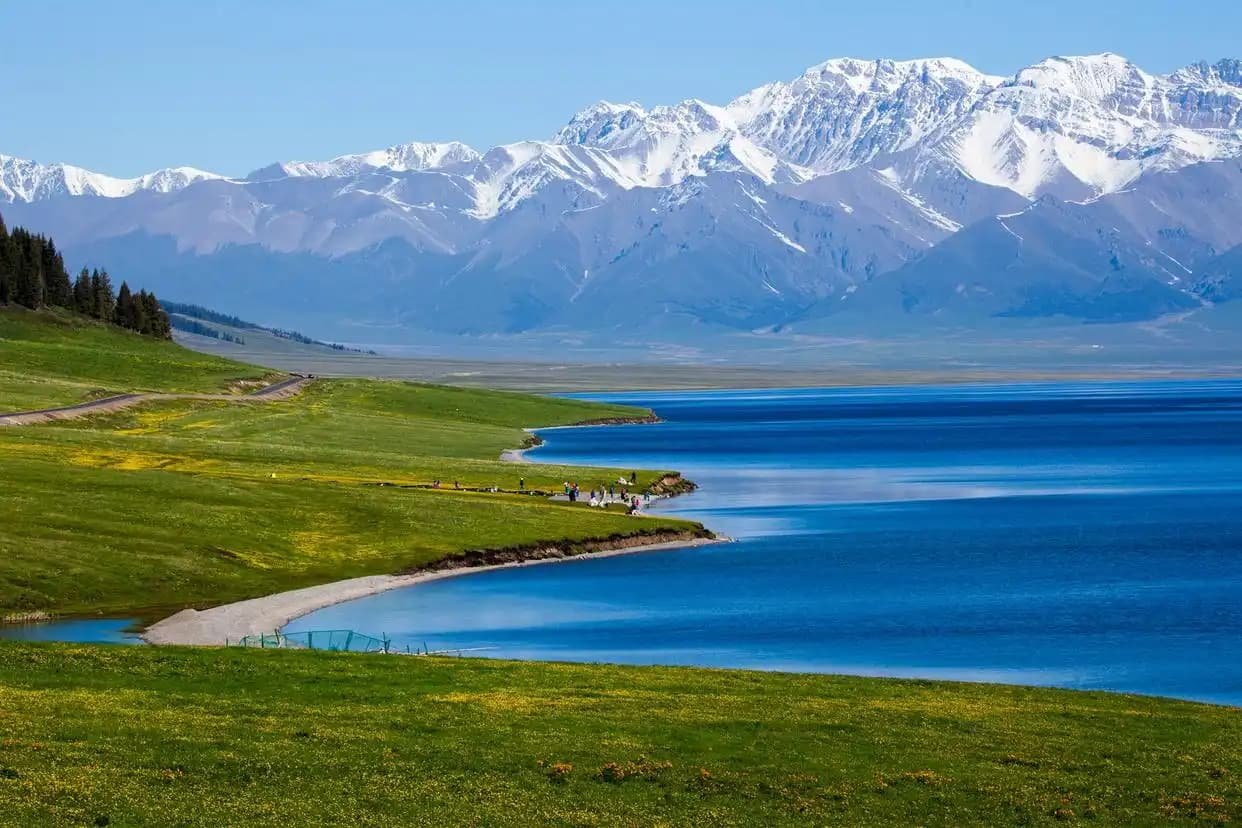
Yining base for three days covering Huocheng lavender and the Ili River. Then Sayram Lake for two, Zhaosu and Tekes for two, out via Yining. Add the Guozigou bridge on the Sayram leg; it is on the way and takes twenty minutes.
Six days in early April, the Pamir version.
Kashgar in, two nights. Karakoram Highway to Tashkurgan with a night at Karakul for altitude. Two nights in the Tajik villages. Back to Kashgar. This is the highest-risk and highest-reward option.

How to Not Miss the Bloom
Book flights refundable or cheap. I now buy the cheapest changeable fare I can find rather than the best-value fixed one, because the ability to move by four days is worth more than ¥400.
Watch Chinese social platforms in the two weeks before you travel. Search the place name in Chinese on Xiaohongshu or Douyin and sort by recent. Local photographers post daily during bloom and the images are dated. This is far more reliable than any forecast.
Call a guesthouse. Guesthouse owners near Tuergen and in Tashkurgan will tell you honestly, because a visitor who arrives to bare branches complains and a visitor who arrives at peak comes back.
Build slack. If you have ten days, plan eight and leave two floating. The floating days are what let you chase.
Go north-to-south or low-to-high. If you get the timing slightly wrong, moving uphill buys you days. Tuergen finished? Drive higher into the valley and the trees at 1,800 metres will still be going.
Weather and What to Wear
April in the Ili Valley runs 5 to 20°C with rain roughly one day in three. The ground is wet, the tracks are mud, and I have written off a pair of trainers. Waterproof boots, a shell, a fleece and a light down layer covers everything.
June in Huocheng and Zhaosu is 15 to 30°C by day and cool at night, with strong UV at 1,500 to 1,800 metres. Sun protection matters more than warmth.
Tashkurgan in April needs full winter equipment despite being a spring trip, and the altitude means you should plan a slow ascent regardless of how good you feel in Kashgar.
Costs
Spring is one of the cheaper seasons outside the specific bloom weeks. A ten-day April trip through Turpan and the Ili Valley with a rental car and mid-range rooms came to roughly ¥6,400 for one person in 2019, excluding international flights. Rooms in Yining ran ¥180 to ¥300, a car was ¥320 a day, and scenic tickets across the whole trip added up to under ¥700.
The June lavender window is more expensive because it overlaps with the start of the summer season in the Ili Valley. Expect accommodation to run 50 to 80 percent higher than April.

I have still only hit Tuergen at proper peak once, on 14 April 2019, standing on that eastern ridge at 09:15 with the mist not yet burned off. The farmer who told me to stay was wrong by a day, and it is the best travel advice I have ever been given.