
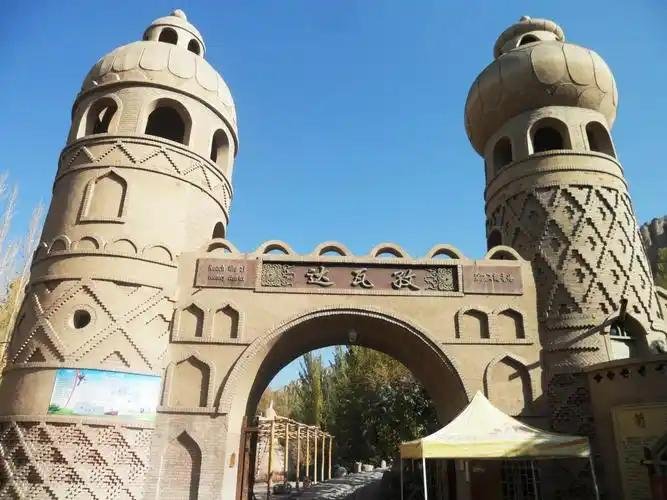
Xinhe County Instrument Workshops: A Driver’s Guide to Toksu
The dutar hung from a nail in an open doorway, unfinished, still pale where nobody had oiled the mulberry yet. I had driven a little over an hour east of Kuqa and pulled over because I could hear sanding. Not music. Sanding, a radio, and two men arguing cheerfully about a late delivery. That is the sound Xinhe County makes on an ordinary Tuesday morning, and it is why I keep telling people to come here rather than buy a souvenir instrument off a stall in Kashgar.
Xinhe, also written Toksu, sits in the eastern half of Aksu Prefecture on the northern rim of the Tarim Basin. On paper it is a farming county: cotton, walnuts, apricots, poplar windbreaks in every direction. In practice a large share of Xinjiang’s hand-built Uyghur instruments comes out of its courtyards. Dutar, tembur, rawap, satar, dap frame drums. Families make them three generations deep and sell to musicians, to music schools, to wholesalers, and now and then to a foreigner who turns up in a dusty rental car with no appointment.
Driving in from Kuqa, roughly 60 to 70 km east
Kuqa is the sensible base. Xinhe town is about 60 to 70 km east depending on which exit you take, and by Xinjiang standards this is easy driving. Two options. The G3012 expressway gets you there in around 50 minutes for a toll somewhere in the ¥15 to ¥25 range in a small car. The old G314 corridor takes maybe twenty minutes longer and is far better company: donkey carts, melon stacks in August, men welding trailer axles in the shade, poplar shadows striping the asphalt every few metres until you feel slightly hypnotised.
I took the surface road both times. If you are basing yourself in Kuqa town before heading east, do not set a dawn alarm. Workshops here run on a rhythm that warms up late morning and continues well past what an office clock would call closing time. Nothing happens at 07:00. Plenty happens at 11:30, and more at 18:00.
One practical warning. There are checkpoints along this corridor and clearance times vary wildly. My fastest was under two minutes. My slowest was 35 minutes stuck behind three trucks while a very polite young officer typed my passport number twice because the first attempt did not save. Keep the passport in the door pocket, not the boot. Do not photograph the checkpoint. That is the whole trick.
How to actually find the instrument workshops
This is where visitors get stuck. There is no ticket office and no signposted instrument village gate. The making is spread through the township areas around Xinhe town, and the workshops are simply houses: a blue metal gate, a swept courtyard, a room with wood shavings ankle deep in one corner.
Three approaches worked for me.
- Ask at a music shop on the main street in town first. Retailers buy from the makers and usually know which courtyard is working on what this week. My best afternoon came from a shopkeeper drawing a map on the back of a receipt.
- Follow the noise after 11:00. Wood glue, apricot sawdust and the short whine of a small bandsaw all carry a long way down a quiet lane.
- Hire a local driver for half a day if your Uyghur and Mandarin are both nonexistent. Expect ¥200 to ¥350. He will walk you into a courtyard where a stranger would still be hovering at the gate.
I did hover at a gate. Twice. Once for ten minutes until an elderly man waved me in with obvious amusement, and once at a workshop shut for a family wedding, which is a very Xinhe reason to be shut.

Inside a workshop: what it smells and sounds like
The first thing that hits you is not sound. It is smell. Fresh mulberry has a faintly sour, milky edge. Apricot is drier and sweeter. Add hide glue warming on a hotplate, a little varnish, and the dust of a few hundred sanded necks living in the roof beams, and you get an atmosphere that no museum display ever manages to fake.
Then the sound layers in. A bandsaw for fifteen seconds at a time. Scraping. Tapping. Someone plucking one string over and over, nudging a peg by a hair, plucking again. In the second courtyard I visited, a boy of about twelve was doing exactly that on a half-strung rawap while his father worked on a different instrument three metres away and corrected him without once looking up.
Nobody performed for me, and that is the point. If you have sat through a staged folk-culture show with matching costumes and a sound system, this is the opposite: cold in spring, cluttered, mildly chaotic, entirely real. A woman brought tea and hard bread without being asked, then went back to threading fret gut in the next room.
Watching without being a nuisance
Ask before you photograph faces, every time. Ask before you touch a finished instrument, and expect the answer to be yes for a wall piece and a polite hesitation for something already sold. If you want to play, hand the instrument back to the maker first and let him tune it. He will, happily, and he will also decide what you get to hold. Do not haggle loudly in front of other customers. Take your shoes off if the family living room is where the tea appears.
How the instruments are built
Wood, and a lot of waiting
Mulberry is the workhorse. It grows all over these oases, it bends reasonably well, and it gives a bright tone. Apricot shows up in better instruments and in decorative work, walnut occasionally. The wood does not go from tree to instrument in a season. Makers stack it in the courtyard or under a roof for a year or two, sometimes far longer, so it can move and split and settle before anyone cuts a body from it. One man showed me a pile he said had been sitting since his son started school. The seasoning is the real reason a good dutar does not crack in its first winter inside a dry European flat.
Bending, gluing, and that absurd neck
A dutar body is carved and hollowed rather than assembled from thin ribs like a European lute. On the rawap you see more assembly, a bowl-shaped resonator and that long thin neck. The necks surprised me most. They are shaped mostly by eye with a hand plane, checked against the maker’s own thumb and forearm, then finished with sandpaper that has clearly seen better decades. No digital calipers anywhere. A lot of stopping to squint along the length of the wood.
Skins, frets and inlay
Some rawaps get a skin head. I have seen both snakeskin and fish skin used, depending on what the maker can source and what the buyer wants, so ask directly if you plan to carry it across a border. A courtyard workshop does not keep a leaflet on wildlife-product rules. Frets on dutar and tembur are tied loops of gut or nylon rather than fixed metal bars, which means they slide. That is deliberate. Muqam tuning does not always sit where a guitarist expects it to sit.
The inlay is the showpiece: fine geometric bands of bone and horn set into the neck and around the soundhole, plastic on the cheap instruments. Up close the difference is obvious. Bone varies in colour and looks slightly warm. Plastic is dead flat white. Check the join lines rather than the pattern.

What things cost
Prices move, so treat these as bands from my last drive through in spring rather than a price list. A small tourist-grade rawap or a decorative miniature runs somewhere around ¥200 to ¥500. It looks the part on a wall. It also has plastic inlay, a thin head and a neck that drifts out of tune while you are still counting notes into someone’s hand.
A genuinely playable mid-range dutar or rawap, the sort a student in Aksu might own, sat in the ¥800 to ¥2,000 band. Above that you are buying instruments made for people who earn a living with them: properly seasoned wood, bone inlay, careful fret work, a satar or a good tembur that the maker will spend twenty minutes tuning before he hands it over. I was quoted figures from ¥3,000 to well past ¥8,000 in that category, and I believed all of them.
Bargaining exists here but it is gentle. This is not the theatre of a tourist bazaar. Grinding a maker down by 40 percent on three weeks of work wins you nothing. Ask the price, ask what makes it different from the cheaper one hanging beside it, then decide. The same logic applies to buying Xinjiang handicrafts such as atlas silk anywhere in the region: the honest answer to why one costs triple is usually visible the moment somebody points at it.
Getting an instrument home in one piece
I have flown a rawap out of Kuqa and it survived, though not without a small negotiation at the check-in desk. Two things to sort in advance.
Packing first. Ask the workshop for a soft case, which many of them keep, then find a cardboard box. Wrap the neck separately, pad the body cavity lightly so it does not rattle itself to death, tape the pegs so they cannot rotate, and slacken the strings almost completely before you fly. Altitude changes plus a rigid neck plus full string tension is exactly how a soundboard cracks.
Then the paperwork question. If your instrument carries an animal-skin head, check your own country’s import rules on wildlife products before you commit. A plain wooden instrument is the simpler purchase for a long-haul flight. On domestic legs anything long goes as checked baggage rather than cabin, so the box matters more than the case does.
Tang-era ruins, and music you might stumble into
Xinhe has old bones. Out on the edges of the county sit Tang-period garrison ruins, the Tongkuzbash group among them, low eroded walls of rammed earth standing in flat farmland and scrub. Do not expect a restored fort with a boardwalk. Expect a rectangle of collapse, a fence in places, and a sign that may or may not still be readable. I only found the second set after asking a man on a motorbike, who then rode ahead of me for two kilometres to make sure I turned at the right ditch.
With luck you will hear the instruments in use rather than in production. Weddings in this corner of Aksu spill into the street, and Muqam suites run long into the evening. I was pulled into one for roughly twelve minutes, handed a plate of polo, and released. If you want something more dependable than luck, read up on where to hear live Uyghur Muqam before you fix your dates, because the reliable venues are not in Xinhe.
When to come, where to sleep, what to eat
May, early June and September were my favourite windows. July and August are punishing on the Tarim rim, past 38C by mid-afternoon, and courtyards go quiet during the worst of the heat. Winter works if you do not mind cold hands and short light, and the workshops are genuinely freezing.
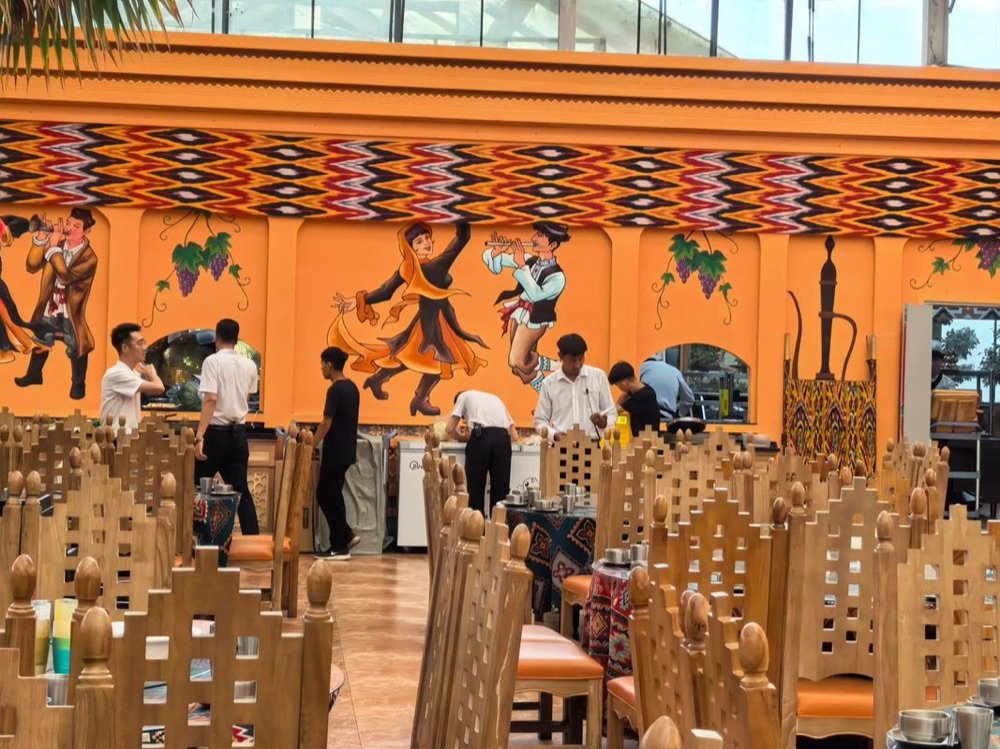
Accommodation in Xinhe town is basic county stock: a handful of small hotels, hot water that arrives eventually, rooms roughly ¥120 to ¥250. I would still sleep in Kuqa and day-trip. Food is better there too. My worst lunch of the whole trip was in Xinhe, a bowl of laghman that had clearly been sitting since the previous shift, dense and cold through the middle. Order kebab and bread from a stall where the oven is visibly hot and you will not go wrong, a rule that holds up when travelling through Aksu Prefecture more widely.
One last comparison. If you have already seen the knife forges of Yengisar, the shape of this place will feel familiar: a county that does one thing extremely well, mostly out of sight of tour buses, where the interesting part is the working room and not the shop counter. Xinhe is quieter and dustier. I liked it more.