
Kanas Lake & The Three Bays: Xinjiang’s God’s Garden Deconstructed
Kanas Lake (喀纳斯湖) sits in the Altai Mountains at ~1,374 m, a glacial-tectonic dammed lake famous for water that cycles through jade, teal, and milky turquoise depending on suspended glacial flour. The surrounding reserve protects Siberian taiga, snow leopard habitat (extremely unlikely to see), and the Tuvan and Mongolian-aligned Uriankhai culture in satellite villages.
Most visitors make the mistake of treating “Kanas” as one photo spot. It’s actually a network of distinct viewing areas, each with its own character, light conditions, and seasonal best times. Understanding this network before you arrive is the difference between a rushed bus tour and a travel memory that stays with you for years.
Why Kanas Belongs on Your Xinjiang Itinerary
For our complete Xinjiang solo travel Guide, see our dedicated Xinjiang Solo Travel Guide with practical details on safety, costs, and planning.
There is a reason this landscape is called “God’s Garden” by locals and “China’s Switzerland” by travel writers. Unlike the desert expanses and flame-colored ridges elsewhere in Xinjiang, Kanas delivers a lush, layered, almost theatrical alpine environment: towering spruce, mirror-calm water, snow ridges that look close enough to touch, and villages where timber architecture and smoke from morning hearths create a scene that feels untouched by the 21st century.
For foreign independent travelers, Kanas also represents one of the most accessible introductions to China’s northern borderland cultures. The Tuvan and Kazakh communities living within the reserve have adapted to tourism, but the core of their lifestyle — seasonal pasture movement, horse-based transport, timber construction — remains visibly intact. You will see hay being stacked on wooden racks, horses being saddled for the day’s grazing, and smoke rising from chimneys fired by local timber, not gas.
The reserve also protects one of China’s last pockets of pristine taiga forest, where the air smells of resin and damp earth, and where the only sounds are wind in the spruce canopy and the occasional call of a griffon vulture circling above the ridge line. For travelers coming from China’s eastern cities, this level of quiet is startling — and addictive.
If you are planning a trip and want expert, first-hand guidance on timing and routing, explore our full Xinjiang independent travel planning resources before you book anything.
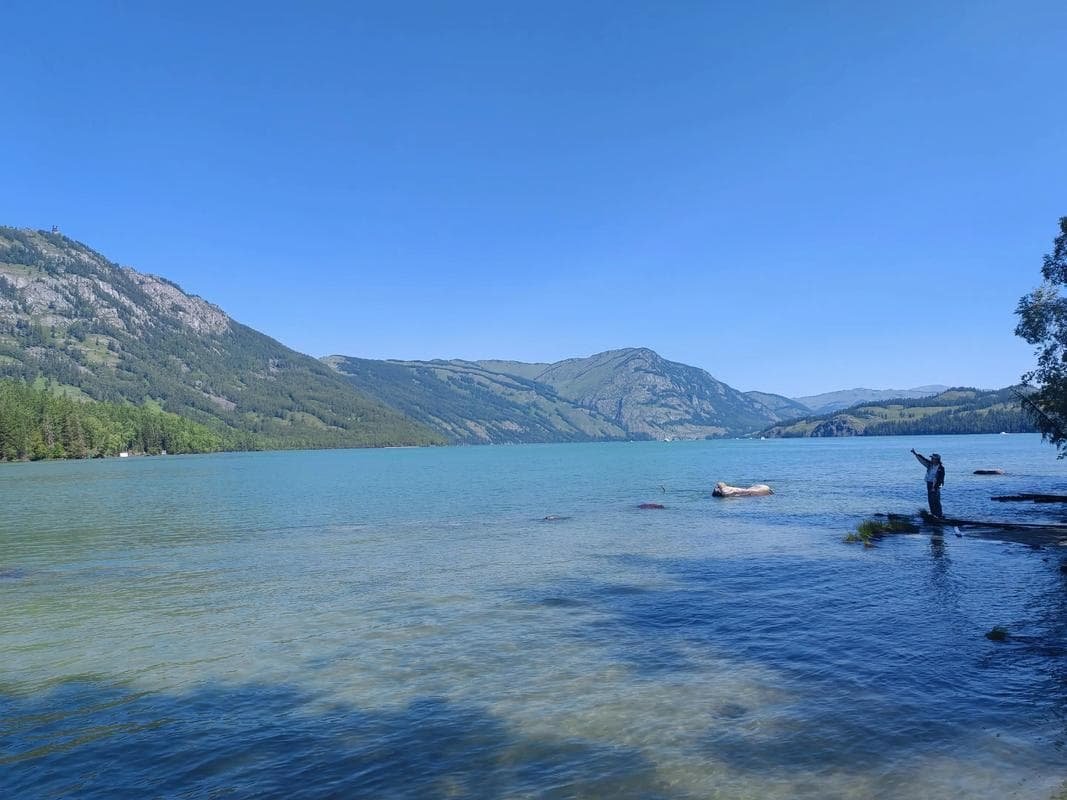 Kanas Lake panoramic view from overlook platform” />
The Core Sight Chain: Walk This, Don’t Just Bus It
The Kanas scenic zone is deceptively large. The main shuttle route drops you at parking zones, but the real magic requires walking — sometimes just 10 minutes from the road, sometimes an hour along a boardwalk. Here is the chain, ordered so you can plan a logical day.
1. Guanyu Bay (观鱼台) — The Overlook
Climb ~1,066 steps or take the shuttle plus escalator (~¥20–40 extra) to the Guanyu Tai platform on the cliff rim above the lake’s eastern arm. This is where you see the S-shaped bend and where the legendary “lake monster” (actually large Siberian taimen or optical illusion) lore originates.
The platform sits at roughly 2,050 m. On calm mornings the reflection is so precise it’s hard to tell where water ends and forest begins. The hike up the stairs takes 25–40 minutes depending on fitness and altitude adaptation; the escalator (added in recent years) reduces it to 10 minutes but costs extra and removes the sense of ascent. Check our seasonal guide to pick the best month for your visit — September gold is a different world from July green.
Photography note: the platform faces roughly west-southwest, so sunset is the magic hour. Arrive 90 minutes before sunset and watch the water shift from teal to burnished copper. If there’s cloud, even better — the broken light creates streaks across the water that no filter can replicate.
2. Moon Bay (月亮湾)
The iconic crescent curve midway along the Kanas River. Wooden stairs take you from the road down to water level and along the bank. Best in September when the birch flank turns gold and the water runs low enough to expose the pale ribbon of the riverbed.
Moon Bay is also the most crowded of the three bays by mid-morning. The workaround: arrive on the first shuttle of the day (usually ~08:00 in summer), or visit in late afternoon when the tour groups have retreated to their lodges. The light is warmer then anyway. There is a well-built boardwalk that follows the river for about 800 meters in each direction from the viewing platform — don’t just take the photo and leave; walk the boardwalk for 15 minutes and you’ll have the river to yourself.
3. Shenxian Bay (神仙湾) — The Morning Mist
Lowest elevation of the three, this is the mist spot. You need to be here at sunrise (yes, that means staying inside the scenic zone or arriving by 06:30). Morning calm produces layered fog ribbons over the braided river channels. It is the most photographed scene in the entire reserve, and also the most weather-dependent.
 Shenxian Bay morning mist and braided river channels at Kanas” />
If it rained the night before, your odds of a spectacular mist go up dramatically. If it’s been dry and windy for three days, you may get nothing but clear water and harsh light — in that case, shift your strategy to Guanyu Tai for sunset instead. Flexibility is the difference between a good Kanas day and a frustrating one.
4. Wolong Bay (卧龙湾)
Broad, flat, “reclining dragon” sandbar formation. Good picnic stop; less crowded than Moon Bay. The water here shallows into a wide channel with a distinctive sandbar that, from the viewing platform, resembles a dragon lying down — hence the name. There is a well-built boardwalk that takes you from the road down to water level in about 15 minutes.
Wolong Bay is also the best place in the reserve to see the water color shift in real time. As clouds shadow and unshadow the water, the turquoise darkens to jade, then lightens to a glacial milky-blue. Sit on the bank for 30 minutes and watch it happen — it’s better than any screensaver.
How to Get to Kanas: The Access Reality
Kanas is not a “drive up and park” destination. The access chain involves at least two segments, and understanding this before you book saves hours of confusion.
Step 1: Get to Burqin (布尔津). Burqin is the gateway town, ~150 km north of the Kanas reserve. You can reach Burqin by: (a) flight from Urumqi to Burqin Airport (seasonal, ~1.5 hrs), (b) long-distance bus from Urumqi (~10–12 hrs, overnight options exist), or (c) private charter from Urumqi (~8–10 hrs, scenic stops possible).
Step 2: Burqin to Jiadenyu (贾登峪). Jiadenyu is the official park entrance and parking zone. From Burqin it’s ~120 km, ~2.5 hours on paved mountain road. Tickets are purchased here; you leave your rental car or bus here and transfer to the park shuttle.
Step 3: Jiadenyu to Kanas Village. The shuttle ride takes ~40 minutes each way and runs from ~08:00 to ~18:00 in summer. Last shuttle back to Jiadenyu is usually ~18:30, so plan accordingly.
Foreign traveler note: If you are driving a foreign-plated rental, confirm with your agency whether you’re allowed to drive all the way to Jiadenyu. Some rental agreements restrict mountain driving; the road is paved and maintained but has steep sections and occasional construction.
Tickets & Logistics (2025–2026 Reference)
Kanas uses a zoned entry plus shuttle system. You cannot self-drive into the core scenic area; all visitors park at Jiadenyu and transfer to park-run shuttles.
- Reserve entrance: approx. ¥160 (peak season dynamic pricing — verify yearly on the official site)
- Shuttle system: mandatory; the shuttle ride from Jiadenyu to Kanas Village takes ~30–40 minutes each way
- Guanyu Tai shuttle: extra fee (~¥20–40); operates on a separate circuit from the main shuttle loop
- Where to sleep: Either inside at Kanas Village (wooden lodges, pricey, atmospheric) or at Jiadenyu (more options, cheaper, 30 min commute each morning)
Foreign access: Open to foreigners; no border permit needed unless you detour to Baihaba (which DOES require one — see our separate guide on Baihaba Village access).
When to Go: The Seasonal Reality
Kanas has one of the shortest accessible windows of any major Xinjiang destination, and the experience changes completely between months.
| Period | What You Get | Temperature | Crowd Level |
|---|---|---|---|
| 15 Sep–5 Oct | Larch gold, elk rut calls, crystal-clear air, first snow possible | 5–18°C (nights near freezing) | Moderate — the best window |
| June–August | Full green, accessible, warm days, wildflowers | 12–25°C | Heavy domestic crowds |
| Oct 6–31 | First snow, dramatic, quiet, lodges discounting | Below freezing at night | Low |
| Nov–mid-May | Snowlocked; some years the road stays open for ski-only access | -20 to 5°C | Not standard tourist season |
If you have flexibility, aim for the first week of October. The larches turn a saturated gold that photography websites have been mining for years — but seeing it in person is still better than any image. Pack a down jacket; the mornings will be near freezing even if the afternoons hit 15°C.
Where to Stay: Inside vs Outside the Reserve
This is the single most important logistical decision you’ll make at Kanas, and it affects both your experience and your budget.
Inside the reserve (Kanas Village): Wooden guesthouses and lodges ranging from ¥200/night (shared bathroom, thin walls) to ¥1,500/night (en-suite, heated, decent breakfast). The advantage: you are already inside when the sun comes up, which means you can reach Shenxian Bay for the morning mist without a 30-minute commute. The disadvantage: it’s more expensive, books out months ahead for October, and the food options are limited to what your guesthouse serves.
Outside (Jiadenyu): More hotels, lower prices (¥120–400/night), better mobile signal, and more restaurant variety. The disadvantage: you lose the early morning light inside the zone. If you stay here, plan on the first shuttle in and the last shuttle out — which is exactly what the tour groups do, so you’ll be commuting with crowds.
Our detailed accommodation comparison breaks down specific guesthouse recommendations by budget and season.
Altitude, Safety & What to Pack
Kanas Village sits at ~1,374 m. That’s not high enough for serious altitude sickness in most people, but the walking is real and the weather changes fast.
- Layers: Even in July, bring a fleece or light down jacket. Mornings at the mist platforms can be 8°C while afternoons are 22°C.
- Footwear: The boardwalks are well-maintained, but they can be damp and slippery. Waterproof hiking shoes > fashion sneakers.
- Sun protection: The alpine sun at this latitude and elevation burns fast. SPF 50+, sunglasses, and a brimmed hat are non-negotiable.
- Cash: ATMs exist in Jiadenyu but not inside Kanas Village. Bring sufficient cash for meals and minor purchases.
- Mosquitoes: Yes, in July–August especially. The wetland areas breed them. DEET 30%+ recommended.
- Power bank: Cold weather + frequent photo = dead phone by 14:00. Bring a fully charged power bank (and keep it inside your jacket pocket so the battery doesn’t chill).
Photography Tips: Light, Timing & Composition
Kanas rewards patience. The classic shots require you to be in position before the light does something special.
- Guanyu Tai: Arrive 60 minutes before sunset. The low sun lights the western shore and the water turns a deep teal. If there’s cloud, even better — the broken light creates streaks across the water.
- Shenxian Bay: Sunrise only. Be at the platform by 06:30 in summer, 07:00 in early autumn. No wind = best mist. If it’s breezy, the mist shreds in 10 minutes.
- Moon Bay: Late afternoon from the north-side viewing platform. The sun backlights the birch trees on the far bank — shoot with the sun at your back for warm rim-lighting on the water.
- Wolong Bay: Morning light from the main platform. The dragon sandbar is most defined when the sun is behind you. Overcast days are actually better here — the diffuse light brings out the turquoise without harsh shadows.
Extending Your Kanas Trip: Hemu & Baihaba
Kanas is the centerpiece, but two satellite villages are accessible within the same scenic system and each deserves at least half a day.
Hemu Village (禾木): About 40 km from Kanas as the crow flies, Hemu is the timber village counterpart — same biogeography, different mood. Hemu is famous for its sunrise viewing deck above the village, where smoke from dozens of chimneys rises into the cold morning air. Stay overnight if you can; the day-tripper crush kills the atmosphere by 10:00 am. The birch groves around Hemu are also spectacular in October — bring warm layers, the deck is windy and ~200 m higher than the village.
Baihabha (白哈巴): The Kazakh-border hamlet at Xinjiang’s northwestern extremity. This one REQUIRES your PSB border permit explicitly stamped for Baihabha / Habahe County. The landscape is similar to Kanas but quieter, more “edge of the world.” Access is only via authorized shuttle from within the Kanas scenic zone. The hamlet has a simple guesthouse or two if you want to stay overnight and really feel the border silence.
Both Hemu and Baihabha can be combined into a 3-day Kanas-area loop if you are not rushed. That said, if this is your first time in Xinjiang and Kanas is one of 5 stops, two full days (one night) in Kanas Village is the realistic minimum.
Practical FAQs
Can I visit Kanas in winter?
Some years the access road stays open and you can reach Kanas on a snow-vehicle shuttle. It’s magical — steam rising from unfrozen stream patches, total silence, snow-loaded spruce — but services are very limited and you need serious cold-weather gear. Only attempt this if you are comfortable with winter backcountry conditions and have confirmed your accommodation will be open.
Is Kanas suitable for children or older travelers?
The shuttle system and boardwalks make the core sights accessible to most fitness levels. Guanyu Tai involves real stairs (1,066 steps), so that one is optional — the rest of the bays are flat boardwalk. Children usually love the boat ride on the lake (extra fee, ~¥80–120) and the “monster” story. Older travelers should bring trekking poles for the Guanyu Tai stairs and be mindful of the morning cold.
Do I need a guide?
Not inside the scenic zone — the shuttle system and signage are adequate for independent navigation. A guide becomes valuable if you want to explore off the boardwalks (not officially permitted in most areas) or if you want cultural context about Tuvan / Uriankhai history that the plaques don’t cover. For foreign travelers, a guide is also helpful for translating local information boards and for navigating the Burqin–Kanas transport logistics.
Can I swim in Kanas Lake?
Officially discouraged and physically unpleasant — the water temperature even in August is about 8–10°C. Some locals do a ceremonial dip for festivals, but for visitors, photograph it, don’t brave it. The lake is also a protected ecosystem; entering the water is discouraged to preserve water quality.
Is there mobile signal in Kanas?
China Mobile and China Telecom have spotty coverage in Kanas Village and along the main shuttle road. Don’t rely on being connected. Tell someone your itinerary before you go, and download offline maps in advance. Inside the core viewing areas (Guanyu Tai, the bays), expect limited or no signal.
The Bottom Line
Kanas is not the easiest place to reach in Xinjiang. It requires a flight or long drive to Burqin, followed by a mountain road up to Jiadenyu, followed by a shuttle into the reserve. But the moment the shuttle rounds the final ridge and the lake opens up below you, the logistics fade from memory. This is one of those rare destinations that earns its reputation — and then some.
Plan for at least two nights. Pack for four seasons in one day. Bring more memory cards than you think you need. And if you go in October, don’t be surprised if you find yourself coming back to Xinjiang just to see it again.