
Baisha Lake (White Sand Lake): The Unusual Desert Lake of Xinjiang
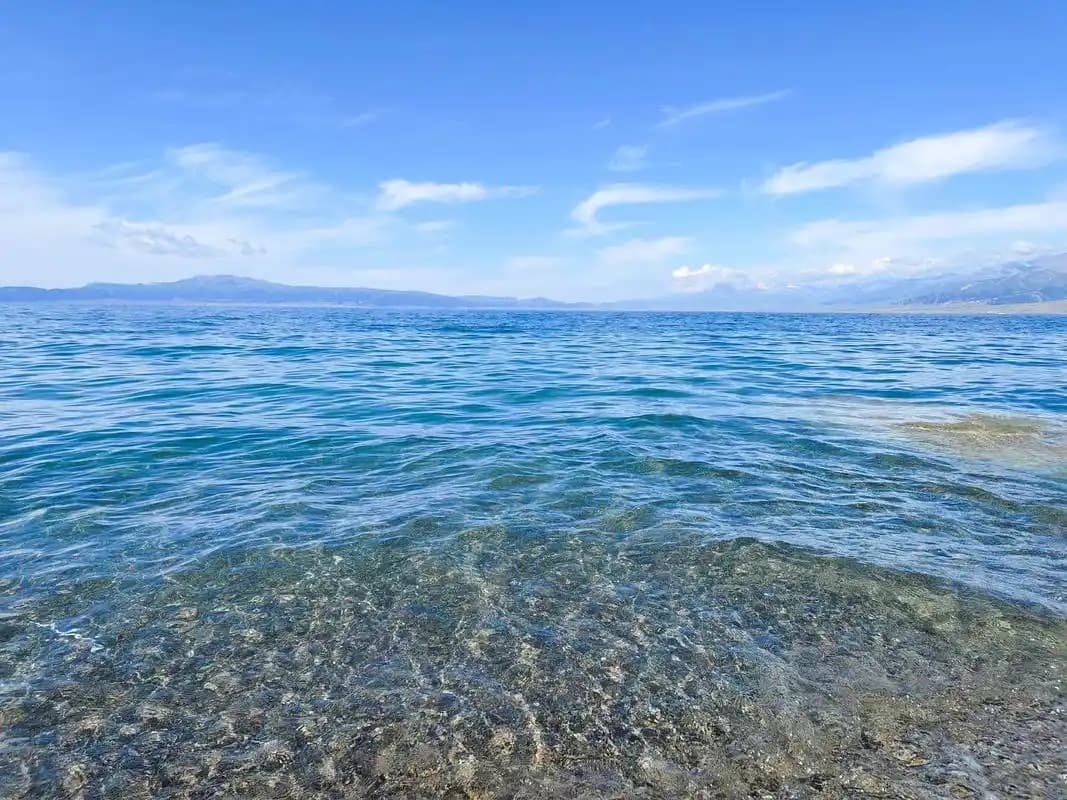
The first time I saw Baisha Lake I thought the driver had taken a wrong turn into a movie set. White dunes rose on the left, a strip of impossibly blue water on the right, and behind both the grey wall of the Pamir. I’d left Kashgar at 8 a.m. with low expectations — another roadside lake, I figured — and by 10:40 we were standing on the shore of a body of water that looks like it belongs in a desert 3,000 km to the south. This is the 白沙山·白沙湖 (Baisha Shan – Baisha Lake) on the G314, the road that runs from Kashgar up to Tashkurgan and on toward the Karakoram border with Pakistan.
Unlike the famous lakes of northern Xinjiang, this one sits at about 3,300 meters and is framed by wind-blown white sand rather than spruce forest. I’ve now passed it four times on different Pamir trips — twice driving myself, twice in a shared van — and the color of the water shifts with the hour in a way that tricks your camera every single time. It’s the single most photogenic 20 minutes of the whole Kashgar-to-Pamir drive, and almost nobody plans a stop there.

What Makes the Sand White
The dunes aren’t tropical beach sand, and they aren’t the orange desert sand of the south either. They’re ground-down white quartzite and limestone scoured off the surrounding mountains — mostly the slopes of the Kongur and Muztagh ranges that loom over the valley — and carried by wind to pile against the lake into what geologists call a “white sand mountain” (白沙山) system. The grains are coarse and pale, almost sugar-colored in hard light, and they squeak under your boots the way dry snow does when you cross a slope. Stand on the crest and you get the full, unreasonable contrast: dead-white dune, electric-blue water, brown-grey peak behind. That’s the postcard everyone stops for, and unlike most postcards, the real thing delivers.
Why the Lake Changes Color Through the Day
Early morning is when I shoot it. The water sits turquoise, almost cyan, because the sun is low and the surface is still, with no wind to stir the sediment. By midday a thin wind comes off the plateau and the lake turns a deeper emerald under the glare, darker and less friendly. Late afternoon the white sand throws so much reflected light back that the whole scene washes pale and the blue gets bleached out. If you have one window, take the morning. I learned this the hard way after driving up once for a “golden hour” that never turned gold — the Pamir evening light here is flat and cold, the opposite of the warm glow you get in the Ili valleys. Plan your stop for 9 to 11 a.m. and you’ll leave happy.

Two practical notes from those four visits. The managed 白沙山 scenic gate charges ¥39 for an adult ticket, but there are free pullouts on the G314 a few hundred meters before the gate where you can photograph the same dunes without paying a cent. I use the free pullout every time; the gate adds a walk but not a better angle. And drones are banned along this entire corridor — it’s a sensitive border zone, and I watched a ranger confiscate one in 2023 and tell the owner to collect it from the police station in Kashgar. Leave the aircraft in the bag. The fine and the lost drone aren’t worth one aerial frame.
Road Condition and Access
The road is fully paved G314, two lanes, in good shape as far as Tashkurgan. No 4WD needed for the lake itself; a normal rental sedan makes it fine, and I’ve done it in a small hatchback. The drive from Kashgar is about 150 km and took me 2.5 to 3 hours both times, because you climb from 1,300 meters to over 3,000 and there are police checkpoints where you hand over your border permit and your documents get scanned. Don’t rush it — the pullouts near 白沙河 (Baisha River) on the way up, where the river braids across white gravel, are worth a ten-minute stop of their own.
Border Permit: The One Thing People Forget
You need a 边防证 (border permit) to go past the lake toward Tashkurgan, and this is the detail that sinks half the independent trips I hear about. You can get it free in Kashgar at the entry-exit office with your passport and a photo, usually within an hour, or apply in your home city before flying. I forgot mine on trip two and had to backtrack 40 km to Kashgar to sort it, losing most of a morning. Get it the afternoon before you leave. The lake itself sits before the strict checkpoint, so you can photograph it without the permit — but if you’re continuing to Tashkurgan and Karakul, which you should, the permit is mandatory and they check it hard.
Photography: Times and Compositions
The classic frame is from the G314 pullout looking east: white dune foreground, lake middle, Muztagh Ata’s snow behind, layered like a stage set. For something different, walk down to the waterline (the gate area allows it, the free pullout doesn’t) and shoot low, with the wet sand as a reflector doubling the blue. A polarizer helps cut the glare but don’t overdo it or the blue goes unnatural and obviously filtered. I shoot at 16mm for the drama of the dune wall and at 70-200mm to compress the dune ridges into repeating curves. The light is strongest and cleanest right after the morning checkpoint opens, around 9:30.
For the wider Pamir shooting plan, the Xinjiang photography route guide maps the whole Kashgar-to-Tashkurgan sequence with exact times, and the Kashgar-to-Pamir trip guide covers the permit process and the overnight stops in detail, including which guesthouses in Tashkurgan actually have heating in September.
Combine It With Karakul and Tashkurgan
Baisha Lake is only the opening act. About 60 km further up the G314 sits Karakul Lake, backed by Muztagh Ata at 7,546 meters, the most reflected mountain in Xinjiang, and beyond that Tashkurgan with its Stone City ruin and the Tajik villages dotting the valley. I usually do Baisha at 10 a.m., Karakul for the midday reflection when the wind briefly drops, and sleep in Tashkurgan (¥180 for a basic room with heating) to catch the Pamir sunrise the next morning off the 金草滩 (Golden Grassland). That’s a full, satisfying day with no wasted kilometer, and the three stops build on each other visually — white dune, blue lake, snow peak, then the human Stone City at dusk.

Getting Yourself There: Drive or Driver
Self-driving the Pamir is straightforward if you’ve sorted the permit and a car. The car rental guide walks through the cross-prefecture rules, where the checkpoints sit, and which rental companies allow the Kashgar–Tashkurgan run (some forbid it in their contracts, so read the fine print). If you’d rather not drive the mountain road yourself, every Kashgar hostel sells a seat in a shared 7-seat van to Tashkurgan for around ¥150, and it stops at Baisha Lake on request — just tell the driver at the morning pickup. I’ve done both; driving gives you the free pullout freedom, the van gives you a nap.
Best Time to Visit
| Window | Condition | My take |
|---|---|---|
| May-June | cold mornings, clear skies | great light, very few tourists |
| July-August | warmest, school-holiday busy | crowds at the gate, still shootable |
| Sept-Oct | crisp air, golden grasslands | my favorite, but cold nights |
| Nov-April | passes at risk of snow closure | avoid, the road can freeze shut |
Pack for altitude even if you feel fine in Kashgar. I carry a small oxygen can, ibuprofen for the mild headache, and a down jacket; at 3,300 meters a sunny noon at 18°C can flip to a freezing wind in ten minutes, and the lake’s exposed shore has zero shelter. Sunglasses too — the white sand doubles the glare and I’ve come back from a morning there with gritty, tired eyes.
A Frame Most People Miss
Everyone shoots the lake from the east pullout and leaves. The frame I like better is from the bend in the G314 just past the gate, looking back west, where the white dune ridge lines up with the road and a passing truck gives you scale against the emptiness. I got my favorite Baisha shot there at 11 a.m. when a tour bus happened through — a tiny bright object in all that white and blue, the only sign of human scale. Patience at the pullout beats the rushed stop every time, and the light holds longer than you’d think once the wind drops.
Summary
Baisha Lake is the weirdest, most photogenic 20 minutes of the entire Pamir drive, and it’s free if you skip the gate and use the pullout. Go in the morning, leave the drone behind, sort your border permit the day before, and keep driving to Karakul and Tashkurgan while the light is on your side. Four trips in, I still pull over every single time, and I still lose a memory card to the views.