
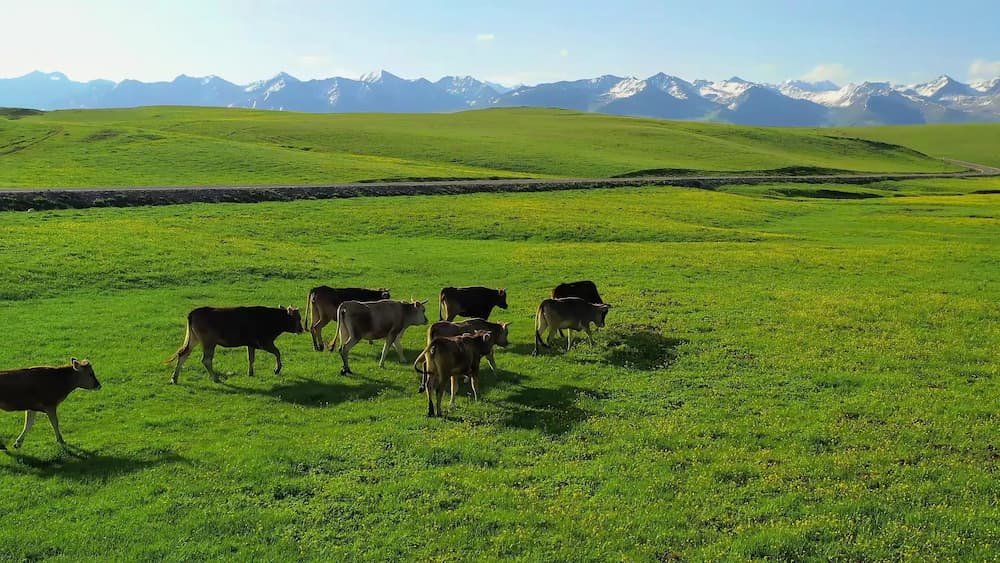
The G7 Jingxin Expressway: Driving Into Xinjiang Through the Desert
The Longest Desert Highway on the Map
There is a particular kind of thrill in pointing a car east from Urumqi and not turning off for more than two thousand kilometers. The G7, formally the Beijing–Urumqi Expressway, is the road that lets you do it. When the final desert segment opened, it became the world’s longest desert expressway, stitching together the grasslands and basins of northern China with the edge of Xinjiang in a single, mostly empty, mostly hypnotic run.
I drove the western half, from Hami into Urumqi, on a June trip, and I will be honest: the first hundred kilometers felt like any other Chinese expressway. Then the settlements thinned, the guardrails started marking nothing but emptiness on both sides, and the road became a straight line drawn across a tawny plain with the heat shimmer doing most of the work of filling the horizon.
This is not a scenic route in the postcard sense. It is a feat of engineering and a lesson in scale. For the self-driver arriving in Xinjiang by car rather than by plane, it is also one of the most satisfying ways to cross the province line.
Why Drive the G7 Into Xinjiang
Most foreign visitors fly into Urumqi or Kashgar and rent a car there. That is sensible. But if you are the kind of traveler who wants to arrive by road, the G7 is the obvious eastern gate. It enters Xinjiang at the Hami region, the province’s eastern panhandle, where the land is still more Gobi than oasis. From Hami you can either continue west on the expressway toward Urumqi, or drop south toward the Turpan depression and the Dabancheng wind corridor that feeds the region’s turbines.
The appeal is the gradual reveal. You start in the dusty eastern plains, climb through passes where the air turns thin and cool, and descend into the bowl of the northwest. It is a slower arrival than a flight, and a more memorable one.
Fuel, Range, and the Tyranny of Distance
The single thing to respect on the G7 is spacing. Service areas exist, but they are not as dense as on the busy eastern expressways, and some are skeletal: a pump, a toilet block, sometimes a shuttered shop. I treat the G7 like the open road it is. Full tank at every opportunity. A car that does 600 kilometers on a tank is comfortable; a small rental doing 400 means you plan your stops, not hope for them.
Charging is improving but uneven on the remote stretches, so if you are in an EV, check the live station map before you commit to a long desert segment. The general self-drive essentials still apply, but on the G7 they move from “good idea” to “non-negotiable.”
Water is the other constant. The cab heats up fast in summer, and the dry air hides how much you are sweating. I carry far more water than I think I will drink, and I have never regretted it.
What the Road Actually Looks Like
People imagine the desert highway as dunes on both sides. It is not. Much of the G7 crosses Gobi: grey-green scrub, occasional rust-colored ridges, and long stretches where the only movement is the heat. The drama comes in bands. There are sections where the road runs dead straight for so long that the distant mountains seem to refuse to get any closer. There are passes where the world suddenly turns green and cold. And there are the wind farms, ranks of white turbines that stand like a silent army across the plain, especially as you near the Turpan corridor.
I pulled over at one unsigned lay-by near dusk and watched the temperature drop twenty degrees in an hour as the sun went behind a ridge. That is the G7 in a sentence: monotonous, then suddenly not.
Hami: The First Real Stop
If you are entering Xinjiang from the east, Hami is where the road starts to feel like Xinjiang rather than “the approach to Xinjiang.” The city is famous for its melons, and in season the roadside stalls pile them high. I bought one the size of a small child for about 15 yuan and ate it over two days. The Hami travel guide covers the city properly, but for the G7 driver the practical point is simple: refuel, rest, stock water, and confirm your next overnight before pushing west.
From Hami west, the expressway and the older roads run roughly parallel, and the older road sometimes rewards a detour when you want to reach a town the expressway bypasses. I kept to the G7 for speed but dropped off once to see a village that the map had reduced to a dot.
Driving Discipline on the Empty Road
The danger on a road this empty is not traffic. It is boredom and its cousin, speed. With no cars ahead and a straight line for fifty kilometers, it is easy to find yourself doing 150 where the limit is 120, or to drift into a micro-sleep at 2 p.m. I set a timer on my phone to remind me to stop every two hours, even when I did not feel tired. The best times to visit Xinjiang tend to be the shoulder seasons, and the G7 in May or September is a kinder drive than the furnace of high summer.
Wind is the other hazard. The corridors west of Hami funnel gusts that can shove a high-sided van sideways. When the turbines are spinning hard, ease off and keep both hands on the wheel. I have seen a sudden crosswind push my car a full lane in a blink.
Connecting the G7 to a Real Trip
The G7 should not be the whole trip; it is the spine you arrive on. Once you reach Urumqi, you are within a day’s drive of the northern grasslands, the Duku Highway, and the Ili valley. If you came from the east, the Gansu Silk Road road trip describes the segment behind you in reverse, useful for planning the drive home.
For me, the G7 worked best as a frame. I spent two weeks exploring the north, then drove back out along the same road with a different eye, noticing the ridges and farms I had been too tired to see on the way in. Repetition on an empty road is not boring. It is how the place starts to make sense.
Final Notes for the Self-Driver
Carry your documents. The expressway has checkpoints, and a foreign passport plus your rental papers are routine but not optional. Keep cash for the skeleton service areas. Download offline maps. And give yourself more time than the distance suggests, because the one thing the G7 will do is make you want to stop and stare at nothing in particular, and those stops are the trip.

A Mistake at the Fuel Pump
On my G7 crossing I assumed the service area I saw at 140 kilometers was the last for a while and filled only halfway, thinking the next would be bigger. It was smaller and closed for renovation. I reached Hami with the gauge twitching near empty and a lesson learned: on a road this empty, full means full, every time, regardless of what the next sign promises. The desert does not negotiate.
The second lesson was about the sun. I wore sunglasses but skipped the sleeve cover, and by mid-afternoon my left arm was pink and hot through the window glass. The UV on these open plains is fierce because there is nothing to soften it. A light long-sleeve shirt and a hat in the car are not vanity; they are the difference between enjoying the evening and regretting the drive.
Distances That Surprise
The G7’s western Xinjiang segment from the Qinghai border to Urumqi is long enough that you should plan an overnight rather than attempt it in a single push, especially if you are also exploring on the way. Hami is the natural break. From Hami to Urumqi is roughly 600 kilometers of good expressway, a full day with stops, not a casual afternoon. Budget it that way and the trip is pleasant; underestimate it and you arrive tired at the wheel, which on this road is the one real danger.
Costs: fuel for a sedan over the desert segment runs 400 to 600 yuan depending on the car and how hard you press. Tolls are modest on the expressway. Food and water at the skeleton service areas are priced for a captive market, so I stock up in the cities. A night in Hami is 150 to 250 yuan for a decent room.
What I Tell Friends Considering It
Driving the G7 into Xinjiang is not for everyone. If your goal is the famous sights, fly in and rent locally; you will see more. But if your goal is to feel the scale of the place, to understand why this province felt like the edge of the mapped world for so long, the road itself is the attraction. I have done it once and would do it again, preferably in September when the heat backs off and the light goes long and low across the plain.
One practical note for foreign drivers: the expressway checkpoints want your passport and rental papers, and they want them without a fuss. Have them in the door pocket. The stops are quick when you are ready and slow when you are not. The G7 rewards the prepared and punishes the casual, which is a fair description of Xinjiang driving generally.
The Quiet Reward
People ask if the desert highway is boring. It is, and then it is not. The boredom is the point: it empties your head of the city, and the not-boring arrives as a sudden range, a fishing village of turbines, a sunset that fills the whole windscreen. Arrive in Xinjiang by the G7 and the province greets you the way it always has, with distance first and everything else second.
Fuel and the Long Empty
The G7 is not short of fuel, but the gaps between stations are real, and the desert has a way of making a half tank feel like a problem. I kept the car above half the whole way and topped up at every town with a sign, which cost me nothing and bought me peace of mind on the empty middle stretch. The wind farms cluster near service areas, and those are the natural fill points; do not press on past one on a low gauge hoping the next is soon, because out here “soon” can mean eighty kilometers.
The other desert habit is water in the door and a charged phone. Signal thins between the oasis towns, and a dead phone on a straight road with no landmark is a smaller problem than it sounds but an annoying one. I learned to screenshot the route the night before and treat the phone as a backup, not the plan. The highway is forgiving; the empty between towns is not the place to discover your navigation was wishful.