
Red Mountain Park Urumqi: The Ultimate City Landmark and Must-Visit Attraction in Xinjiang
Red Mountain Park Urumqi: The Ultimate City Landmark and Must-Visit Attraction in Xinjiang
When travelers ask about the best Xinjiang attractions and things to do in Xinjiang, most people immediately think of Kanas Lake, Sayram Lake, or the vast deserts. But if you’re starting your Xinjiang journey from Urumqi—as most independent travelers do—there’s one urban oasis you shouldn’t miss before heading out to the wilderness. Red Mountain Park (Hongshan Park) is Urumqi’s most iconic city landmark, a free urban park that packs surprising historical depth, panoramic city views, and a direct connection to the city’s cultural soul.
In this guide, I’ll walk you through everything you need to know about visiting Red Mountain Park—from its 18th-century pagoda to the best sunset viewing spots, plus practical tips on how to fit it into your Xinjiang itinerary.
Why Red Mountain Park Deserves a Spot on Your Xinjiang Itinerary
Red Mountain Park (Hongshan Park, 红山公园) isn’t just another city park. It’s a 4.1-square-kilometer natural mountain park that rises straight out of downtown Urumqi, offering a rare combination of urban convenience and wilderness feel. With 97.5% green coverage and over 30,000 trees of 70+ species, it’s essentially Urumqi’s central “green lung.”
But what makes it truly special for the independent traveler are three things:
- It’s free. No ticket gate, no scam, no pressure. You just walk in.
- The view. From the top, you get a 360-degree panorama of Urumqi’s sprawling cityscape with the Tianshan mountains—including Bogda Peak on a clear day—as a dramatic backdrop.
- The history. The park’s centerpiece, Red Mountain Tower (Hongshan Ta), dates back to 1788 and has survived earthquakes, wars, and urban renewal. It’s the symbol of Urumqi.
If you’re spending a day or two in Urumqi before heading to Heavenly Lake or Kanas Lake, Red Mountain Park is the perfect low-effort, high-reward orientation stop.
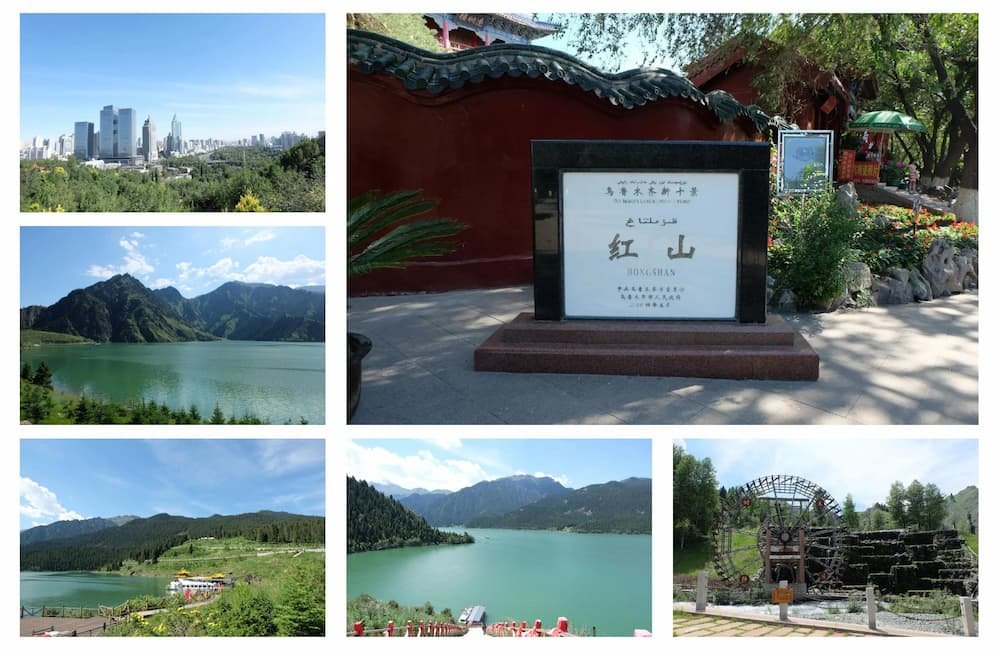 Red Mountain Park Urumqi city view from the top” style=”width:100%;max-width:700px;display:block;margin:20px auto;”>
The Story Behind the Red Mountain
The “Red Mountain” gets its name from the purple-red sandstone that makes up the hill. According to local geological research, the mountain was pushed up during the same Himalayan orogeny that created the Tianshan range some 80 million years ago. The iron oxide in the rock gives it that distinctive reddish-purple hue, especially dramatic at sunset—hence the old Urumqi “Eight Scenic Spots” listing of “Tower Reflecting the Setting Sun” (塔映斜阳).
There’s also a local legend: a giant red dragon was slain by the Queen Mother of the West, and its body became Red Mountain while its sword turned into the Urumqi River. Whether you buy the myth or not, the mountain has been a sacred site for local people for centuries—traditionally a place to offer sacrifices to Bogda Peak, the sacred mountain of the Tianshan.
Red Mountain Tower: Urumqi’s Oldest Landmark
The park’s defining structure is the Red Mountain Tower (Hongshan Ta), a nine-story, hexagonal, solid brick pagoda built in 1788 during the Qing Dynasty’s Qianlong era. It was constructed to “lock the dragon” and protect the city from floods—a feng shui move, essentially. At 10.5 meters tall, it’s not huge, but it’s survived over 200 years of earthquakes and remains the most recognizable silhouette in the Urumqi skyline.
The tower is especially beautiful at sunset when the red sandstone of the mountain and the brick of the tower both glow warm orange. Photographers, take note: this is one of the best sunset spots in the city.
Yuantiao Tower: The Best View in Urumqi
For the best panoramic view, climb up to Yuantiao Tower (远眺楼), a three-story Qing-style pavilion at the park’s highest point. Built in 1989 and covering 1,150 square meters, it’s 21.95 meters tall with a 138-meter-long surrounding corridor. On a clear day, you can see all the way to the Bogda Peak massif of the Tianshan range—the same peaks that tower over Heavenly Lake.
Entry to Yuantiao Tower costs 10 RMB (about $1.40). If you’re on a tight budget, you can still get good views from the open areas around the tower without paying, but the tower itself gives you the highest vantage point.
 Red Mountain Park Urumqi” style=”width:100%;max-width:700px;display:block;margin:20px auto;”>
Dafo Temple: A Reconstructed Buddhist Sanctuary
Dafo Temple (大佛寺) is one of the larger Han Chinese Buddhist temples in Xinjiang. The original temple complex at the foot of Red Mountain dated back to the Qing Dynasty, but was damaged during the wars of the 1930s. When the park was expanded in 1989, the temple gate was relocated to the summit and the main hall was reconstructed. Today it includes a Heavenly King Hall, a Great Buddha Hall, a Guanyin Hall, and a Dizang Hall. It’s an active place of worship with real incense burning—not a museum piece.
Even if you’re not Buddhist, the temple architecture is worth a look, and the atmosphere is peaceful compared to the bustle of downtown Urumqi just below.
Lin Zexu Memorial: History Beyond the Scenery
Red Mountain Park also houses a statue of Lin Zexu, the Qing Dynasty official and national hero who was exiled to Xinjiang in 1845 after speaking out against the opium trade. Lin climbed Red Mountain during his exile and wrote a poem about it—you can still see the memorial plaque. There’s also an anti-drug education exhibit here; Red Mountain was the first anti-drug education base in Xinjiang. It’s a small but meaningful historical layer that adds depth to your visit.
Practical Information for Visitors
Opening Hours & Tickets
- Park entrance: Free, open daily 07:30–23:00
- Yuantiao Tower: 10 RMB
- Underground Palace (Digong): Separately charged, features mythological exhibits with light and sound effects
Best Time to Visit
- Spring (April–May): Flowers blooming, comfortable temperatures, fewer crowds
- Autumn (September–October): Best visibility for mountain views, pleasant weather
- Summer (June–August): Green and lush, but bring sun protection—UV is strong at this altitude
- Winter (December–February): Snow-covered red mountain is beautiful, but paths can be slippery
- Time of day: Sunset (around 21:00 in midsummer, 18:00 in winter) is magic
How to Get There
- By bus: Take bus 29, 35, 61, 62, 63, 73, 908, 919, or 927 to “Hongshan Park Station” (红山公园站)
- By BRT: Several BRT lines stop near Hongshan
- By taxi/Didi: From city center, about 10–15 minutes, roughly 10–15 RMB
- On foot: If you’re staying near People’s Square or the International Grand Bazaar, it’s walkable (20–30 minutes)
What to Wear
The park is a mountain—there’s real elevation gain and stairs. Wear comfortable walking shoes. In summer, bring a hat and sunscreen. In winter, be careful of ice on the stairs.
How to Fit Red Mountain Park Into Your Xinjiang Trip
Red Mountain Park works best as a half-day (or even 1–2 hour) stop either at the beginning or end of your Urumqi stay. Here are three ways to combine it:
- Arrival day: Drop your bags at your hotel, then head to Red Mountain Park for a first orientation to the city. The view from Yuantiao Tower will help you understand Urumqi’s layout before you venture further.
- Departure day: If you have a few hours before your flight, Red Mountain Park is only 20–30 minutes from Urumqi Diwopu Airport by car. It’s a peaceful way to say goodbye to the city.
- Combined with other Urumqi sights: Pair it with a visit to the Xinjiang Regional Museum (20 minutes away) or the International Grand Bazaar (walkable).
Nearby Attractions Worth Your Time
If you have extra time in Urumqi, consider these nearby spots:
- Urumqi International Grand Bazaar: 15 minutes by car. The largest bazaar in the world, great for handicrafts, spices, and people-watching.
- Xinjiang Regional Museum: Home to the “Loulan Beauty” mummy and the “Five Stars Arise in the East” silk banner. Essential for understanding Xinjiang’s deep history.
- Heavenly Lake (Tianchi): 1.5 hours from Urumqi. A stunning alpine lake at 1,910 meters, backed by Bogda Peak. Doable as a day trip from Urumqi.
- Shuimogou Hot Springs: 30 minutes from the park. Natural hot springs where locals go to relax.
Final Thoughts: Why This Park Matters
Red Mountain Park isn’t the most spectacular natural wonder in Xinjiang—that’s not the point. The point is that it’s a living, breathing part of Urumqi where the city’s past and present overlap. You’ll see elderly Uyghur and Han Chinese men playing chess, families on weekend outings, and young people taking photos against the red rock. It’s real, it’s local, and it’s free.
For the independent traveler, Red Mountain Park is also a great first lesson in reading Xinjiang’s cultural landscape. The coexistence of the Buddhist temple, the Qing Dynasty pagoda, and the Lin Zexu memorial—all in one small urban park—tells you something important about this region’s layered history.
So before you rush off to the “big” attractions, spend an hour or two at Red Mountain Park. It’s the best 10 RMB (or free, if you skip the tower) you’ll spend in Urumqi—and it might just change how you see the rest of your Xinjiang trip.
Last updated: July 2026. If you’ve visited Red Mountain Park recently and have tips to share, let us know in the comments!