
Saiga Antelope in Xinjiang: Meeting One of the World’s Most Endangered Mammals
The Saiga’s Strange Face and History
Last July I drove north out of Karamay toward the empty steppe, and somewhere past the last oil pumps I finally understood why people call the saiga one of the oddest mammals alive. The first time you see a photograph of that face, you think the photographer doctored the nose. He did not. The saiga carries a swollen, downward-hanging snout that looks less like an animal’s feature and more like a fleshy trumpet someone glued on by mistake.
That bizarre bulbous nose is not a joke of evolution. It warms the freezing winter air before it hits the lungs, filters the dust that rolls off the steppe in summer, and helps the herd pick up scents across long distances. I spent a cold morning at a research station listening to a ranger describe it, and the more he talked, the more the strange face made perfect sense.
Saiga are small antelopes, really. A mature male stands about 60 to 80 centimeters at the shoulder and weighs somewhere between 30 and 50 kilograms. The females are hornless; the males wear a pair of pale, slightly translucent horns that curve back from the forehead. In the wild they live roughly six to eight years, though in a protected setting a few reach ten. What strikes you in person is how fast they move. A startled herd can hit 80 kilometers per hour across open ground, kicking up a pale cloud that hangs in the air long after they vanish.
The species once ranged across a vast belt of grassland and desert from the edge of Europe deep into Central Asia. Herds of hundreds of thousands migrated with the seasons, and travelers in the 1700s and 1800s wrote about walls of moving animals that took hours to pass. Those numbers are almost impossible to imagine now. The saiga is a survivor of the Ice Age, a creature that shared the plains with mammoths, and it nearly did not make it into our own century.
What fascinates me as a driver is how this animal’s fate is tied to places most foreign travelers never reach. You can read about saiga in a zoo, but to understand them you have to go to the wind-scoured borders of northwest Xinjiang, where the land itself seems to be waiting for something to happen. That is where I headed next.

Range in Xinjiang’s Northwest
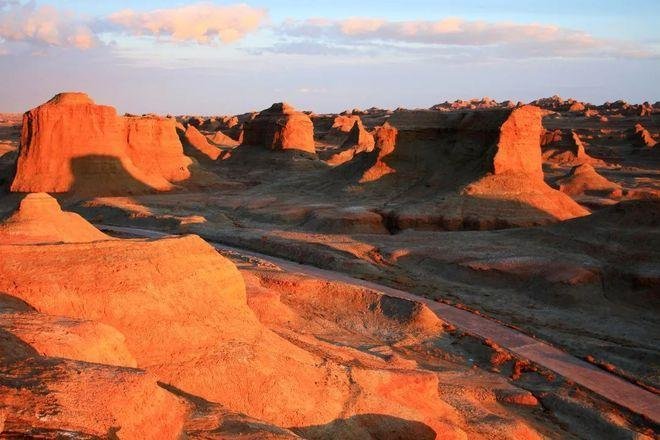
In Xinjiang the saiga survives in a few remote fragments, and the heart of that range sits in the northwest. The main population clings to the dry grasslands and semi-deserts of the Junggar Basin, the great enclosed bowl of land that lies between the Tian Shan to the south and the Altai to the north. This is not the tourist Xinjiang of Turpan or Kashgar. It is a quiet, windy country of grey scrub and distant ridges.
The two places you will hear named again and again are Hoboksar and Jimunai. Hoboksar Mongolian Autonomous County straddles the steppe near the Kazakhstan border, and its open plains offer exactly the kind of terrain saiga prefer: low vegetation, long sightlines, and few people. Jimunai, a border county tucked into the Altai prefecture, marks another edge of the animal’s world. If you want the broader picture of the region, our guide to the Jimunai border county lays out roads, distances, and the practical limits of traveling this close to the frontier.
I drove the stretch from Hoboksar toward Jimunai in late summer, when the grass had gone the color of old paper. The road is mostly good asphalt, but the distances are huge. Between the two counties you cover roughly 280 kilometers, and for long stretches the only signs of life are the wind turbines turning slowly above the horizon. Saiga move across this whole corridor, though you are far more likely to see their tracks than the animals themselves.
The Kazakhstan border runs close here, and the saiga does not respect it. Herds drift across the line with the seasons, which is one reason conservation has to be international. China, Kazakhstan, Russia, and Mongolia all hold pieces of the population, and what happens on one side of a fence affects the other. For a self-drive traveler this means something practical: the best saiga country is also sensitive borderland, and you should expect checks, permits, and a lot of empty road.
What I remember most is the light. In the Junggar Basin the sky is enormous, and at dusk the whole plain turns the color of a struck match. Standing there alone with the engine off, I understood why these animals need so much space. They are not a forest creature or a mountain creature. They are a horizon creature, and the horizon here goes on for 200 kilometers without a break.
The Conservation Comeback
The saiga’s recent history is one of the most dramatic conservation stories on the planet, and it is worth telling plainly. In the early 2000s the numbers collapsed. A combination of poaching for the male’s horns, which were shipped abroad for use in traditional medicine, and a series of brutal mass die-offs from disease cut some populations by more than 90 percent in a single bad year. One famous event in 2015 killed an estimated 200,000 saiga in Kazakhstan in a matter of weeks, roughly half the entire global population at the time.
Xinjiang’s herds suffered the same pressures. By the late 1990s the local population had fallen to a few hundred animals, and biologists genuinely feared the Chinese saiga would disappear. The government responded by tightening protection, setting up guarded reserve zones, and working with Kazakh counterparts to police the borderlands where poaching crews operated. The effort was slow, but it worked.
By the late 2010s surveys began to show real recovery. The Xinjiang population, once barely hanging on, climbed into the low thousands, and calf counts each spring started to look hopeful again. The saiga remains listed as critically endangered, so this is no victory lap. But the curve, for the first time in decades, points the right way. I find that genuinely moving, because so many conservation stories only get worse.
The biology behind the rebound is strange and a little fragile. Saiga are boom-and-bust breeders. A healthy female can produce twins in a good year, and a well-protected herd can double in size over a few seasons. That fast reproduction is the only reason the species survived its own near-collapse. It also means a single disease outbreak can undo years of work, which is why the reserves watch the herds so closely.
For a traveler the lesson is simple but easy to forget. The saiga you might catch a glimpse of on the steppe represents a thread that came within a hair of snapping. Every animal out there is precious, and the people who guard them know exactly how many there are.
Responsible Viewing (Mostly Indirect)
Here is the honest truth I want every foreign driver to hear before they point a rental car toward the border: you will probably not see a saiga in the wild, and chasing one would be the wrong thing to do. These animals are skittish, the habitat is closed in places, and the last thing the population needs is a tourist in a hurry scaring a pregnant female into a run. The responsible approach is to watch indirectly, and to enjoy the search more than the sighting.
The best responsible viewing happens from a distance, often with binoculars, from a designated pull-off or a reserve observation point. Several of the local nature reserves run guarded zones where rangers will tell you where you may drive and where you must not. Stay on the road. Keep your distance. If a ranger says turn back, turn back. The fine is the least of it; the cost to the herd is the real penalty.
I learned to read the sign of saiga without seeing the animal itself. Their hoof prints are small and neat, narrower than a sheep’s, and in soft morning ground they show clearly. In winter the herds leave shallow trails worn into the snow, and following one of those trails on foot for a hundred meters, then stopping and listening, gave me a closer sense of the creature than any photograph. You feel the scale of their world without disturbing it.
There is also the camera-trap route. A few education centers and reserve offices show footage collected by motion sensors, and watching a night-time clip of a saiga passing through a beam of infrared light is its own quiet thrill. You see the odd nose up close, the cautious step, the way the whole herd flows like water around a stone. For most visitors this indirect view is the realistic and the ethical one.
If your real interest is the broader animal life of the region, our general wildlife-watching guide covers where to look for snow leopards, wild camels, and birds across the province. The saiga is one thread in a much larger tapestry, and the other threads are easier to find.
Museums and Education Centers to Visit
Since the wild sighting is unlikely, the smart traveler builds the saiga into a route of indoor learning. Karamay, the oil city at the southern edge of the Junggar Basin, is the natural base. Its natural-history displays include mounted specimens and panels on the basin’s steppe ecology, and after a day of driving empty roads it is a relief to stand in an air-conditioned hall and put names to what you saw.
North toward the Altai, the small county museums in Hoboksar and Jimunai keep modest but genuinely useful exhibits on local wildlife and the borderlands. Do not expect grand buildings. Expect a single room, a patient curator, and a chance to ask the questions you could not ask on the steppe. In Jimunai I once spent an hour with a volunteer who pulled out a worn map and traced the saiga’s seasonal drift by hand. That conversation taught me more than any brochure.
Further west, around Sayram Lake, the visitor centers often carry regional ecology displays that place the saiga in the context of the whole northwest. Sayram itself is a high blue lake ringed by mountains, and the drive there from the basin is a long, beautiful haul of roughly 400 kilometers through changing country. Pairing the lake with a museum stop turns a saiga interest into a full loop rather than a single disappointed detour.
These centers matter for a reason beyond tourism. They are where the next generation of Chinese rangers and biologists gets hooked, and where a foreign visitor can leave a small donation or buy a booklet that actually funds the work. I always buy the booklet. It weighs nothing in the trunk and it puts a few yuan toward the fences and the patrols.
Driving the Remote Borderlands Safely
Self-driving here is a serious proposition, and I mean that in the practical sense, not as a warning to stay home. The roads are real, the fuel is available, and the scenery is unforgettable, but the margins are thin. Plan your tank around the towns, because between Hoboksar and Jimunai the fuel stations thin out and a wrong turn can leave you 100 kilometers from help.
Timing matters more than route. Spring, from April to early June, brings howling wind and sudden snowmelt floods across low sections of road. Autumn, September through October, is the sweet spot: cool, clear, and calm, with the steppe at its most photogenic. I avoid deep winter, when temperatures near the Kazakhstan line drop past minus 25 Celsius and a breakdown stops being an inconvenience and starts being a risk.
Borders require paperwork. Carry your passport, your valid driving permit, and any local travel authorization the county police ask for. At checks near Jimunai the officers are professional and quick, but they will not wave you through on a smile. I keep a printed copy of my hotel bookings and a simple route sheet in the glovebox; it has smoothed every stop I have had.
Budget for the slow pace. A sensible day covering Karamay to Hoboksar and back, with museum stops, runs about 320 kilometers and eats a full daylight window. Fuel for a standard SUV over that loop costs roughly 250 to 320 yuan, and a basic county hotel runs 180 to 260 yuan a night. None of this is expensive by Western standards, but the costs add up because you drive so far for so few sightings.
One more thing from hard experience: download your maps before you lose signal. The basin swallows phone coverage for long stretches, and a cached offline map has saved me twice. Tell someone your route and your expected return, even if that someone is just your hotel desk. The steppe is beautiful precisely because it is empty, and empty works both ways.
Why Protecting Them Matters to Travelers
You might wonder why a self-drive website spends words on a shy antelope most visitors will never see. The answer is that the saiga is a measuring stick for the whole northwest. When its corridors are intact, the steppe still works: the wolves still hunt, the foxes still den, the migrations still mean something. When those corridors close, the silence you feel at the roadside is not peace. It is loss.
Travelers hold a small piece of the outcome. Every yuan spent on a reserve entry, every booklet bought, every stranger who learns the saiga’s name and goes home to tell the story, pushes the curve a little further upward. The animal’s strange face is, in the end, a kind of ambassador. It asks the world to notice a corner of Xinjiang that maps rarely show, and to care that it stays wild.
For me the saiga became the reason I learned the Junggar Basin at all. I went to find a nose like a trumpet and stayed to understand a landscape. If you drive north with that same open curiosity, keep your distance, and let the reserves do their quiet work, you will have met one of the planet’s most endangered mammals in the only way that counts. You will have left them alone, and you will have left them alive.