

Uyghur Courtyard Houses: How to Read a Xinjiang Home
The First Threshold
I stepped through a carved wooden gate into a courtyard shaded by a poplar, and the heat of the Turpan afternoon dropped away as if someone had switched off the sun. A grape vine ran overhead on a trellis of dried willow, its leaves stitching the light into a green quilt. Somewhere behind a mud-brick wall a tap ran, and a child laughed, and I understood at once that I was not looking at a house so much as a small, walled world.
The traditional Uyghur home is called a hoyla, though you will hear the word softened into many local pronunciations across Kashgar, Yining, and the villages of the Ili Valley. It is a courtyard house, and the courtyard is the point. Everything else, whether the rooms, the walls, the carved door, or the fruit trees, exists to serve that open square of packed earth where a family actually lives. To read a Xinjiang home, you begin not with the building but with the threshold you cross to enter it.
I have now stayed in a dozen such houses, from a two-room dwelling in the oasis of Tuyugou to a sprawling family compound outside Kashgar where three generations share one walled garden. Each is different, yet each obeys the same quiet logic. The logic is climate, privacy, and the rhythm of a day that begins before dawn and ends on a roof under the stars.
Reading the Walls
The first thing your hand learns, if you press it flat against a courtyard wall in July, is that the mud brick is cool. This is the oldest trick in the desert and the most important one. The walls are built from sun-dried bricks of local earth, mixed with straw and sometimes chopped reed, then faced with a daub of the same material. In Turpan, where summer temperatures sit past forty degrees Celsius for weeks, those walls can be half a meter thick or more.
Thickness is the whole system. A massive earthen wall absorbs the punishing heat of the day and releases it slowly, so the interior stays dim and even. I once measured the difference with nothing but my own skin: outside the gate it was a furnace; three paces inside the courtyard, against the shaded northern wall, it was merely warm. The house does not fight the climate. It banks it.
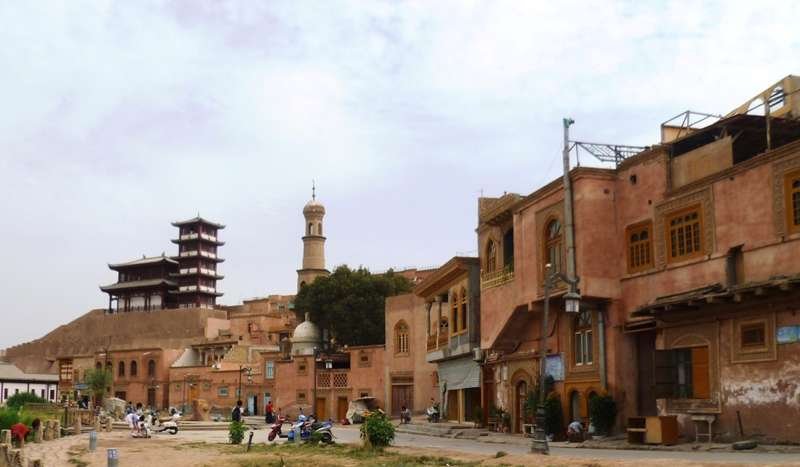
You can see the same cooling logic in the Uyghur architecture of Turpan, where the great minaret and the tomb complexes use thick piers, small openings, and deep shadow to keep their interiors livable. The domestic house is the same idea at the scale of a family. The brick is usually left its natural tan, though in Kashgar you will find courtyards where the lower courses are painted a chalky blue or a muted ochre, a band of color at knee height that the dust never quite erases.
How the Bricks Are Made
In the villages the bricks are still formed in wooden molds by hand, laid out to bake on the flat roof of the house itself. I watched a man in his sixties tamp a mixture of river silt and straw into a frame, flip it out, and set it in a row beside a hundred brothers. After a week of dry wind the brick is hard enough to build with and soft enough that a century later it can be crumbled and remade. A Uyghur courtyard house is never finished. It is maintained the way a garden is maintained, a little every season.
The Courtyard, or Hoyla
Step inside and the courtyard claims you. It is almost always rectangular, longer than it is wide, oriented so that the main rooms open to the north and escape the worst of the southern sun. The floor is packed earth, swept smooth, sometimes ringed by a raised platform of brick where shoes are left and where, in the evening, cushions are thrown down for sitting.
A mature poplar stands in nearly every courtyard I have visited, its trunk pale and straight, its canopy high enough to throw shade without stealing the breeze. Beneath it the family eats, repairs tools, and receives guests who are not quite inner-circle. The poplar is practical, fast-growing, and deep-rooted enough to survive on the little water an oasis allows. Where there is no room for a tree, a trellis does the work instead.

The grape vine is not decoration. In Turpan the vine is agriculture brought into the living room, and a single arbor can carry enough fruit to dry on the roof into raisins for the winter. I have stood under an arbor heavy with green and black clusters in late August, the air smelling of sugar and leaf-mold, while the grandmother of the house snipped a bunch and pressed it into my hands without a word. The courtyard feeds you, shades you, and cools you, all at once.
The Iwan and the Shaded Porch
Along the north side of many older houses runs a deep, roofed porch, an open-fronted room that the Persians would call an iwan and that local builders simply build because it works. It is a half-space: not outside, not fully inside. Its floor is raised a single step above the courtyard, often laid with brick in a running-bond pattern, and it is here that the most important domestic life happens in summer.
I slept on such a porch one August night, on a thin mattress with a sheet over my face against the mosquitoes, and woke to find the whole family already up, the father performing his morning prayers at the far end, the mother stacking flatbread to take to the market. The porch is the summer sitting room, the guest room, the dining room, and sometimes the bedroom. When the cold comes, the household retreats to the small heated rooms behind it and the porch falls quiet until spring.
What makes the porch readable as Uyghur rather than generically “Central Asian” is the woodwork. The posts are turned on a lathe into fluted columns, and the beam above the opening is carved with a running vine scroll. Even a poor house will have a single decorated post, because the entrance deserves it. Hospitality is announced at the threshold.
Doors, Lattices, and Wood
The gate is the signature of the house, and no two are identical. I have seen gates of halved apricot wood nailed with hand-forged studs, gates painted the blue of a clear noon sky, gates so covered in carved rosettes that they look embroidered. The double-leaf door swings on iron hinges set into the mud, and behind it a smaller human-height door is cut into one leaf, so that a caller can be admitted without throwing the whole street a view of the courtyard.
Inside, the windows are the second great wood moment. They are built of many small panes set into a lattice of turned spindles, a pattern called a qosh screen in some regions, though the names matter less than the effect. The lattice lets air move and light filter while preserving the privacy that the courtyard itself guarantees. A woman can sit at the window and see the street without being seen. I found this detail repeated in every town, from Yining to the southern edge of the Taklamakan.
The carving itself draws from a tight vocabulary: the pomegranate flower, the grape leaf, the tulip, the scrolling vine. These are not random. They are a spoken language of fertility and welcome, repeated so often that a traveler learns to read a doorway the way a birder reads a wing. A gate heavy with pomegranates belongs to a family proud of its daughters and its orchard both.
Vines, Fruit, and Water
Beyond the grape there is almost always a second tree, and very often it is a pomegranate. The pomegranate tolerates the dry heat and rewards it with a crop of leathery red fruit that the family eats fresh, presses for a sharp juice, or sets aside for the New Year table. I have seen pomegranates trained flat against a south wall to catch every degree of warmth, their roots sunk into a basin that catches the wash water from the kitchen.
Water is the courtier of the courtyard, never the king. An oasis cannot waste it. The rawaq, the raised brick platform around the edge of the yard, slopes almost imperceptibly toward a single drain, and the water that has rinsed vegetables or cooled a child’s feet is guided to the roots of the trees. Nothing leaves the hoyla that has not first done two jobs.
In the cooler north, around Yining and the Ili Valley, the same house type adapts. The courtyard is tighter, the trees are more likely to be apricot and walnut, and the vines climb a frame over the summer kitchen rather than a grand arbor. The logic is identical; only the weather has changed the dials. A traveler who learns to read one house can read them all.
How Space Is Gendered and Seasonal
The courtyard house is not a neutral box. It sorts people by season and by gender with a gentle, inherited precision. In summer the family lives outdoors, and the boundary between male and female space softens, because the work of the yard (drying fruit, tending the vine, receiving the occasional male guest at the outer platform) falls to whoever is nearest. In winter the household pulls inward, and the heated qong rooms behind the porch become the women’s domain of cooking, sewing, and child-rearing, while men more often receive visitors in a front room set aside for them.
The roof tells the same story in reverse. In the hottest months the flat roof, reached by an external staircase of mud brick, becomes a sleeping terrace. Whole families migrate upward after dark, unrolling mattresses under a sky so clean and so full of stars that I stopped trying to count them. The roof is the most egalitarian floor in the house, shared by grandparents and grandchildren, and it is where I have had some of the quietest conversations of my travels, lying on my back and naming constellations in a language neither of us fully shared.
What surprised me most was how the house protects women’s mobility rather than restricting it. The lattice window, the inner courtyard, the separate guest door: each lets a woman move through her day unseen by the street, free to work, rest, and receive her own guests within the walls. The privacy is a garment, not a cage. I say this as a visitor, not an authority, but it is what the women of the houses I stayed in told me, and what their ease inside those walls confirmed.
Where You Can Stay in One
The good news for travelers is that you no longer have to be invited. Across the region, families have opened their courtyards to guests, and staying in one is the surest way to understand the architecture from the inside out. In Kashgar the old town maintains centuries-old houses where you can sleep under the carved beams and eat breakfast in the cool of the porch. In the villages around Turpan, family homestays let you help press the flatbread, climb to the roof at night, and learn the difference between a summer room and a winter one by sleeping in both.
For a starker version of the same idea, travel to the oldest Uyghur village, where mud-brick houses cling to a ravine and have done so for a thousand years. The houses there are smaller and older, built into the earth of the cliffs, but the courtyard principle survives: a walled square, a vine, a shaded place to sit. Few places make the deep history of the form so tangible.
If your route carries you north to the grasslands, the logic of the courtyard gives way to a different but related shelter. In the Ili backcountry you can sleep in a primitive Kazakh village of timber cabins and felt dwellings, and then trade the forest for the open steppe by booking into yurt camps where the round felt dwelling answers the same questions of wind, heat, and family that the Uyghur hoyla answers in brick. Seeing both side by side taught me more about Central Asian building than any museum.
A Closing Walk
On my last morning in Tuyugou I walked the lane before the heat rose, past gates closed and open, past a woman sweeping the packed earth of her yard, past a child who pressed a single grape into my palm and ran. I tried to read each house as I had been taught: the thickness of the wall, the direction of the porch, the tree in the court, the carving on the door. Each was a sentence in a language I was only beginning to speak, and each said the same thing in its own accent—welcome, shade, and the slow patient work of living well in a hard and beautiful land.
You do not need an architect’s training to read a Xinjiang home. You need an open gate, a willing host, and the humility to sit on a brick platform in the shade of a poplar and let the house tell you how it breathes. Do that, and the courtyard will do the rest.