
Xinjiang Motorcycle Travel Guide: Inbound Riding Routes, Bike Prep & Long-Distance Resupply
Last September I left Urumqi on a 650cc adventure bike and spent 12 days looping the northern Xinjiang circuit, covering 3,100 km in total. Friends asked most: “Riding a motorcycle into Xinjiang — how is it different from driving?” Half a joke, my answer: driving is tourism, riding is penance. Wind, sand, crosswinds, temperature swings, and 200 km stretches with no repair shop — in a car you hide in the cabin; on a bike you carry it all.
This is for anyone thinking about riding into Xinjiang. I do not assume you are a veteran, but if city commuting still makes you tense, build your basics before planning routes. Below, five blocks — routes, bike, documents, resupply, safety — what I learned the hard way, no motivational speeches.
Choosing your line into Xinjiang
Xinjiang is too big for one trip. By difficulty and scenery, four common routes, low to high.
Northern Xinjiang Loop is my top pick for a first ride: Urumqi – Sayram Lake – Yining – Zhaosu – Tekes – Nalati – Bayinbuluk – Duku Highway – Dushanzi and back. About 1,800 to 2,200 km, 8 to 12 days, with lakes, grasslands and snow mountains, and relatively forgiving roads. The Duku Highway is the highlight but opens only June to October; check the exact Duku Highway opening months and traffic restrictions first. My 12-day trip ran this loop and felt the most balanced.
Southern Xinjiang Loop suits culture and wilderness: Kashgar – Shache – Hotan – Minfeng – desert highway – Luntai – Kuqa – Aksu – back to Kashgar, around 2,500 km. The Taklamakan desert highway is straight, blazing and sparse on resupply. A friend crossed it solo, blew a tire, and pushed four kilometers to a maintenance station.
G219 Xinjiang–Tibet is the “graduation exam”: from Yecheng toward Tibet, altitude past 5,000 m, hundreds of kilometers of no-man’s-land. Too much for a first trip. For the northern G216/G217 and their hard sections, see how to ride the northern Xinjiang G216/G217 routes; the pass descriptions help on two wheels too, since many passes are shared with cars.
Eastern Xinjiang mini-loop fits a tight week: Turpan – Shanshan – Hami – Barkol. Flaming Mountains, Kumtagh Desert and Barkol grassland differ wildly, and the east stays low with dense resupply — a good shakedown. For city-to-city distances, mileage and drive times on Xinjiang’s five scenic highways has the table I planned my daily km from.
Do not be greedy with distance. A car does 600 km a day; a comfortable ride is 250 to 350 km, leaving room for flats, roadwork and weather. My average was under 260 km a day, and I saw more than those who forced the pace.
Prep the bike, or your trip becomes a tow
Skip the pure sport bike or small scooter — cramped and low-clearance versus short-range and useless off-pavement. The sweet spot is a 250 to 650cc adventure or dual-sport: upright seat, big tank (14 L+), light off-pavement ability. My 650 ran ~380 km per tank, and that only just counts in Xinjiang. Under 12 L and the desert highway becomes daily anxiety.
Tires come next. Many scenic spots leave the pavement for gravel where a road tire slips and drops you. I run 50/50 dual-sport tires; a little more noise and fuel use, worth the calm. For tubeless, carry plugs and a mini pump — plug a puncture on the spot. Once I picked up a nail on the S101 and fixed it in five minutes.
Service before departure: lube and tension the chain, check oil, brake fluid, coolant, replace thin brake pads. I do a full service within 500 km of entry and swap wear items. Carry tools, hex keys, a repair set, a spare clutch cable, a spark plug — easy inland, often impossible in a frontier town with only a tractor shop.
Mods: crash bars are mandatory, they save the engine in a tip-over; hard panniers beat a backpack; set the windscreen to block chest wind; the phone mount must be waterproof and shock-resistant with charging, since the screen is your only nav. I also strap a tank bag with a day’s water and food — if I break down, that bag keeps me alive. The full kit cost ~¥4,000, every yuan bought calm.
Do not overload. Newcomers pack like moving house, then wonder why it handles like a pig and snaps the top-box bracket. Keep total load under 25 kg, heavy items low and center.
Documents and formalities — stricter on two wheels
Three basics: license, registration, compulsory insurance. Checkpoints ask repeatedly. Xinjiang security checks are denser than inland — entering counties, at stations and scenic areas you swipe ID and pass inspection, motorcycles included. Cooperate; at the pump you also face-scan, and motorcycle refueling can mean pushing to a zone and a longer queue, so never wait for the low-fuel light.
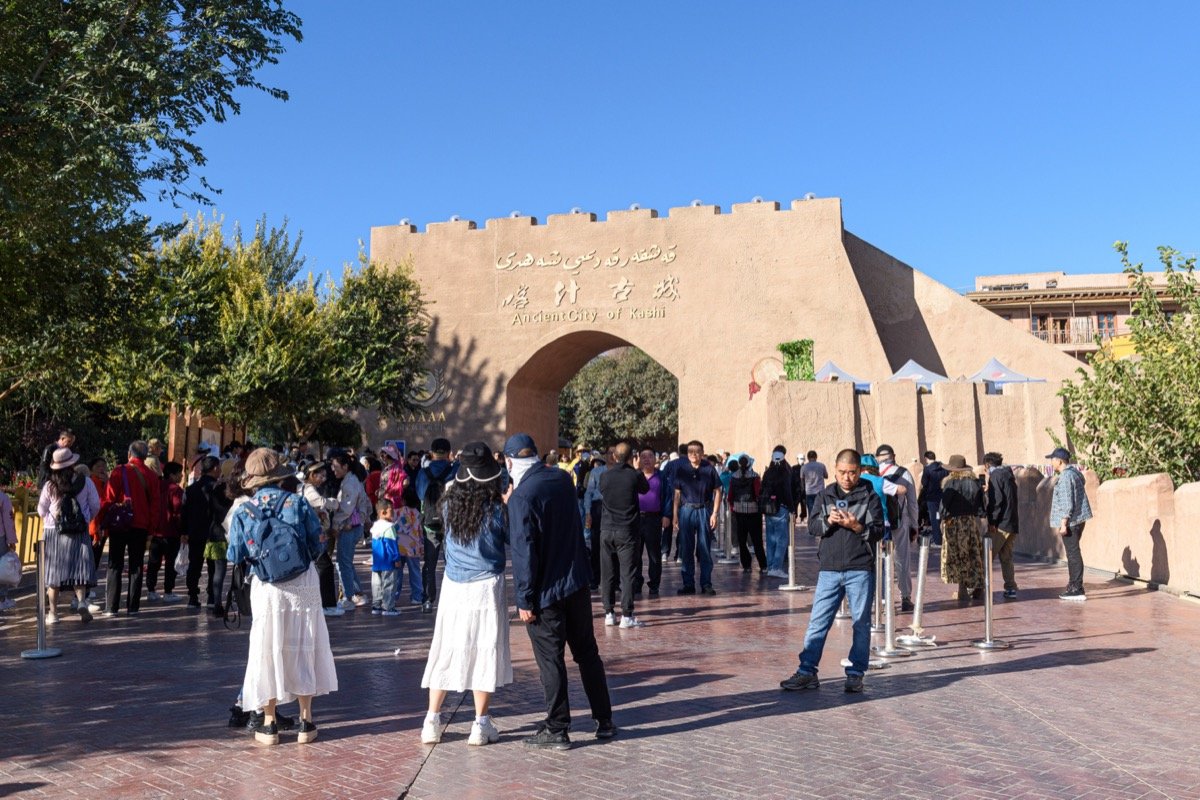
Heading to Kashgar, Tashkurgan or Khunjerab? Get a border permit in advance — apply at your registry or a Kashgar office, or arrive at the pass unable to enter. Sort it early; see how to get a border permit before heading toward Kashgar. Toward Tashkurgan they may ask your plan too, so have paperwork ready.
An out-of-province plate is fine, no translation needed. Watch insurance not lapsing — checkpoints glance at the sticker. Do not overload or carry a passenger over the limit; Xinjiang enforces this and a stop eats your day. I saw someone strap luggage to the pillion, get fined and re-tie it, half a day gone.
Do not let annual inspection lapse. Checkpoints match the frame number; expired inspection can mean impound on the spot. Check a month before; do not gamble.
High-altitude and long-distance resupply
Drivers think “yellow gauge, any station.” Riders carve range into bone. Between stations it is 80 to 150 km, some desert stretches 200 km plus with none. My rule: refill at half a tank, never bet on “one ahead.” On the Duku, service gaps are long, so I top off at every station.
Skip the jerry can. Xinjiang controls loose gasoline strictly; stations will not fill a can and it may cause inspection trouble. Better: a long-range bike, resupply points in your track, pace with the truck convoys. If you must carry, use a compliant metal can and follow procedure; a plastic jug gets confiscated.
Water beats fuel. Gobi days hit 35°C plus and you sweat; I drink 3 L a day and carry two days of water plus biscuits, chocolate, raisins. Sparse repair means you fix it yourself — tube, chain, cable — so practice at home. I rebuilt my chain a week before leaving so I would not fumble roadside.
Above 4,000 m on the G219 or Pamirs you get dizzy and slow — deadly on a bike. Above 3,500 m I cut distance and sleep a night at altitude to acclimatize, never push. A friend forced 4,800 m, threw up at the pass, and was brought down by a passing car.
Wind is the invisible enemy. Gobi and pass crosswinds shove the bike, worse light or on a bridge. Slow, drop your body, grip, do not fight it. A gust once pushed me over a meter on a bridge; now I drop to 60 km/h at the warning sign.
Safety — no margin for error
A car bumps, you fix the car; a bike drops, you get hurt. Full-face helmet, knee and elbow armor are not optional. I have seen T-shirt riders lose a slab of skin in a minor spill. Gloves too — hands hit ground by instinct. I bought armor piece by piece for ~¥1,200, cheaper than one ER visit.
Hazards are “live”: crosswinds, sudden herds crossing, blinding night trucks, pavement turning to gravel. My rules: no night riding, no speeding, ease off through animals, drop weight in wind. I never ride at night; many stretches have no lights and you see a herd 30 m out — too late to stop.
Do not skimp on insurance. Compulsory pays the other party, not you; add a policy covering accident and medical. The insurance you actually need for a Xinjiang motorcycle trip explains the cover; spend half an hour. Mine included medical evacuation, ~¥600 a year — if I go down in no-man’s-land, someone comes.
Report to a fixed contact daily with an agreed check-in. Xinjiang is so big a passerby may take hours to appear; proactive reporting beats everything. I send my wife a location and “stayed at XX” before 10 p.m.; if she hears nothing she follows our plan and calls local rescue. That let my mother relax.
Soft safety in the kit: offline maps and rescue numbers. 12122 may not connect in many areas; I saved civilian rescue WeChat contacts from rider groups, faster than official lines. Log hospitals along your route so you know where to run if you fall.

The night I remember most
Day seven of the northern loop, riding Nalati to Bayinbuluk, cold rain started, temperature dropped to 6°C, gloves soaked, fingers barely working the clutch. Sixty km out, phone at 8%, nav flickering. I stopped half an hour at a herder’s guesthouse, warmed my hands on milk tea, charged the bike, reloaded the track into a backup phone, then continued. Bayinbuluk was dark when I arrived, but its lights were more reassuring than any view.
That night taught me: the plan never survives reality; all you trust is the preparation and the calm you keep. After that I ran “worst case?” before every departure and rode more relaxed.
Plain talk for a first ride
Do not jump to the G219; start with the northern loop. Do not compromise on the bike — range and clearance are the floor. Get documents, insurance and border permits early. Carry two days of water and food, refuel at half a tank. Skimp on no armor, keep the check-in daily. 250 to 350 km a day is best. Do that and Xinjiang gives a freedom driving cannot — wind past your ears, road to the sky’s edge.
My 650 has passed 12,000 km, half in Xinjiang. If you ride in this year, remember: Xinjiang does not trouble the prepared; it rewards those who did the homework. See you on the road.
Best months to ride
June to September is the golden window — seasonal roads like Duku and Yizhao open, grasslands green, temperatures kind. May and October work but high passes can snow; I keep newcomers off them. Winter is not recommended: northern Xinjiang hits minus twenty or thirty, roads ice, a spill is no joke.
Months differ. July is hottest (Gobi above 35°C) and priciest; a room can cost double the low season. August brings fruit but occasional southern sandstorms. September is my favorite — autumn color, fewer tourists, mild. My 3,100 km ran in September with no extreme weather.
Day-night swing is real: September days 25°C, nights 8°C, high passes near 0. Riding into wind you feel ten degrees colder, so layer — wicking base, fleece mid, windproof shell; peel on arrival, wear on the road.
Getting the bike in: ship or ride
Two ways: ride in from Gansu or Qinghai and warm up en route, or train-ship it crated to Urumqi and fly in to collect. Shipping is a few hundred yuan but needs handlebars off, fuel drained, reassembly. For a first-timer far away, fly to Urumqi and rent or ship, learn the feel first; ride all the way from inland later, as its own epic. Either way, full-check the bike on arrival — shipping loosens bolts, do not point straight at the Duku.
Where to sleep, where to park
Riders fear pried panniers overnight and a tampered bike by morning. I pick hotels with a courtyard or park where the desk sees the bike; nothing valuable stays in the boxes. Once by Kashgar’s old town the owner let me push the bike into the yard — I slept easy. Herder guesthouses and garrison stations are basic but watched. Security is decent, but three boxes draw eyes; carry little, park under cameras. Charging is easy: push to the room door, run a line from the window.
The crosswind at Dabancheng
Dabancheng’s wind gap earns its name. Toward Turpan my 650 was shoved sideways at 80 km/h, straining to hold the bars. I rolled to 50, dropped onto the tank, gripped hard; two kilometers later the wind eased and I pulled over to breathe. Lesson: at any “beware crosswind” sign, drop speed early, never fight the wind. In dust, no hard braking or yanking the bars — follow the taillights ahead. A yellow wall at Kumtagh cut visibility to thirty meters; I trailed a truck’s lights and crawled through in ten minutes.
Repair and spares — do it yourself
Worst case is breaking with no one to fix it; beyond prefecture capitals many towns have auto but no motorcycle repair. So plug, tension, splice must be your skills. I carry: tire plugs, mini inflator, hex set, spare clutch cable, spark plug, zip ties, tools — under ¥300, but they walk you back onto the road. Tubeless puncture: pull, plug, inflate, ten minutes. Loose chain: two notches. Snapped cable: fit the spare. I practiced at home so my hands would not shake. Knowing how beats carrying how many.
Gear and sun protection
Xinjiang UV peels exposed skin in a day. I wore a UV-rated suit, neck gaiter, face mask, full-finger gloves, ankles covered. T-shirt riders sunburn to sleeplessness in two days. Balm for lips, Vaseline for nostrils — small, lifesaving. The outer layer must be windproof and waterproof; my ¥200 soft-shell saved me on a Duku hail. Skip hard armor — it bruises and hurts control; CE-rated protectors are safest.
Staying in touch with home
My system: send the day’s route and lodging before departure; “passed XX, normal” at each signaled town; location and “stayed down” before 10 p.m. If 24 hours pass with no word, my wife calls the local alarm number and my satellite text, then the rider group. A Beidou box (~¥1,000 plus a few hundred a year) can send “G217 km XX, need rescue” from no-man’s-land; I set its SOS to one button by the bar so my hand never leaves the bike to press it.
One flat that taught me a tow rope
Day nine, a companion’s rear tire blew on S101 gravel. Plug, inflate, ride five km, flat again — hole too big. A passing SUV towed us 20 km to a station. Since then a 5-ton rope always rides with me, tens of yuan, worth more than anything when stranded. A rope makes “help” simple for a stranger too.
The small trouble of refueling
Cars drive in; bikes push. Stations inspect strictly, often sending bikes to a zone with boxes off and a face scan — ten minutes longer than a car. Never wait for the low-fuel light. Photos and calls are forbidden; follow the rules, be polite, and staff may warn you of roadwork ahead. Several of my tips came from chatting with station managers while fueling.
Rough cost of one ride
My 12-day, 3,100 km trip: fuel ~¥900 (4 L/100 km at ¥7.5/L), lodging ~¥2,600 (¥220 × 12), food ~¥1,200 (¥80–120/day), tolls near zero on free national roads, gear and service amortized ~¥1,500. Total just over ¥7,000, cheaper than two splitting a car, and the freedom is not for sale. Peak lodging and shipping add a line; book early.
One last plain word
Xinjiang is lenient toward those who prepare. I have seen too many arrive with romantic notions, then retreat for lacking water, skipping the border permit, or neglecting service. Do these lessons up front; the rest, leave to the wind, the road, and that vast, reassuring emptiness.