
Beiting Ruins: The Silk Road’s Best-Kept Secret in Xinjiang
Last updated: July 2026
When most travelers plan a Xinjiang itinerary, the usual suspects dominate the list: Kanas Lake, Kashgar Old Town, Sayram Lake. All spectacular — but all well-trodden. If you’re the kind of independent traveler who prefers standing where few others have stood, who finds centuries-old dust more compelling than crowded boardwalks, there’s a place in Xinjiang that belongs on your radar: Beiting Ruins (北庭故城遗址).
Hidden in plain sight near Jimsar County, two hours northeast of Urumqi, Beiting is one of the Silk Road’s most important archaeological sites — and one of its least visited. A UNESCO World Heritage Site since 2014, it was once the military and political command center for all of China’s vast northwestern frontier. Today, what remains is a haunting, beautiful expanse of earthen walls and silent mounds that whisper stories of Tang Dynasty generals, Uyghur kings, and monks who carried Buddhism across the mountains.
Where Is Beiting Ruins — and Why Should You Go?
Beiting Ruins sits about 12 km north of Jimsar (吉木萨尔) County, in the eastern part of Xinjiang’s Changji Hui Autonomous Prefecture. The site sprawls across roughly 1.5 square kilometers of flat, windswept grassland at the foot of the Tianshan Mountains. It’s remote enough to feel like a discovery, yet close enough to Urumqi to visit as a very rewarding day trip.
Here’s why it’s worth your time:
- UNESCO World Heritage status — inscribed in 2014 as part of the “Silk Roads: the Routes Network of Chang’an-Tianshan Corridor”
- 1,500+ years of continuous history — from the Tang Dynasty through the Yuan Dynasty
- Remarkably intact layout — you can still walk the “回”-shaped double-wall structure and understand how a Tang frontier capital was organized
- The Beiting Museum — a small but excellent on-site museum with artifacts that never leave Xinjiang
- Zero crowds — unlike Turpan or Kashgar, you may have the entire site to yourself
A Brief History: The Capital of the Northwestern Frontier
The Tang Dynasty: Beiting’s Golden Age
In 640 AD, the Tang Emperor Taizong established the Beiting Grand Protectorate (北庭大都护府) to administer the vast territories north of the Tianshan Mountains. This was no minor outpost — Beiting was one of only two Grand Protectorates in the entire Tang empire (the other being Anxi, based in Kucha). At its peak, Beiting commanded a military district stretching from the Altai Mountains in the north to the Taklamakan Desert in the south.
The city was laid out in a “回” (backwards-L) shape — an inner city surrounded by a larger outer city, together covering 1.5 km². The inner city was where the Protector lived and worked; the outer city was where merchants, artisans, monks, and soldiers lived. Walking the site today, you can still trace the grid of streets and the locations of major buildings.
The Uyghur Kingdom Period
After the Tang Dynasty weakened in the 9th century, Beiting became part of the Uyghur Khaganate’s domain. The Uyghurs maintained the city and added their own architectural layers — including a major Buddhist temple complex whose vivid murals were preserved under sand for a thousand years before being rediscovered in the 20th century.
The most spectacular discovery at Beiting is the Beiting Buddhist Temple Museum (北庭高昌回鹘佛寺博物馆) — the ruins of a 10th-11th century Uyghur Buddhist temple, with wall paintings that show a fascinating blend of Chinese, Turkic, and even Central Asian artistic styles. The temple was buried by shifting sands in the 13th or 14th century, which is exactly what preserved the murals in such vivid condition.
The Mongol Period and Decline
Beiting continued to function as an important administrative center under the Mongol Empire (Yuan Dynasty). But by the 15th century, as trade routes shifted and the region’s political center moved elsewhere, the city was gradually abandoned. The wind and sand did the rest — burying the ruins under meters of dust until archaeological work began in the 20th century.
What to See at the Site
The Outer City Walls
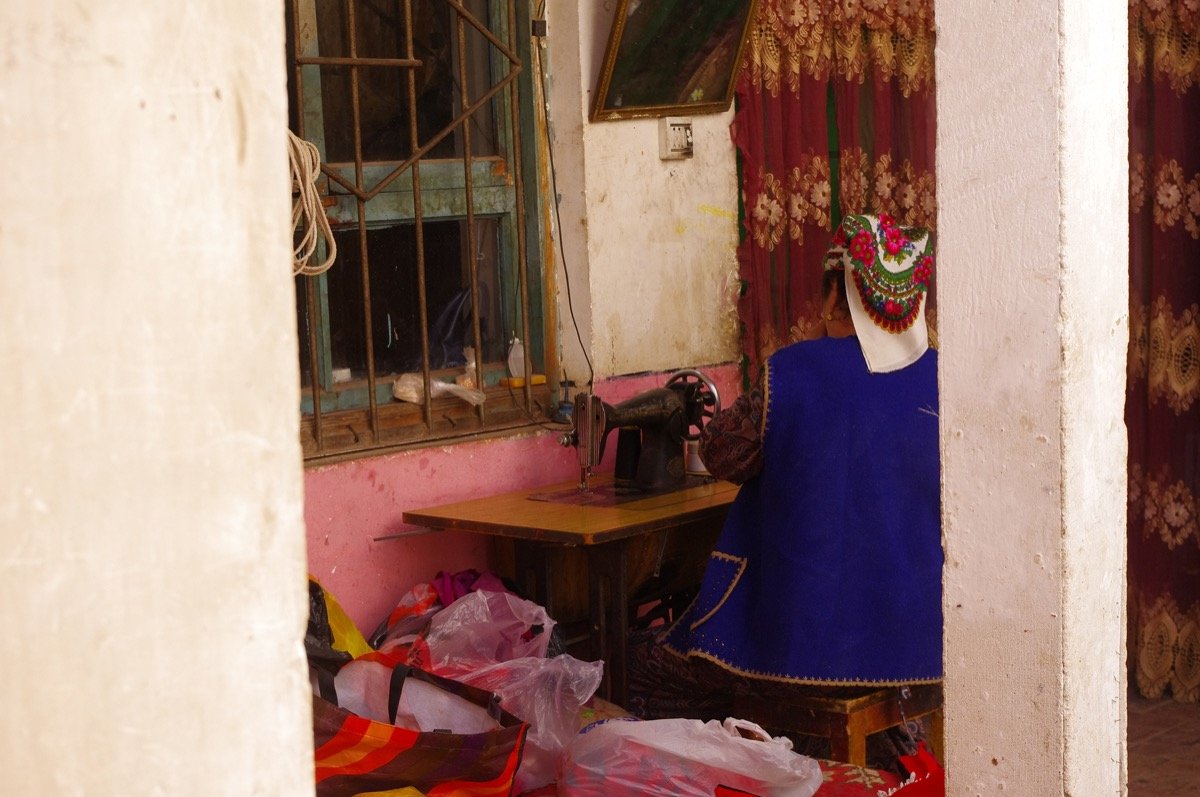
The most striking feature of Beiting is the massive earthen wall that once enclosed the outer city. Stretching roughly 1.5 km on each side, the wall was originally 8-12 meters high and 6-8 meters wide at the base. Large sections are still standing today, weathered into graceful, crumbling ribbons of mud brick that glow a deep burnt-orange in the late afternoon sun.
You can walk along the top of some sections of the wall — it’s an eerie, wonderful feeling to stand where Tang Dynasty sentries once kept watch over the northern frontier.
 Beiting Ruins outer city walls at sunset – ancient earthen fortifications of the Tang Dynasty protectorate in Xinjiang China” />
The Inner City (Imperial Compound)
Inside the outer city’s southern half lies the inner city — a smaller, rectangular compound where the Tang Protector and his administration lived and worked. The foundations of several major buildings are visible, including what archaeologists believe was the Protector’s main hall. The scale is impressive: this was a seat of imperial power, built to impress.
The Beiting Museum (Highly Recommended)
Don’t skip the on-site museum. It’s small, but the collection is superb. Highlights include:
- Tang Dynasty pottery and coins — everyday objects that make the past feel real
- Uyghur Buddhist murals — removed from the temple site and preserved in climate-controlled conditions; the colors are astonishing after 1,000 years
- A scale model of the entire Beiting site — helps you understand the layout before you walk it
- Explanatory panels in Chinese and English — rare for a regional museum in Xinjiang
The Buddhist Temple Ruins
A short walk from the main city ruins brings you to the Uyghur Buddhist temple site. What remains above ground is modest — low walls and the ghostly outline of a central stupa. But the temple’s importance is out of proportion to its visible remains: this is where the murals now in the museum were found. Standing here, imagining the temple as it was in 1000 AD — smoke curling from incense burners, monks chanting in Old Uyghur — is one of those travel moments that stays with you.
Beiting vs. Other Silk Road Sites in Xinjiang
If you’ve already visited Xinjiang’s more famous Silk Road sites, how does Beiting compare?
| Site | Crowds | Preservation | Atmosphere |
|---|---|---|---|
| Jiaohe Ruins | Moderate | Excellent (dry climate) | Dramatic, windswept |
| Gaochang Ruins | Moderate | Good | Vast, desert setting |
| Beiting Ruins | Almost none | Good (less excavated) | Solitary, contemplative |
| Kashgar Old Town | High | Living city (reconstructed) | Vibrant, bustling |
The bottom line: if you love archaeological sites and don’t mind a bit of extra effort to get there, Beiting offers a quality of experience — solitude, scale, authenticity — that the more famous sites can no longer match.
How to Get to Beiting Ruins
From Urumqi
Distance: ~200 km northeast of Urumqi
Drive time: 2.5-3 hours via G7 (Beijing-Xinjiang Expressway)
Route: Urumqi → G7 east → Jimsar/Xiaojiangshan exit → follow signs to Beiting Ruins (12 km north of Jimsar county seat)
This is an easy self-drive trip with good roads all the way. The G7 expressway between Urumqi and Jimsar is in excellent condition.
From Jimsar County
Jimsar is a small county town with basic hotels and restaurants. From the county seat, it’s a 15-minute taxi or Didi ride to the ruins. If you’re relying on public transport, you’ll need to take a local bus from Jimsar to the Beiting site (very limited schedule) or hire a taxi for the round trip (~150-200 RMB including waiting time).
Organized Tours
Very few organized tours include Beiting. This is fundamentally a destination for independent travelers — which, frankly, is part of its appeal.
When to Visit
| Season | Pros | Cons |
|---|---|---|
| May-early June | Mild weather, wildflowers, few visitors | Can be windy |
| September-October | Cool and clear, perfect walking weather | Nights get cold (bring layers) |
| July-August | Warmest weather | Can be hot midday (visit early/late) |
| November-April | Completely solitary | Very cold; some facilities may be closed |
The site is open year-round during daylight hours. There’s no bad time to visit, but September and early October are ideal — the light is beautiful, the weather is comfortable, and the surrounding Tianshan foothills turn golden.
Practical Information
- Opening hours: 10:00-19:00 (summer), 10:30-18:00 (winter)
- Entrance fee: 40 RMB (as of 2026; confirm on arrival)
- Facilities: Parking, on-site museum, basic restrooms. No restaurant on site — eat in Jimsar before/after.
- Guided tours: Available in Chinese; English-speaking guides may be arranged in advance through the Jimsar County tourism office (call ahead).
- Photography: Allowed (no tripods inside the museum building). The outer walls at sunset are spectacular.
Combine Beiting with Other Nearby Attractions
Beiting works well as part of a broader eastern Xinjiang itinerary. Consider combining it with:
- Qitai Petrified Forest (~120 km southeast) — Asia’s largest petrified wood forest and China’s “dinosaur kingdom,” a surreal landscape of 150-million-year-old tree fossils scattered across the desert.
- Jimsar Thousand Buddha Caves (Baishui County ruins) — lesser-known Buddhist cave sites in the same region.
- Fukang / Tianchi Lake — if you’re driving back to Urumqi, the famous Heavenly Lake (Tianchi) is a natural stop on the way.
If you have more time, this region connects well with a broader Xinjiang itinerary that includes both northern and southern routes.
Why Beiting Matters — and Why You Should Care
There’s a particular kind of travel satisfaction that comes from standing in a place where history is still being uncovered — where the archaeologists’ work sheds are visible at the edge of the site, where new finds are made every excavation season. Beiting is that kind of place. It’s not a polished, Disney-fied heritage park. It’s a working archaeological site where the past is treated with seriousness and respect.
For independent travelers in Xinjiang — the people who skip the tour buses and seek out the stories behind the scenery — Beiting Ruins is unmissable. It’s a place that changes how you understand this region: not as a remote edge of empire, but as a center of gravity in its own right, where cultures met, traded, fought, and created something enduring.
The Tang poets knew this. Cen Shen (岑参), who served as a military secretary in the Beiting region in the 750s, wrote poems about the vastness of the northwestern frontier that are still taught in Chinese schools today. Standing on the wind-scoured walls of Beiting, it’s not hard to see what moved him.
Final Tips for Independent Travelers
- Bring water and sun protection — there’s very little shade on the site.
- Wear sturdy shoes — the ground is uneven and sandy.
- Download offline maps — mobile data can be spotty in this region.
- Combine with Jimsar town — the county seat has decent accommodation if you want to stay overnight and explore more of the region.
- Learn a few phrases in Chinese — English is not widely spoken in Jimsar, though the museum has some English signage.
Beiting Ruins won’t be a secret forever. For now, though, it remains one of Xinjiang’s most rewarding “I was there before it was famous” destinations. If you’re planning a trip to Xinjiang and want to experience something beyond the standard itinerary, make the detour. You won’t regret it.
Have you visited Beiting Ruins, or is it on your Xinjiang itinerary? Share your thoughts and questions in the comments below — we’d love to hear from fellow independent travelers.