
Astana Ancient Tombs: What Turpan’s Dry Air Preserved
Most people who visit Turpan see the big three — the ruined cities, the caves, the grape trellises — and drive straight past a low fenced field of gravel about 40 kilometres east of town without registering it. That field is the Astana cemetery, and a reasonable case can be made that it has told us more about how people actually lived on the Silk Road than any standing wall in the basin.
I went the first time out of completeness and expected to be bored. I stayed nearly two hours.
What Astana is
Astana — the name is usually glossed as “capital” or, in local usage, “resting place” — is the burial ground that served the city of Gaochang from roughly the third century through to the eighth. Several hundred tombs have been excavated across a stretch of desert flat between the Flaming Mountains and the Gaochang walls, in the administrative area of Sanbao township, and the excavation record from the twentieth century onward is extraordinary.
Turpan’s climate did the archaeology a favour. The basin is one of the driest and hottest inhabited places in China, and in that air organic material simply does not rot. What came out of these shaft tombs was not just bone and pottery. It was silk with the dye still readable, paper contracts recording the sale of land and slaves, tax registers, letters, a wooden model of a woman making dumplings, and dumplings themselves — actual wheat-flour dumplings, fifteen hundred years old, dry as biscuit.
That detail is the one I cannot let go of. Somebody in the Tang period wrapped food for a journey nobody takes, and because it never rained, we can see what shape they folded the dough into. Most Silk Road sites give you scale and geometry. Astana gives you a household.
Visiting the site itself
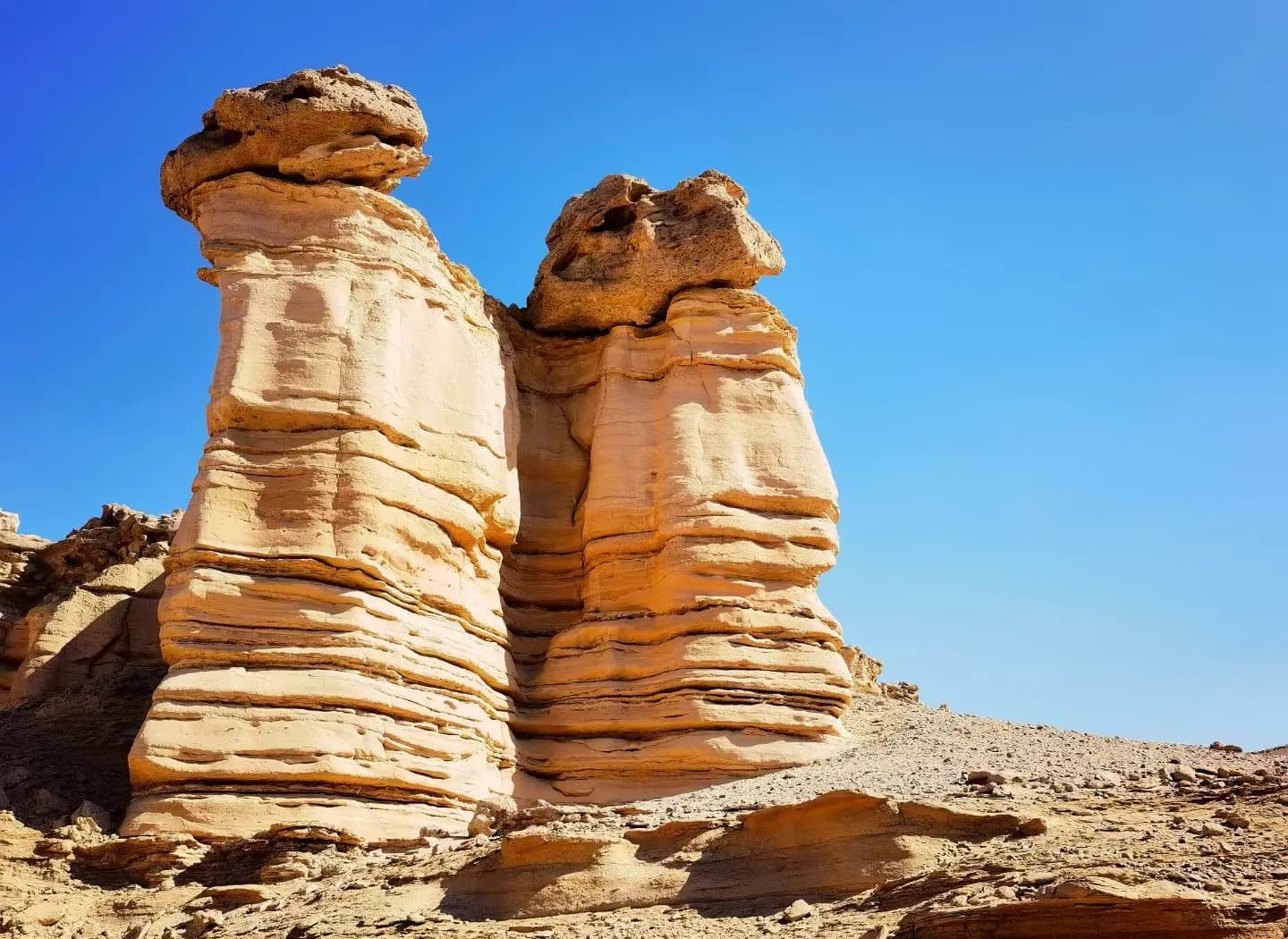
Be clear about expectations, because this is where visitors get frustrated. Above ground, Astana is a flat expanse of grey-brown gravel with numbered markers, a low boundary, a small building, and a path. The Flaming Mountains sit to the north like a burnt red wall. There is nothing dramatic to photograph. This is a site you visit for what is under the ground and, on a good day, for the three tombs you can go into.
Access to the open tombs is by a steep sloping ramp — the original entry passage — down maybe four or five metres into a small chamber. Two of the ones I have entered still carry wall painting. One had a pair of birds and a plant motif in ochre and black on the rear wall, faded but unmistakable, and the temperature down there was startlingly cool after the surface. A guard sat at the top of the ramp with a fan and a thermos and did not follow me down.
Tickets, hours and the heat
Entry has run in the ¥20 to ¥40 range on my visits, cheap by Turpan standards, and it is not usually bundled into the multi-site tickets that the bigger attractions sell. Opening hours track daylight, roughly 9:00 to 19:00 in summer with a longer window than you would expect because Xinjiang runs on Beijing time and the sun here sets late.
The heat is the operative constraint. In July I have watched the dashboard read 44°C on the road outside, and the gravel radiates it back at you. Go before ten in the morning or after six in the evening. There is shade at the entrance building and essentially none on the site. Carry more water than you think you need, and if you are doing several Turpan sites in a day, put Astana first while you still have tolerance.
April, May, October and early November are far more civilised months to be in the basin at all. Our Turpan city guide goes into the seasonal detail; the short version is that summer is survivable rather than pleasant.
Where the artefacts actually are
Here is the thing that trips up first-time visitors. The objects that make Astana significant are not at Astana. They are split between museums, and a large and important share sits in the collection in town.
If you only have time for one, go to the museum. Seriously. The Turpan Museum holds textiles, documents, funerary figures and the preserved remains that came out of these tombs, displayed with enough context that the empty field starts to make sense. Ideally do the museum first, then the site, in that order. Walking the gravel after you have seen the paper contracts changes what you are looking at entirely. Walking it before means you are looking at gravel.
A portion of the material also travelled to collections abroad during the early twentieth-century expeditions, which is a longer and less comfortable story. Local signage touches on it briefly.
The paperwork of a vanished society
I want to spend a little longer on the documents, because they are the reason specialists care about this cemetery far more than tourists do.
Tombs at Astana frequently contained paper that had been recycled — cut up and pasted into shoe soles, hats, funerary clothing and papier-mâché figures. Scholars unpicking those objects have recovered administrative records that nobody intended to preserve: household registers listing family members by age, land allocation records under the Tang equal-field system, receipts for grain tax, military rosters, loan agreements with interest rates written in, contracts for hiring a camel, and a bill of sale for a slave girl.
This is the sort of material that almost never survives anywhere. Official histories tell you what emperors decided. These fragments tell you what a clerk in a frontier oasis actually wrote down on a Tuesday. From them, historians have reconstructed grain prices, marriage patterns, litigation over inheritance, and the specific mechanics of how a distant imperial administration collected tax from a multi-ethnic desert town.
There are also school exercises. A child in Gaochang copying out characters, the paper later cut up to stiffen a shoe, the shoe buried, the tomb dry, the paper legible thirteen hundred years later. I find that chain of accidents more remarkable than any of the frescoes.
A very short timeline, so the site makes sense
Roughly: from the first century, Han-period garrisons and colonists establish agriculture in the basin. By the fifth century Gaochang is an independent kingdom with a largely Chinese-speaking elite, ruled for over a century by the Qu family, and the Astana cemetery serves that population. In 640 the Tang annex the kingdom and it becomes Xi Prefecture, integrated into the imperial administration — which is precisely when the density of bureaucratic paperwork in the tombs increases. Tang control weakens after the eighth century; the Uyghur Khaganate’s successor state takes the region, Buddhism continues, and burial practice changes. The cemetery falls out of use.
Knowing that arc matters at the site, because the tombs are not one thing. You are walking over five centuries of changing practice, changing script, changing religion, and changing overlords, all stacked in the same gravel.
Fitting Astana into a Turpan day
Astana sits within a very tight cluster, and this is its real practical advantage. Everything worth seeing on the eastern side of the basin is inside a 20-kilometre radius.
The route I would run, starting early from Turpan city: drive east about 45 kilometres to Gaochang ancient city and do it in the first cool hours, then cut across to Astana, which is roughly ten minutes away and directly related — these are the people who lived in those streets. From Astana continue north-west along the base of the Flaming Mountains to the Bezeklik Thousand Buddha Caves in the Murtuk gorge. That is a full and coherent morning-to-early-afternoon loop, maybe 130 kilometres of driving in total, and it has an argument running through it rather than being a list of stops.
Save the west-side site, Jiaohe, for a separate late afternoon. Trying to do Jiaohe and the eastern cluster in one day is how people end up sunstruck and resentful.
Getting there without your own car
There is no useful bus. A taxi from Turpan city, negotiated as a half-day with waiting time, ran me around ¥250 to ¥350 for the eastern loop including Gaochang and Bezeklik. Drivers know the circuit well and will suggest it themselves. Ride-hailing works out of town but getting a car back from Astana is unreliable, so keep the driver.
If you are driving yourself, the roads are excellent — flat, straight, well surfaced — and the only hazard is the temptation to speed on empty tarmac past speed cameras that are very much present.
How to read what you are seeing
A few things that made my second visit much richer than my first.
Look at the tomb orientation and spacing. The cemetery is laid out in family clusters, and the excavation reports show generations grouped together, with the epitaph bricks recording names, dates and official titles. This was a bureaucratic society keeping careful records, not a frontier of nomads passing through.
Notice how mixed the material is. Chinese-style funerary figures sit alongside Central Asian textile patterns and Sogdian coins. The Gaochang elite wrote in Chinese, buried in a Chinese idiom, and dressed in fabrics woven with Persian motifs. If you want a single site that demonstrates what Silk Road exchange actually did to a place culturally, over centuries rather than in a season, this cemetery is a better witness than any caravanserai.
And spare a thought for the ordinariness. Among the documents recovered here are complaints about debts, a school exercise, and inventories of household goods. The romance of the Silk Road tends to get told through monks, generals and merchants. Astana is full of clerks.
Practical notes for the visit
A short list of things that made the difference between my two visits.
Go early. Not “reasonably early” — be at the gate when it opens. The site is exposed gravel and the difference between nine in the morning and one in the afternoon in summer is the difference between an interesting hour and a grim twenty minutes.
Bring a torch. The open tombs are lit, but dimly, and a phone light picks up detail on the painted walls that you will otherwise walk past. Do not use flash — it is prohibited and for good reason with pigment this old.
Take the ramp slowly. The descent passages are steep, uneven and, if there has been any moisture, slick. There is a handrail on some and not others.
Expect cold below and heat above. The chambers sit several metres down and hold a genuinely cool temperature year-round. Going in and out repeatedly on a 40-degree day is a shock to the system; I now carry a thin layer purely for the two minutes I spend underground.
Ask the attendant which tombs are open today. It varies. Conservation work closes chambers on rotation and there is no schedule published anywhere I have found. On one visit two were accessible, on another three.
Do not expect English signage beyond the basics. Panels are mostly Chinese with some Uyghur. A translation app and the photograph function does the job adequately, and reading the museum’s material beforehand covers most of what you need.
Combine your ticket thinking. Turpan’s sites are individually cheap and there is no single pass that covers everything usefully; buying as you go is fine, and Astana is inexpensive enough that it does not need to earn its place in a budget.
Verdict
Astana is not a spectacle and should not be sold as one. If you have a single day in Turpan and want the images that go on a postcard, spend it at Jiaohe and the grape valley and skip this. If you have two or three days, or if the thing you actually enjoy about travel is standing where evidence came from, put an hour aside for a field of numbered gravel between a burnt red mountain and a ruined city.
I have walked plenty of impressive walls in Xinjiang. I remember the dumplings.