
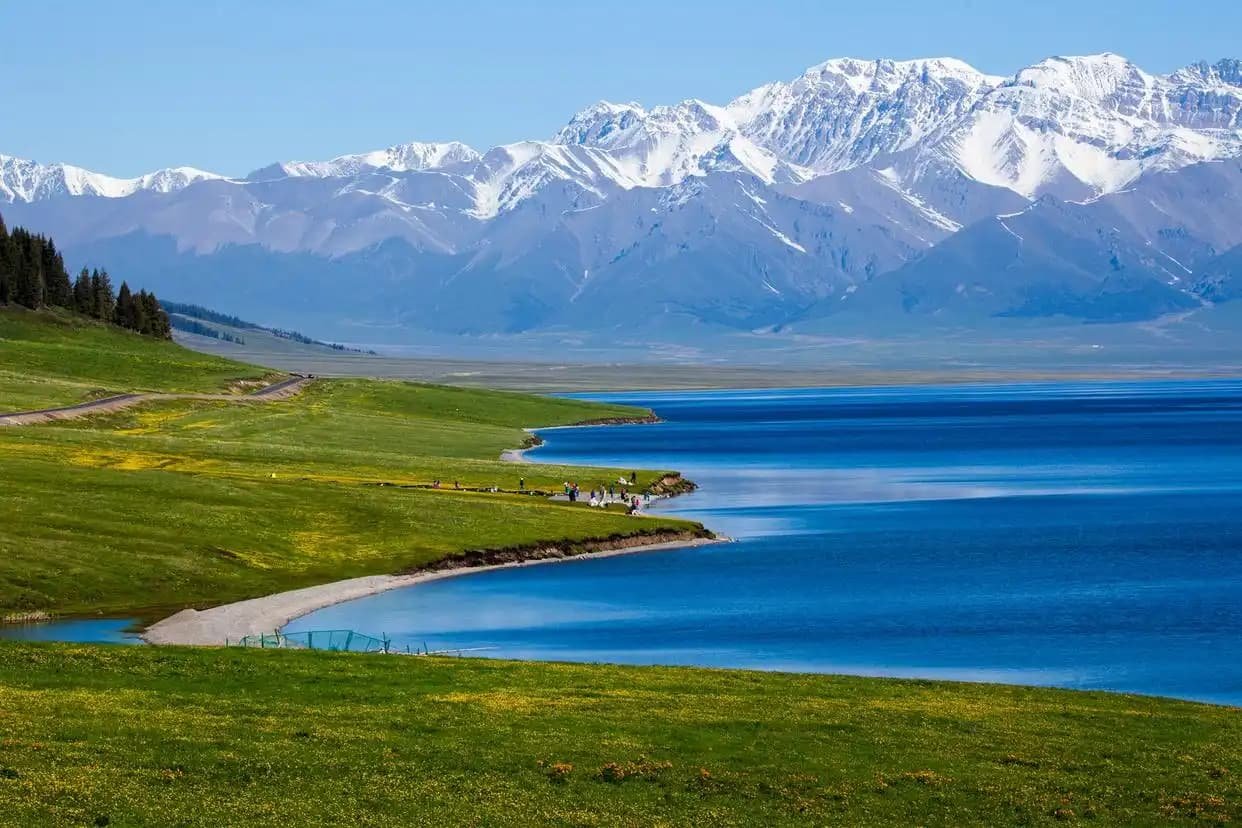
White Sand Lake Xinjiang: The Desert Holy Spring at China’s Northwestern Frontier
Tucked into the northwestern corner of China, where the Altai Mountains meet the Gurbantünggüt Desert, there’s a small body of water that doesn’t seem like it should exist. It sits in the middle of a desert, with no visible inlet or outlet, yet the water level never rises or falls, never freezes solid in the harsh winter, and never turns turbid. Locals call it White Sand Lake—Bai Sha Hu in Chinese—and for centuries it has been one of the most quietly astonishing sights along the northern Xinjiang frontier.
 White Sand Lake Xinjiang alpine lake scenery” style=”width:100%;height:auto;margin:20px 0;border-radius:8px;”>
Where Is White Sand Lake?
White Sand Lake (白沙湖) is located within the Baihaba area of Habahe County, Altay Prefecture, in the Xinjiang Uyghur Autonomous Region. The scenic area sits about 2.5 kilometers from the China–Kazakhstan border and is managed as part of the 185th Regiment’s tourism zone. It’s a national AAAAA-level scenic area—the highest rating in China’s attraction grading system.
The lake itself is modest in size: roughly 800 meters north to south and 600 meters east to west, covering about 0.5 square kilometers. What makes it extraordinary is its setting. On three sides the lake is ringed by sand dunes whose grains are unusually pale—almost white, hence the name. On the fourth side, contrary to all desert logic, grow thick belts of Siberian silver birch, poplar, and reed beds that shelter wild lotus flowers blooming right out of the sand.

The Mystery of the Desert Spring
The most famous thing about White Sand Lake is also the thing that scientists still can’t fully explain. The lake sits in a desert basin with no visible inlet or outlet. Yet across the seasons—through scorching summers when the surrounding sand hits 60°C and brutally cold winters when temperatures plunge below -30°C—the water level remains essentially constant. It doesn’t freeze solid. It doesn’t dry up. It doesn’t fill with sand.
This phenomenon has earned the lake the nickname “Desert Holy Spring” (沙漠圣泉). Local legend says that in 1218, Genghis Khan’s army camped here during his westward campaign and used the lake as a watering stop for his horses—giving the site its secondary name, “Genghis Khan’s Horse-Drinking Pool”. Whether or not the story is true, it captures something real about the lake: this water has sustained life at the edge of the desert for a very long time.
What Makes the Landscape So Special?
White Sand Lake is really three ecosystems in one tiny area, and that’s what makes it feel almost surreal to visit. Within a few hundred meters you can stand in:
- The lake itself—freshwater, teeming with reed beds and wild lotus in summer, reflecting the white sand dunes and the Altai peaks beyond.
- The birch-poplar forest belt—a narrow band of deciduous trees that shouldn’t exist in a desert but does, creating a microclimate that supports birds, small mammals, and a carpet of wildflowers in June.
- The white sand dunes—the pale quartz-rich sand that gives the lake its name, sculpted by wind into soft ridges that glow almost silver in the late afternoon light.
In autumn (late September to early October), the forest belt turns brilliant gold and deep red. The contrast—white sand, emerald water, golden birch leaves, and the distant grey-blue Altai Mountains—is the reason photographers from all over China make the long journey here.
Other Highlights in the Scenic Area
The White Sand Lake ticket covers more than just the lake. The scenic area is a cluster of small but memorable sites:
Singing Sand Dune (Mingsha Shan)
A short walk from the lake brings you to a dune where the sand “sings” when you slide down it—a phenomenon caused by the uniform grain size and low humidity. The dune also reflects perfectly in the lake on calm days, creating one of the most photographed views in Altay Prefecture.
Northwest China’s First Border Company (185th Regiment, Company 3)
This is one of the westernmost PLA border garrison units in China. The soldiers patrol a frontier line that runs within walking distance of the lake. Visiting the company area gives you a glimpse of the human side of China’s remote border—the young recruits who spend winters at -40°C keeping the frontier stable. It’s a moving and very different kind of travel experience.
Northwest China’s First Couple Sentry
A married couple who collectively serve as border sentries, living in a small post year-round. Their story has been widely covered in Chinese media and is genuinely affecting. It’s a reminder that this beautiful landscape is also a working border zone.
Birch Forest and Red Leaf Valley
In October the birch and aspen groves around the lake turn brilliant shades of gold and crimson. Wooden boardwalks let you walk right into the forest. It’s quiet, cold, and exceptionally beautiful.
 Kanas Lake Xinjiang pristine alpine water” style=”width:100%;height:auto;margin:20px 0;border-radius:8px;”>
Best Time to Visit White Sand Lake
The lake has two peak seasons, and they offer completely different experiences:
June to August (Summer)
This is when the wild lotus blooms on the lake surface and the reeds are at their greenest. The weather is warm (25-30°C during the day) and the birch forest is lush. It’s also when the “desert vs. oasis” contrast is most striking—the surrounding desert is hot and dry, but the lake area stays cool and humid.
September to mid-October (Autumn)
This is the photography season. The birch and poplar leaves turn gold, the sky is consistently clear, and the light in late afternoon (4-6 PM) turns the white sand dunes a warm champagne color. By early October the red-leaf valley is also at peak color. Come mid-October, snow can start to fall—which is also beautiful, but the access road can become tricky.
Winter (November to March) is possible if you have a 4WD and local contacts, but the scenic area may limit access due to snow. Spring (April-May) is transitional—the lake wakes up but some facilities may still be closed.
How to Get to White Sand Lake
The lake is remote. Here’s the practical reality:
Nearest airports: Altay City (Aletai) Airport or Kanas-lake-the-colorful-beach/”>Burqin (the nearest town to Kanas). From Altay, it’s about a 2.5-hour drive to the lake.
From Burqin: Burqin is the gateway town for both Kanas Lake and White Sand Lake. The drive from Burqin to the lake takes about 1.5-2 hours along the Z840 scenic road. Most visitors come on a day trip from Burqin or as part of a longer Altay loop that includes Kanas, Hemu, and the lake.
From Habahe County: Habahe is about 108 km from the lake (roughly 2 hours’ drive). Some tours start here.
Border checkpoint note: Because the lake is close to the Kazakhstan border, all visitors must pass a border checkpoint. Bring your passport or Chinese ID card—you won’t be allowed in without it.
Tickets and Opening Hours
- Entrance + shuttle bus: 78 RMB per person (as of 2025)
- Children under 6: 8 RMB
- Students (6-18): 43 RMB (with valid student ID)
- Seniors 65+: 8 RMB
- Opening hours: 09:30 – 19:30 (year-round)
Tip: Residents of Karamay, Tacheng, Altay, Bortala, and relevant XPCC divisions get free entrance with valid ID (policy since October 2018).
A Practical Travel Tip: Combine It with Kanas
White Sand Lake is often visited as a day trip from Hemu Village or Burqin, usually as part of a 3-5 day Altay loop. If you’re already making the journey north to see Kanas, adding White Sand Lake is an easy and rewarding extension. The landscapes are completely different: Kanas is about alpine forest and mountain grandeur; White Sand Lake is about an impossible pocket of water in the desert, with a side of living border history that you won’t find in any guidebook.
Where to Stay
There’s no accommodation inside the scenic area itself. Most visitors stay in:
- Burqin (布尔津): The most popular base. Plenty of hotels (mid-range to basic), lots of restaurants, and it’s only 1.5 hours from the lake. Burqin is also where you’ll find the famous night market by the river.
- Habahe County (哈巴河): Closer to the lake (about 2 hours), quieter than Burqin, fewer tourist facilities but perfectly adequate for a night.
- Inside Kanas scenic area: If you’re doing a longer loop, you can stay in the Kanas village area and drive out to the lake for the day (about 2 hours each way).
Respect the Border, Respect the Landscape
White Sand Lake sits in a sensitive area. A few things to keep in mind:
- Don’t wander off toward the border fence—it’s clearly marked and patrolled.
- Don’t pick the wild lotus or damage the reeds. The lake’s ecosystem is fragile precisely because it’s enclosed.
- Bring your ID/passport. You’ll need it at the checkpoint and again at the ticket office.
- The shuttle bus is mandatory. The scenic area is large and the walking distances between sites (lake, birch forest, border company) are long.
Final Thoughts
A trip to Xinjiang often focuses on the big names—Kanas, Sayram Lake, Kashgar. White Sand Lake isn’t as famous, and that’s exactly why it’s worth visiting. It’s a place where the landscape doesn’t quite make sense, where a desert has a freshwater lake that shouldn’t be there and stays there anyway, and where the silence is broken only by wind in the birch leaves and the distant sound of a border patrol vehicle. It’s one of those places that stays with you not because it’s spectacular in the usual way, but because it’s quietly, stubbornly impossible.
Last updated: June 2026. Practical details (ticket prices, opening hours) were verified as of June 2025 and are subject to change—check the official scenic area notice before you go.